
Collars on Boys' Shirts: Cronological Trends--The 19th Century
We notice quite a range of different collar styles in the 19th century. Our information on the early 19th century is limited. We note open-neck and collar-buttoning styles. There were collars on bloses and shirts as well as detachable collars. The large, fancy collars would mostly worn by younger boys and were often used in age grading. But i the 1800s-2-s we see adultsearing large fancy colles as well. Boys at the beginning of the Century still wore open ruffled collars, often with skeleton suits. Gradually other styles appeared, such as wide white collars. The fashion of wearing collars closed became more prevalent after the 1820s. An American housewife invented the detachable collar in 1827 and by mid-century it had become widely dopted by middle-class Americans and Eurpeans wearing white shirts. Laundry was a daunting undertaking at the time. And the collar was the part of the shirt that got the dirties fastest. So the detchabl collar mean that people could wear shirts longer by meerly changing the collar. We know quite a bit about the mid- and late-19th century. With the advent of the CDV we have ahuge record of 1860s fashions. Some boys' collars were so small that they could barely be seen. We see some of the basic collar styles at mid-century, but in the 1860s they tend to be very small, although this varied from country to country. The Eton-styled collars wotn by American boys, for example, tended to be very small. We see larger collars in England. The popularity of cut-away jackets provided more information. Some boys' collars were so small that they could barely be seen. We see some of the basic collar styles at mid-century, but they tend to be very small. Others were normous. We also notice very plain collars as well as extremely fancy ones with lace and ruffles. We note open-neck and collar-buttoning styles. There were collars on bloses and shirts as well as detachable collars. The large, fancy collars were mostly worn by younger boys and were often used in age grading.
The 1800s
We notice quite a range of different collar styles in the 19th century. We note open-neck and collar-buttoning styles. There were collars on bloses and shirts as well as detachable collars. The large, fancy collars would mostly worn by younger boys and were often used in age grading. But i the 1800s-2-s we see adultsearing large fancy colles as well. Boys at the beginning of the Century still wore open ruffled collars, often with skeleton suits.
The 1820s
Gradually other styles appeared, such as wide white collars. The fashion of wearing collars closed became more prevalent after the 1820s. An American housewife invented the detachable collar in 1827 and by mid-century it had become widely dopted by middle-class Americans and Eurpeans wearing white shirts.
The 1830s
Laundry was a daunting undertaking at the time. And the collar was the part of the shirt that got the dirties fastest. So the detchabl collar mean that people could wear shirts longer by meerly changing the collar.
The 1840
Our information on the early 19th century is limited, but we know quite a bit about the mid- and late-19th century. This is because photography appeared in the 1840s with the Daguerreotype. W Have been unable to find many Europen Dags, but we have quite a number of American Dags. Boys by the mid-19th Century were wearing mostly closed collars. We see some boys with open collars. A good example is Swiss boys in 1840. The cloesd-collar blouses and shirts, however were much more common. Here we begin to have a much better idea of popular fashion because of the development of a photogrphic industrt. The style of the collars varied, including ruffled, Eton, and plain white collars.
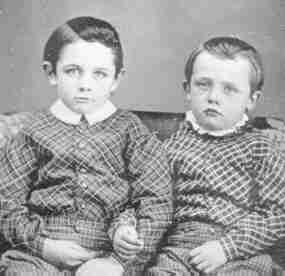
Figure 6.--Many classic boys collars were worn in the mid-19th Century, but they were generally much smaller than those worn later in the century. These boys wear an Eton and a ruffled collar. These differences in collars, notice the outfits are identical, were commonly used to indicate age differences.
|
|
The 1850s
The most distinuishing feature of boy's collars at mid-century was was that they were generally small. Often they are very visible at the neckline of a jacket which often buttones at the collar. In other instances they are clearly seen, but quite small. A good example an unidentified American boy about 1850. Another example is an unidentified American boy in 1855. We notice various styles including pounted collaers, rounded collars, and ruffled collars. An exanple of pointed collars is the Wallis brothers in 1852. They were not nearly as an important fashion element as they were to become later in the century.
The 1860s
With the advent of the CDV we have ahuge record of 1860s fashions. Some boys' collars were so small that they could barely be seen. We see some of the basic collar styles at mid-century, but in the 1860s they tend to be very small, although thos varied from country to country. The Eton-styled collars wotn by American boys tended to be veryt small. We see larger collars in England. The popularity of cut-awy jackets provided more information. A good example is Charles J.J. Carter in the 1860s. We continue to see small collars in the late-1860s. A good example is Auhustus Davies.
The 1870s
Collars tended to grow in size during the 1870s, but tended to be relaively small, especially in the early-70s. We continue to see cut-away jackets in the 1870s. Another good example is V.A. Blasque about 1870.
The 1880s
Collars began to increase in size in the late-19th Century. New fashions appeared like lace collars for boys. Collars were commonly used in the late 19th century as age specific clothing. Thus as a boy got older the style of the collar he wore with his suit changed significantly with his age. Collar sized changed framaticlly in the 1880s, especially for boys. This was a trend alreadu in progress when Mrs. Burnett wrote her book, Little Lord Fauntleroy. Suddenly you begin to see boys wearing huge collars. As a general rule, the smaller the bo, the larger the collar. The Fauntleroy Craze was strongest in America, but we see larger collars becoming popular fir biys in Europe as well. Some were enormous.

Figure 10.--These American boys from Freeport, Illinoiswae huge rylled collars and floppy bow, probably in the 1890s.
|
|
The 1890s
After the Fauntleroy craze of the mid-1880s, the size of the collars increased significantly.We notice quite a range of collars. Some were very plain collars which we see as well as extremely fancy ones with lace and ruffles. We note lace collars of vary shape. The largest collars were commonly ruffled collars. Some became very large indeed, sometime covering the boys shoulders with lacey finery. Older boys might wear stiff Eton collars. All collars were worn buttoned tightly closed.
HBC

Navigate the Historic Boys' Clothing Web Site:
[Return to the Main collar chronology page]
[Return to the Main collar page ]
[Introduction]
[Activities]
[Artists]
[Biographies]
[Chronology]
[Clothing styles]
[Countries]
[Photography]
[Bibliographies]
[Contributions]
[Essays]
[FAQs]
[Glossaries]
[Images]
[Links]
[Registration]
[Tools]
[Boys' Clothing Home]
Navigate the Historic Boys' Clothing Web chronological pages:
[The 16th Century]
[Early 1800s]
[The 1870s]
[The 1880s]
[The 1890s]
[The 1900s]
[The 1910s]
[The 1920s]
[The 1930s]
[The 1940s]
[The 1950s]
[The 1960s]
[The 1970s]
[The 1980s]
Navigate the Historic Boys' Clothing Web style pages:
[Dresses]
[Smocks]
[Bows]
[Bodice kilts]
[Kilts]
[Sailor suits]
[Eton suits]
[Blouses]
[Ring bearer/page costumes]
[Fauntleroy suits]
Created: 12:19 AM 11/23/2007
Last updated: 10:45 PM 1/28/2015