
Boys in the Military: United States
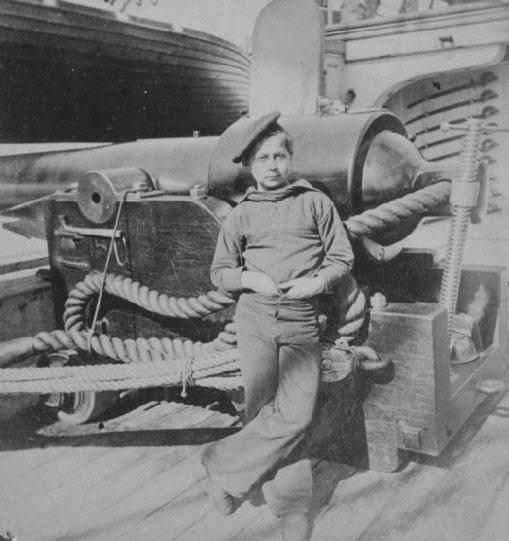
Figure 1.--John Anglin served as a Union (Northern) cabin boy and powder monkey aboard the 'USS Pawnee' during the Civil War. Another source says the 'USs New Hampshire' off Charleston. He is wearing a uniform with sailor elements such as the cap and bell-botom trousers, but not the the 'V' front a stripe derailing. Note the angle of his cap. He aas about 14 years old when this photograph was probly taken in 1864. He went on to win the Contrssiojnal Medal of Honor. Click on the image for more detaiuls. Source: National Archives Online collection.
|
|
We do not yet have much information on the use of boys in ancient amd medieval militaries. We do have some information on more modern times. Boys were extensively use by both the Union and Confederacy as drummer boys during the Civil War (1861-65). Boys were also used by the navy in the Civil war as ships' boys and powder monkeys. I do not recall seeing drummer boys in the Spanish American War (1898-99), although I am unsure about just what the regulations were. Nor are we familiar with U.S. naval regulations concerning the age of service. This practice declines in Europe and North Ameruca in more modern times.
Wars
Boys were extensively used as drummer boys during the War of 1812 and the Civil War (1861-65). Boys were extensively used in both the Federal and Confederate Army during the Civil War. They were also used in the fledglig American Navy in the early 19th century and the more established Navy during the Civil war as ships' boys and powder monkies. I do not recall seeing drummer boys in the Spanish American War (1898-99), although I am unsure about just what the regulations were. Nor are we familair with U.S. naval regulations concerning the age of service.
Revolutionary War
Mny boyserved on both sides of the Revolutionary Wae, the youngest as musicians. Many more youths served as soldiers. Perhaps the most famous boy is the little drummer boy who began to beat his drums after Redoubts 9 and 10 had fallen to the Frech and Amercans. Soon the bombardment of Yorktown convinced Lord Cornwallis thatis situatin was untennable. There were no reinforcements coming and the last supplies were running out. Cornwallis sent the drummer boy and an officer to discuss the terms of surrender. The drummer boy appeared first and began bearing his drum. Then the British oficer appeared with a white flag.
War of 1812
The War of 1812 was fought in three ronts, the North, Central (Chesapeake), and Southern Front. Boys played a role in the Northern Front. Martin James Aiken (1791- )organized a group of boys to defend a bridge important in the Battle of Plattsburgh in northern New York. They became known as Aiken’s Volunteers. Aiken lived in Willsboro and belonged to the Essex County Militia 40th Brigade. He would later serve as Essex County district attorney. America at the time was still relying on miitia forces for defense. He understood that Gen. Alexander Macomb, with amall force of reguars ws badly outnumbered by 10,000 well trained and armed British regulars massing at the Canadian border opposite Plattsburgh. The boys at the Plattsburgh Academy wanted to join the fight, but were too young to enlist. [Demarse] General Macomb would not have allowed them to enlist. Some one pparently said, "If you can find yourselves a sponsor, you can volunteer.’ The sponsor’s name would go down into the registration and the age of his command would not be etered. Thus Aiken became a captain and the academy boys became soldiers.
Thousands of children were directly involved in the Civil War. Older boys served as soldiers. Many younger boys were also invoved, some boys as young as 11 years old. The younger boys generlly served as drummer or buggle boys. Commonly the drummer and buggle boys were 13-15 years of age. Both the Confederate and Union soldiers tried to look after the younger boys. In major engagements they were often sent to the rear when charges into fortifications were planned. In some cases they had to be forced to the rear crying. Such a scene is portrayed in the movie Glory. In addition, over 1 million boys of 17 or under served in the Federal Army alone. Beyond the use of very young boys as deummer boys and buggle boys, about 1 million boys 17 years of age and under fought with the Federal Army alone. Almost surely very large numbers of similsrly aged boys fpught with the Conderacy, although actual records are less available. So many boys served in both the Federal and Confederate Army that one author has suggested calling the American Civil War the Boys' War.
Services
Boys in America have served in both the Army and Navy. There is a long history of boys in the military, long predating the United states. This included the Revolutionary war. And it continued throughout the 19th century. And with the invention of photography, there is a photographic record of the Civil War.
Army
The primary activity for younger boys in the United States Army was service as drummer and buggle boys. Through the Civil War, however, substantial numbers of boys served and fought in regular Army combat units. We have considerable information on the Civil War, the first American war for which there is a photographic record.
Boys in the navy served as both ships boys / cabin boyhs) and powder monkees. Actually women also lived abord British ships in the early 19th century while ships were in port. I think the same may have been true of the early American navy. Families lived around where the father worked. Thus babies wre born among the gun crews, giving rise to the expression "son of a gun". These boys might become a ship's boy or powder monkey. A powder monkey was a humorous term for a powder-boy onboard a ship. The powder monkeys were normallly the smallest and youngest member of the crew who were used to fetch gunpowder. Young boys, perhaps only 10 or 12 years old, served on British ships in the early-19th century, I'm not sure about American ships yet. The powder monkey collected the gunpowder charges from the magazine deep in the hold of the ship and carried it to the he was assigned to and performed other ordnance duties on a warship. The term was used on British ships (usage dating to 1682). [OED] The term was also adopted by the American Navy. We note an exciting story about an Irish-American powder monkey set in the early-19th century during the War of 1812 with Britain. [Galloyway] Another entertaining account about a powder monkey is the story of Tad Lynch, a young boy, who becomes trapped below the deck of a naval vessel while chasing a stray cat. [Campbell] He is trapped just as the ironclad CSS Virginia (the Merrimack) is leaving dock. The warship is on its way to Hampton Roads, where it is about to engage in a two-day battle with the Union vessels Cumberland, Congress, and Monitor. Discovered by the cook, Tad is given the dangerous job of carrying powder to the guns, i.e., he becomes a 'powder monkey'. He then does his best to perform his duties amidst the noise, smoke, and confusion of battle. I'm not sure, however, just how powder monkeys were actually recruited.
Sources
Campbell, Carole R. The Powder Monkey. Young American Series, no. 4/ White Mane Kids 1999.
Demarse, Joy. Nine Days a Soldier.
Galloway, George J. The Powder Monkey. Galloway wants an Irish-Ameican boy involved. Actually the Catholic Irish Americans did not begon to migrate until three centiries later. If an Irish-American boy was involved in the War of 1812, he surely would have been a Protestant Scotts Irish boy.
The Oxford English Dictionary (New York: Oxford University Press, 1933).
CIH

Navigate the CIH Civil War Pages:
[Return to the Main boys in military service country page]
[Return to the Main military service page]
[Return to the Main uniform page]
[Return to the Main military page]
[Return to the Main Civil War page]
[Return to the Importance]
[Biographies]
[Campaign]
[Causes]
[Emancipation]
[Families and youth]
[Fiscal policy]
[Formations and units]
[Law]
[Railroads]
[Reconstruction]
[Slavery]
[Soldiers]
[Uniforms]
[Weaponry]
[Lost Cause]
[Civil Rights movement]
[Return to CIH Home page]
Created: November 29, 2001
Last updated: 10:18 PM 9/13/2016