|
Many countries of Western and Central Europe have a long tradition of church
boys' choirs dating back to the medevil era. The choirs were associated with the Catholic Church, but
choirs were also formed by some Protestant churches. Some of Europe's earlist post Roman schools were
formed to educate choristers. Although there are now many girls' and mixed choirs, until
recently the church choirs were all boy choirs.
The choir has taken its name from the area of the church occupied by the singers. At different periods of church archetecture, it came to designate two
dsistinct areas:
Early churches: The area of the church mid-way between the upper end, or sanctuary, occupied by the higher clergy, and the lower end, or naive and isles,
occupied by the laity.
Medieval and later churches: In later churches the entire upper or eastern end of the church, including the high alter and aspe, to which the singing
had been transferred.
Choral music is music written in parts, usually for four different voices and performed by a chorus or choir. The coral service is the musical service celebrated by a full complement of clergymen, lay clerks, and choristers, and sung or intoned in the rubrics. The European boy choral tradition originated in the church and for a milenium was purely an eclesiartical function. Cecular boy choirs have appeared in 20th century and now consitute a substantial number of choirs.
|
Boy singers have always been highly valued by the Christian Church in its liturgy. According to tradition, it was in the 6th century that Pope Gregory
founded the Schola Puerorum at St. John Lateran and St. Peter's Basilica. In the 11th century Guido of Arezzo composed the Micrologus as a didactic aid in teaching chant to boy singers. During the Middle Ages all cathedral and churches of any consequence possessed trained boy choristers. The tradition faded, however, in many countries during the 17th and 18th centuries. The disorders and wars associated with the Reformation, Counter-Reformation and French Revolutions took their toll on the Cathedrals, churches, and royal families that had supported boy choirs. The relative stability of England has left that country with many of the few current choirs which
can date their foundation back many centuries.
There has been a movement in the 20th century to revive boy choirs. Pope Pius X in 1903 made a significant effort to return boys to their traditional place as singers, as part of his sweeping liturgical and musical reforms in the Catholic Church. Many countries took up this challenge and proceeded to re-found boys' choirs as part of their reform of church music. In France in 1907, Paul Berthier founded a group called Les Petits Chanteurs a la Croix de Bois, who, under their subsequent director L'Abbe Maillet, toured the towns and villages as a sort of missionary group for this type of liturgical singing involving boys. Their symbol was a wooden cross on a white alb, their liturgical dress. Other groups in Europe soon followed their example.
The history of boy choirs is rooted in the catholic church. Some of the oldest known European schools since the fall of Rome were schools opened at cathedrals and monestaries to train boys for choirs. The oldest exist choirs appear to be English and German/Austrian choirs and date to the 16th century. While France has one of the more active boy choral movements, all of the existing choirs are of very recent creation. The early choral tradition was broken by the anti-clericism of the French Revolution. The idea of secular boy choirs which are important in America is a relatively new idea, primarily a 20th century development. Interestingly two countries with the strongest catholic traditions (Italy and Spain) do not appear to have strong boy choral traditiions. None of the better known European choirs are Italian or Spanish. Another important catholic country has a few wellknown choirs, but they appear to be of realtively recent origin reflecting Poland's turbulent history.
|
Why are choir uniforms important? Surely it is the music that is important? Why have choir over centuries given so much importance to uniforms? Even in America where uniforms for children, until recently,
have not been important, choirs have given considerable attention to uniforms. Some European choirs have quite destinctive uniforms.
Probably one of the most distinguishing characteristics of a boy choir is the group's uniform. Uniforms used to be more distinctive than is the case today, but they continue to be important. One American choir master in describing their uniforms, writes,
... the Boy Choir is its immaculately, stiffly-starched white collars, grey flannel trousers, and flannel jackets. In the years past the choirboys have brought their neatly pressed uniforms before thousands of people in all parts of the United States. These people have come to know that the high standards of neatness of the Boy Choir are only in keeping with the high standards of performance.
The first impression which a person receives of a group is esentially by its appearance, its bearing, and its behavior. The choirboys have been told, and rightfully so, that a large group attracts more attention by its lack of noise and confusion than by any other means. In meeting a person for the first time, one is impressed by outward appearance and inner bearing, both of which give purpose to that individual's presence. We feel that this is essentially true with groups, also.
|
Any given group expresses a corporate personality. Such a personality is present, whether there is conscious effort or not. An ill-organized group will express no general direction of itsactivities and energies. Therefore, it will express no esprit de corps nor inner life which says in effect to the world, "This is a way of life," "This is a philosophy of life," or "This we believe."
We must not forget that every group expresses some kind of philosophy. Each group says by its appearance, its bearing, or its behavior: we are organized, or we are disorganized; we have purpose, or we have no purpose; we are a thoughtful people, or we have no thought for people; our thinking is built
on principle, or our thinking principle is not yet built. I am sure that much of your interest in this organization was because of some such realization found in the boychoir.
Interestingly enough, all of us take pride in doing a difficult job well. It is difficult enough to maintain the exacting schedules of home-life, and school-life, but maintaining these schedules in addition to the Choir-life is no average person's job. It takes
much fore-thought.
Probably the most difficult task of all is to maintain a uniform in constant preparedness. We attempt to post the parents as far ahead of concert schedules as possible. Sometimes this is impossible, since sudden opportunities present themselves, opportunities which the directors and executive committee feel should not be by-passed for one reason or another. Then the frantic word goes out that a concert is scheduled for tomorrow night! Confusion ensues. The result is
last minute stops at the cleaners, or if there is not enough time, a disheveled choirboy at the concert.
One choir master in which the boys wear long grey flannel trousers, warns the boys and parents:
Other than the usual dictum of not enough starch in the collars of the white shirts, probably the most unsolved is the matter of "baggy-knees" in the grey flannel trousers. Since the material is flannel wool there always exists a basic problem of a need for pressing. If the weather is humid and damp, you may assume that upon return home your choirboy's pants will need pressing. If your family's "nightingale" is not yet in the habit of hanging up his trousers neatly and carefully (something which he must do on tour), you may assume that his trousers will need pressing. Usually, this brief bit of pressing can be done at home, yet it should be done after each performance in which your representative has been on a lighted stage for more than thirty minutes, or has participated in concert for more than 45 minutes, regardless of lighting. If a choirboy perspires this moisture will affect the crease of the wool. We attempt to take necessary precautions to see that no abuse of the uniforms takes place. However, in the case of the Choir jacket, the best insurance against wrinkles, before concert and after, is a coat-hanger.
|
Choir masters, especially in countries where the weather can be quite cold, need to plan for neded uniform items. In case of cold weather, some
alternate jacket should be worn to and from the concert place to prevent any chilling taking place. Scarves should always be worn about the throat after
dark in weather below 45� Fahrenheit. Wool
navy blue scarves are considered regulation. One choir master suggests to parents that wool navy blue knit caps (no pom-poms) should be worn on Choir occasions when there is a chilling wind which might result in colds and other health impairments. Caps are considered necessary in weather below 40� Fahrenheit.
Shoes and socks also have to be considered as part of the uniform. Black shoes are required by most choirs. Griffin All-White Shoe Polish has broadcast for years, "If you wore shoes upon your head, you'd make sure your shoes look neat." This maxim can certainly be applied to choirboys and black shoes! In bright lights dusty or unpolished shoes look very dull. We are convinced that a weekly polishing (more if necessary) by the choirboy of his choir shoes is a must. We don't believe in the parents doing this job for the boy, even
though, as my grandmother used to say, "It's easier to do it myself." The choirboy will take better care of his shoes while he wears them if he has to do them himself. One American choir advises the parents, "in self-defense, you can tell him that "a bright
child has bright shoes."
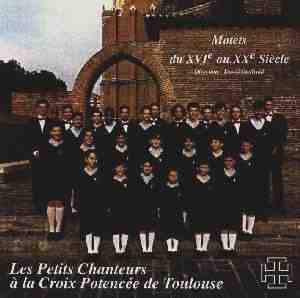
Socks were particuarly important when boy choirs generally had short pants uniforms when the socks were more apparent. Socks are now less important, but still have to be considered as many boys where white atletic soc ks when not advised to do differebtly. British choirs have generally required grey knee socks when the boys wore short pants. French choirs have mostly
requirded white kneesocks. American choirs where the boys have usually worn long pants have mostly required black socks.
Well groomed hair is another matter to be considered. Nothing can detract from a choral group, other than a sour note, like a smattering of poorly coif red heads. As every good choirboy soon learns, he is expected to have on his person when in uniform, one black comb and two white handkerchiefs (one in his jacket pocket, and one in his hip pocket). These simple items insure the finishing touches of a well-groomed choirboy who is presented to the public in concert.
Some choirs have put a special interest on smartly starched collars. This was particulaly true of the early part of the century when Eton collars were commonly worn. Even today, however, stiff collars are stressed by some choirs. One American choir advises its parents:
Over the years we have learned, or maybe I should say the mothers have learned, that a stiffly starched white shirt is the most economical way to launder a choir shirt. When a choir shirt is well-starched and ironed, and the choirboy's neck is clean, the usual child can use the same shirt for two choir occasions, since the time of wear is about 2 hours. This will vary with the child and condition of the shirt. However, may we say that we must insist on a very stiff choir collar (cardboard stiffness) which is the trademark of the organization. If you know of no special way in which to accomplish this, the following directions are given for your particular help: When new, use Perma Starch for the first time. Starch with hot cooked starch, dry. Then starch with the following cold starch mixture: [Omega] cup water 2 level tablespoons sugar, 3 heaping tablespoons starch. Mix thoroughly and dip collar and lapels into it, squeeze out, then take lapels and collar and rub between hands, rubbing in the starch well. Repeat this cold starch treatment three times. Sprinkle shirt, roll up and place in refrigerator for 24 hours. Iron back of collar first, then iron collar and lapels with white cloth to avoid scorching.
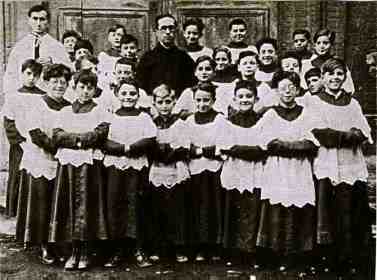
The costumes for formal church singing was eclesiastical wear dictated by the local church and in keeping with the dress of priests, vicars, and other churchmen. The primary choir garment is the surplice which is a white linnen garment worn over a robe. The surplice is worn by Roman Catolic eclesiastics in choir except the officiants of the mass. It is also worn by Anglican/Episcopalian clergy. The surpice is worn by laymen and boys in both the Catholic and anglican church who sing in the choir or assist at the altar.
|
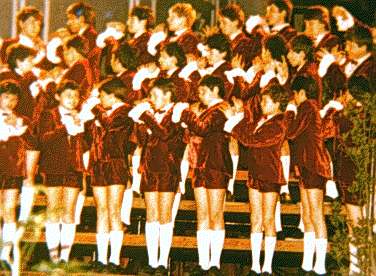
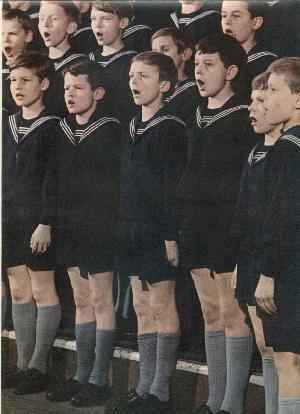
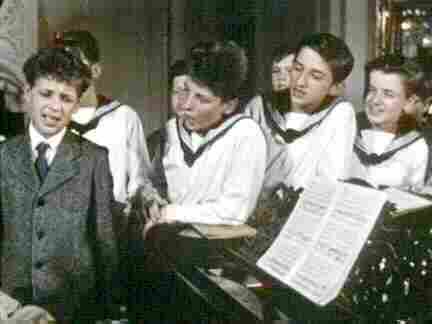
As the choirs developed in the late 19th and early 20th centuries, new costimes were developed for performanes of non-eclesiastical music, including sailor suits and velver suits or other formal dress. German boy choirs such as the Vienna choir boys often chose sailor suits. French and British choirs often had short pants costumes. Several boys' choirs were formed in America, one of the most famous being the Harlem Boys' Choir. Since the 1970s, most choirs have gradually adopted blazers and long pants. A few choirs continue more traditional costumes like the Vienna Choir Boys who continue to wear sailor suits.
Some are concerned about the future of boys choirs and one of the concerns is choir costumes and and the participation of girls. The Times newspaper of
July 13, 1998 provided some interesting insights. The growing number of girls' choirs in cathedrals could be damaging the traditional all-male choir beyond repair, according to some leading English organists. Boys are apparently increasingly unwilling to join choirs where girls have been admitted. The primary reason for this
notable trend is that many boys do not want to be seen doing what they preceive as "girlish things", according to a report by the Friends of Cathedral Music. The organisation, which is "monitoring developments" in girls' choirs, gives warning that the tradition
of male choral music in cathedrals is being threatened by political correctness. It says that boys who are prepared to dress up in "white surplices and triple ruffs" if they sing with men, apparently think twice
when girls appear alongside them. The growing shortage of boys means that there will be fewer men able to sing bass or tenor in cathedral or other choirs at a time when most choral music is still written with parts that
must be sung by men.
Gordon Stewart, organist at Blackburn Cathedral, says that it has become politically unacceptable for many to have all-male choirs. He notes wryly: "It's all right to destroy centuries of tradition for the sake of political correctness". He continues: "How do I get on, working in a place like Blackburn, with a bunch of 30 boys, some of them aged 14, dressed up in white surplices and triple ruffs? It works because it is an all-male environment and the men are in white surplices too and they are just as disciplined in rehearsals as the boys ... make singing into something the girls do, and you will find very few real little boys wanting to do it."
|
Choir uniforms have varied widely from country to country. Many choirs employed the destinctive national styles for their choir uniforms making them easily recognizable. Other choirs employed very formal clothing styles. Other choirs associated with church grous like the English choirs often perform in liturgical robes. Sailor suits were popular choir costumes in many countries. The choirs have both traveling clothes an performance costumes. Most choirs are in Europe and North America and Europe, but there are choirs in others areas as well. Many choirs are associated with specific schools and thus wear the uniform at the school, althugh they might also have other costumes for performances, especially if they are connected with a cathedral or church group. British choirs have thus worn blazers, white shirts, ties, and short pants, although most have now switched to long pants. Increasingly choirs around the world are moving to a common uniform of blazers and slacks. Often the only basic difference in these costumes is the color of the blazer. Some choirs retain destinctive national styles, but there number is declining and it is increasingly difficult to tell one choir from the other.
A wide variety of garments are associates with choir groups. Some of the most important have been the following. Many of the distinctibe garments are the liturgigal garments worn by the British cathedral choirs and te folk costumes worn by various European choirs. Choir costumes have also been stringly influenced by British school uniforms, as choristers are often attached to the public and preparatory schools maintained by English cathedral choirs. Another major choir costume has been the sailor suits favored bu German and Scandinavian choirs.
Choir boys do not commonly wear caps. Some of the German and other choirs wearing sailor suits wore sailor caps. (I do not know of any who have worn sailor hats.) The British choirs located in cathedral schools often wore peaked caps, but this was more their school uniform than a choir costume.
Many choirs wear blazers. This style was set by the British Cathedral choirs where the choristers were recruites from an associated school. The blazer has been aopted by American choirs and other choirs around the world.
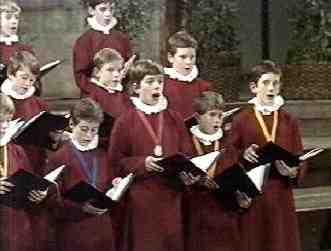
Choir costumes have been made with may different collar styles. The boys wearing sailor suits of course wore middy blouses with sailor collars. Ofthe distinctive collars are the ruffled collars worn by the British Cathedral choirs. While ruffled collars are most common, a few choirs in England and Ireland wear Eton collars.
Some French choirs wears cassocks as they are supported by various French Catholic ordrs. A Spanish choir also wears cassocks.
A few choirs also include capes as part of their choir costume. The cape is, however, is more associated with French school uniforms. HBC knows of some Britush choirs which war capes. There probably have some French choirs which also wear capes, but HBC can not identify them at this time.
Many of the most famous boy choirs are European. The English cathedrals have a long history of boy choirsd spanning centuries. The modern Englisg choirs are attached to Cathedral sponsored preparatory and public schools and thus affected by English school uniforms. Coninental choirs, with a few exceptions, have 20th centiry origins. As a result the pants styles are strongly influenced by popular boys clothing standards. As a result, many choristers wore short pants. The English boys mostly wore grey shorts. Blue shorts were common in France and black shorts in Germany and Poland. Since the 1980s, however, most choirs have generally shifted to long pants.
Eclesiastical robes are most common in England where the boys wear them for religious services in England's great cathedrals. Some European choirs in the Netherlands, Spain, and other countries also wear eclesiarical robes, but this is most common in England.
Almost all of the choirs wearing short pants and kneesocks wore grey socks. Theasee were often grey kneesocks with tops in the school collars. Many of the Continental choirs, especially the French and German choirs wore white knee socks.
|
Some interesting movies have been made in Europe about boys choirs. The movies have
been of uneven quality, but do show some details about the cotumes worn by choirs in the
various countries. The films reflect the various costumes worn by the choirs in the various
countries, including sailor suits, short pants, lederhosen and other outfits.

Navigate the Historic Boys' Clothing Web Site:
[About Us]
[Introduction]
[Activities]
[Biographies]
[Chronology]
[Clothing styles]
[Countries]
[Girls]
[Theatricals]
[Bibliographies]
[Contributions]
[FAQs]
[Glossaries]
[Images]
[Index]
[Links]
[Registration]
[Tools]
[Main HBC Topic page]
[Boys' Historical Clothing Home]