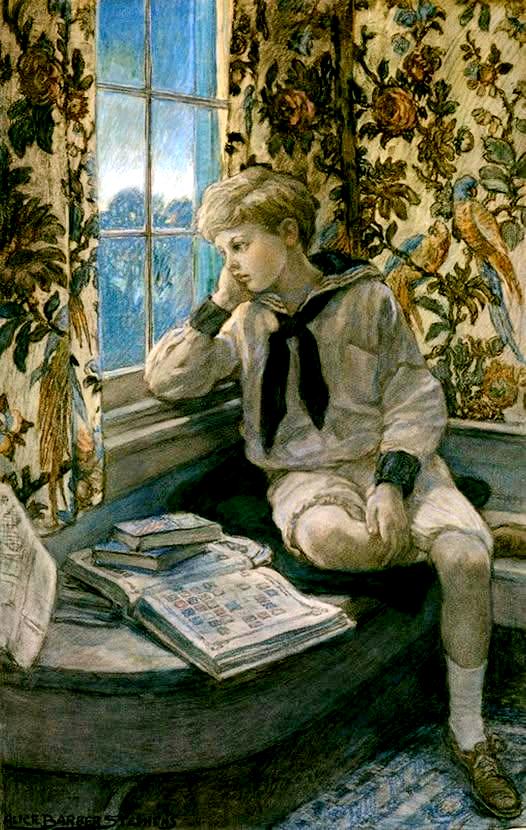
|
Alice Barber Stephens was an American artist and engraver, but is probably best classified as an illustrator. Her illustrations were carried in important mass circulation magazines including Scribner's Monthly, Harper's Weekly, and The Ladies Home Journal. She was one of the earliest female illustrators that broke into art and played an important role in the Golden Age of Illustration. Through the 19th century, there were very limited opportunities for women. Art was one of the first areas that women broke into and Stephens helped lead the way. Alice was born in to a Quaker family near Salem, New Jersey, the eighth of nine children. Her parents were Samuel Clayton Barber and Mary Owen. She attended local public schools and then schools in Philadelphia, Pennsylvania. After completing primary school when she was 15 ears old, she entered the Philadelphia School of Design for Women (Moore College of Art & Design). She began studying wood engraving (1873). At the time to publish an image, an engraving was need. Lithography was very basic. Her real interest was art, but engraving was as close as she could get. Barber began attending classes taught by artist Thomas Eakins at the Pennsylvania Academy of the Fine Arts (PAFA). She decidrd to mstop engraving the work others and focus on her ownn work. The PAFA had much higher artistic standards and began accepting women (1878). Strephens was their female student. Stephens left the Academy to work as an engraver (1880). Few engravers at the time were engravers. But the American economy was in high gear and the market for magazines was growing. And illustrations were important for success. Which meant that skilled engravers were in high demand. It is difficult categorize her illustrations, but she is best known for her genre illustrations of domestic situations, commonly with women and children. Stephens began working with Harper's, the oldest general-interest monthly magazine in America known for its illustrations (1882). Much of her work was published in Harper's Young People (later known as Harper's Round Table. Soon after her health began deteriorating. She recuperated in Europe (1886-87). She traveled to sketch, study, and rest. While in Paris she studied at the Académie Julian and the Académie Colarossi. She exhibited two works at the Paris Salon (1887). Upon returning to America she resumed her career in earnest. She resumed contributions to Ladies' Home Journal and launched book projects with Houghton Mifflin and Crowell. She began painting in oil. Stephens exhibited her work at the Palace of Fine Arts and The Woman's Building at the 1893 World's Columbian Exposition in Chicago, Illinois. The advancements in lithography meant that with the turn of the 20th century, images could be reproduced, even full color images in newspapers and magazines. Gender studies are very popular in American universities. These include detailed study of he very real limits on women into the early-20th century. Stephens was one of the many pioneers. Often gender studies professors, however, fail to mention that America led the ways in widening opportunities for women.

Navigate the HBC illusdtrator pages' Historical Clothing Web Site:
[Return to the Main individual American illustrator page]
[Return to the Main individual illustrator page]
[]
[Belgium]
[England]
[France]
[Germany]
[Soviet Union]
Navigate the Boys' Historical Clothing Web Site:
[About Us]
[Introduction]
[Activities]
[Biographies]
[Chronology]
[Cloth and textiles]
[Countries]
[Garments]
[Girls]
[Photography]
[Topics]
[Bibliographies]
[Contributions]
[FAQs]
[Glossaries]
[Images]
[Links]
[Registration]
[Search]
[Tools]
[Boys' Clothing Home]