|
Charles d'Agar was born in France, but the family emograted to England when Charles was a boy before he even began training as an atist. We are not sure why they emigrated. They may have been Protestants. Or perhaps there were better opportunities to find clients in England. France at the time was a much richer country than England, but there may have been less competiion in England. The family migrated (1681). As far as we know, his artistic career was mostly conducted in England. His father was Jacques d'Agar, also an artist. His mother was Marie Picard. He does not seem to have studied art, but would hve been trained by his father. He was apprenticed to Robert Robinson, a painter-stainer in London, but not for very long. Charles accompanied his father to Copenhagen (1685). His father remained there as a court painter until his death (1715). Charles returned to England on his own and settled in London (1691). His son David was also an artist but does not seem to have been very successful. D'Agar was an important portrait English painter during the late-Stuart era (1690s-20s). His portraits are primarily wealthy English aristocrats and their families. All of the portraits we have found are English, although many are unidentified subjects. An unusually large portion of his portraits were children. Many are unsigned and identified as 'circle of Charles d'Agar'. These are for the most part undated. This probably in part reflects the limited number of prtraits of such quality at the time. as money flowed in from India and the Caribbean sugar islands, there were nore portaitsdone in the send half of the 18yth century. They are extremely well done portaits, some of the best available during the period, although his body of work is uneven. Some like the poraits of the Gates children here are of lesser quality. Perhaps some of the work was done by assistants. D'Agar was highly regarded by English society, but we do not know of any royal portaits. There was aportrait of Charles II’s French mistress, Louise de Kéroualle, Duchess of Portsmouth. Among his portraits was John Churchill, 1st Duke of Marlborough. We see the men wearing wigs that were a part of high society and the frock coats that were the standard styles.
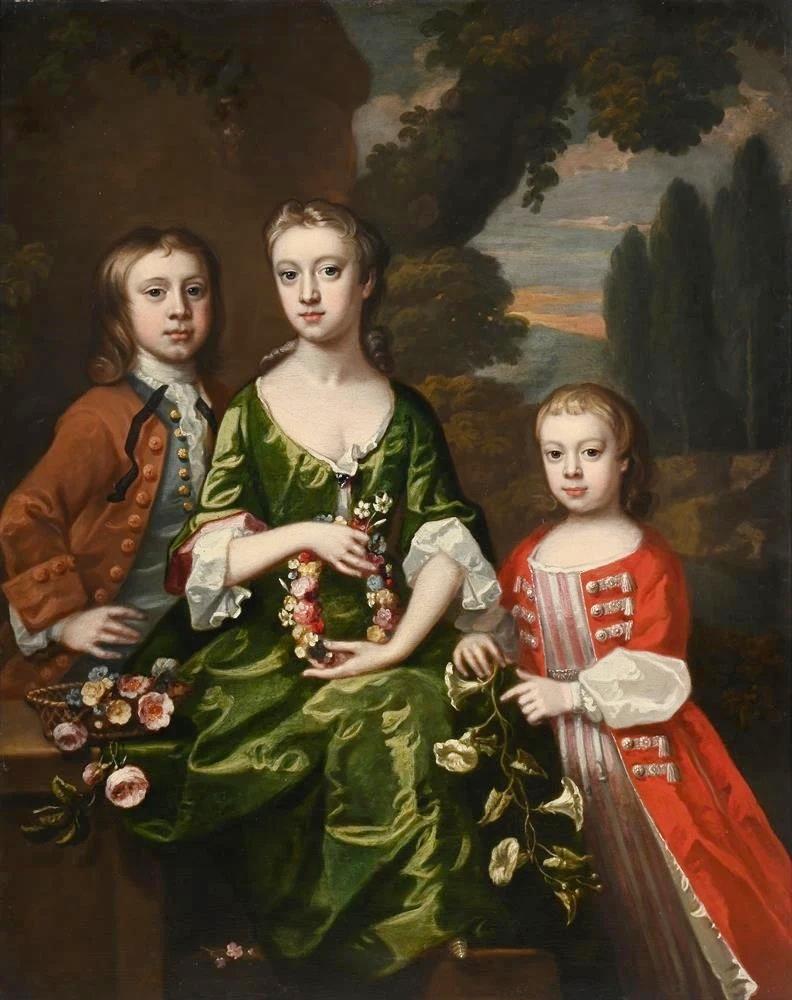
Here we have an undated Agar portrait of the Gates children (figure 1). The gielswear colorful dresses with low necklines. The boys wearsa long frock jacker and a different xolored vest. This is not one of D'Agar's better portraits. The work here is not even. The boy's face is reasonably well dome, the girls faces not so well so. This is one of the many portrits attributed to the 'd'Agar circle'. We are not sure when it was painted, probably the early-18th century.
This d'Agar portrait shows Henry Harpur, later Sir Henry Harpur, 5th Baron, and his brother John Harpur painted in 1718. The boys wear matching frock jcket suits with slighly longer cpards and knee breeches. We are confused by Henry's left leg suggesting white knee beeches. We are just not sure how to interpret this. These are not juvenile outfits. This is how their father would have dressed. We are not sure, however, about the bright red coloe. We think this was more common for boys than adult men. We do not know a great deal bout either boy. They do not particularly destinguished them selves. Henry Harpur was a Tory Member of Parliament for Worcester (1744-47) and for Tamworth from 1747-48. He died (1748). We note a portrait of Henry son also named Henry (1739-89) who suceeded him as the 6th Baron.

Navigate the Boys' Historical Clothing Web Site:
[Return to the Main boys 18th century page page]
[Return to the Main girls chronological pages]
[Introduction]
[Activities]
[Artists]
[Biographies]
[Chronology]
[Clothing styles]
[Countries]
[Bibliographies]
[Contributions]
[FAQs]
[Glossaries]
[Images]
[Links]
[Registration]
[Tools]
[Boys' Clothing Home]
Navigate the Boys' Historical Clothing artistic pages:
[Return to the Main English art page]
[Return to the Main individual A-L artist alphabetical page]
[Return to the Main artistic page]
[Chronologies]
[Individuals]
[National]
[Styles]