|
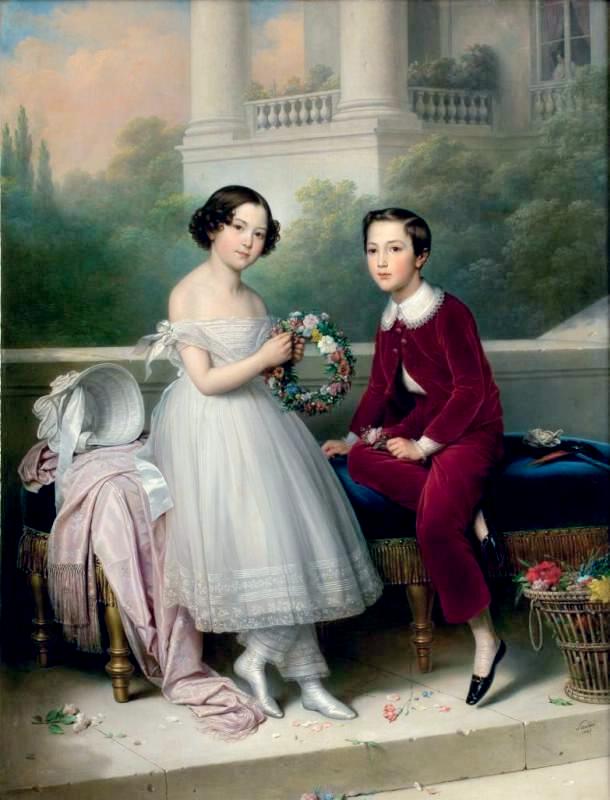
This Charles de Stuben painting illustrates some interesting aspects of 19th century trends. Notice how Charles's father easily moved from a German to a Russian military service. Something unthinkable in the 20th and 21st century. Nationalism was not an all important attribute in the 19th century. As a result of the French Revolution (1790s) and Napoleonic Wars (1800-15), nationalist sentiment exploded in the 19th century. Also notice Charles' conflict between a military heritage and his own artistic instincts. We notice boys wearing long pants in th first half of the 19th century. This would change in the second half of the century. The attitudes toward modesty are also important. Notice Iryna very low-cut neckline, yet long pantalettes that even cover her ankles. We also see how French fashion dominated the dress of Russian aristocratic families.
Charles Auguste Guillaume Steuben was a German-born French Romantic painter and lithographer who trained in France ans worked extensively in Russia. He was active during the first half of the 19th century basically from the Napoleonic era to the beginning of the Second Empire.
Charles (Karl) was born into a Württemberg military family. Württemberg was dukedom in southern Germany. His father, Carl Hans Ernst von Steuben, when Charles was 12-years old moved the family to Saint Petersburg, the capital of the Tsarist Empire. He entered Tsarist service as a captain. This was an era when ethnicity did not totally determine loyalty. The French Revolution and Napoleonic Era would lead to a rise in nationalist sentiment which would sweep over Europe. Charles studied drawing at the Art Academy as a guest student. His father has social contacts in the Tsarist and Württemberg ducal court. At age 14 years, he was a page at the ducal court, a position along with his father's tradition would have normally led to a military career. Instead Charles was drawn toward art. Famed poet poet Friedrich Schiller was a family friend who noticed Charles' artistic gifts. He also instilled liberal ideals contrasting with aristocratic courtly influences. Although the family was not affluent, contacts enabled him to study in France, including the prestigious École nationale supérieure des Beaux-Arts, where he studied under Jacques-Louis David and Pierre-Paul Prud'hon. He befriended naturalist Alexander von Humboldt, whose brother Wilhelm von Humboldt founded of the University of Berlin. This opened important contacts in the not yet united Germany. De Steuben in 1812 debuted at the Salon de Paris with his painting of Peter the Great(1812) just as fortunes were about to turn for Napoleon. He did many historical paintings, including Charles Martel at the Battle of Tours (1837). He also did portraits. He got commissions from King Louis-Philippe. Throughout his life de Stuben was torn between his military oriented family and upbringing and Paris bohemian/artistic life. He became a French citizen (1823). He painted a deathbed scene
of Napoleon (c1828). Hewas an actual witness at Napoleon's deathbed (May 1821). French Army veteran and war hero Colonel de Chambure apparently arranged for De Steubun to go to St. Helena. The work was exhibted (1829). Stendhal wrote a positive review of the paintig. DeSteuben was awarded a gold medal at the Salon de Paris for his highly acclaimed hisdtorical paintings (1840). He eventually returned to Russia, primarily for financial reasons where he did portraits Steuben returned to Russia (1843). He did portraits as well as an acclaimed seven paintings for the Saint Isaac's Cathedral. He suffered a stroke and returned to France (1854). His infirmity affected his work. He suffered two more strokes He died (1856).
The children here are aristocratic Russian children in St. Perterberg, Iryna and Illarion Vorontsov-Dashkov, painted in 1845 by Charles de Steuben. He belonged to the Vorontsov aristocratic family fervently loyal to the Tsar.
Illarion was born in Saint Petersburg (1837). As a young officer he participated in the Tsarisdt conquest of Central Asia (1860s). He commanded the Life Guard Horse Regiment (1867–74). He was well connected with the Tsarist court, friendly terms with Tsarevich, future Alexander III/ After Alexander's father was assassinated, Vorontsov-Dashkov organized a counter-revolutionary squad (druzhina) -- the Holy Brotherhood. Alexander had great confidence in Vorontsov-Dashkov and placed him in charge of the imperial court and promoted him to Full General of Cavalry. He also was ran the imperial stud farms and vineyards. Vorontsov-Dashkov fought in the long-running Caucasian War and the Russo-Turkish War (1877-78). When Alexander died (1894), Nicholas II removed him from the office of Minister of Imperial Properties, but appointed him to the State Council of Imperial Russia. With the outbreak of Revolution (1905), Nicholas recalled Vorontsov to active service. He was appointed to the Viceroyalty of the Caucasus. Vorontsov-Dashkov fostered reformist policies, but his performance was impacted by revolutionary activity, war, and continuing social upheaval. When World War I broke out he reentered active military service (1914) He commanded Russian forces in the Battle of Sarikamish. during the early months of World War I, although the effective command lay with General Alexander Myshlayevsky. He was removed from command, probably because of age. Grand Duke Nicholas replaced him (1915), He died in his Vorontsov Palace (1916).
We have no information on Iryna. We found some information on a daughter born in Rome, but not on Iryna herself.

Navigate the Boys' Historical Clothing Web Art pages:
[Return to the Main German artist page]
[Main artist page]
[Chronology]
[Country]
[Individual Artists]
[Styles]
Navigate the Boys' Historical Clothing Web Site:
[About Us]
[Introduction]
[Activities]
[Biographies]
[Chronology]
[Clothing styles]
[Countries]
[Girls]
[Theatricals]
[Bibliographies]
[Contributions]
[FAQs]
[Glossaries]
[Images]
[Index]
[Links]
[Registration]
[Tools]
[Main HBC Topic page]
[Boys' Historical Clothing Home]