|
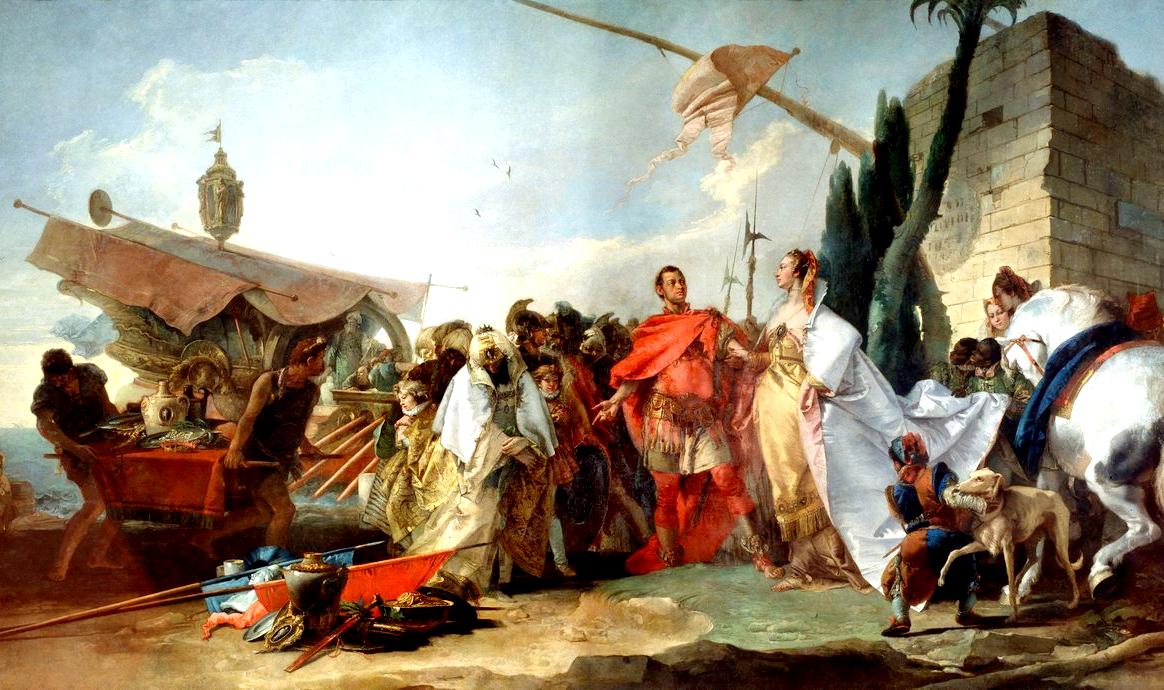
The long period of Persian rule in Egypt ended when Alexander the Great after defeating the Persians occupied Egypt (332 BC). Alexander founded the Greek polis of Alexandria. One of Alexander's most important generals and closest advisers was advisers important generals was Ptolemy. Alexander launched the Hellenistic period beyond Greece itself, carving out a Macedonian Empire extending from Greece and Macedonia east to India. It rmcompassed a vast area, but did not last long. Alexander died and with him his empire (323 BC). Ptolemy was appointed governor of Egypt and Libya. After a series of battles with the diadochi (other contending Greek generals), Ptolemy declared himself king of an independent Egyptian kingdom -- Ptolemy I Soter (305 BC). Unlike previoius Egyptian dynasties, it is not numbers, but wold have been XXXI. Ptolemy fought the Syrian Wars with the Seleucid Empire (one of the rival Hellenistic states), the Ptolemaic Kingdom expanded its borders into eastern Libya, the Sinai, and northern Nubia.Alexandria under his and the rule of his descendants became the foremost commercial and cultural center of the known world. The Ptolemaic Kingdom and dynasty would last until the death of Cleopatra VII (30 BC). The Ptolemies were the longest and final dynasty of ancient Egypt. They brought about a distinct era of religious and cultural melding involving Hellenistic and Egyptian culture. 【Rutherford】 It is at this time that the focus of history turns from Egypt and Greece to Rome, but the Ptolemaic Kingdom as of some considerable importance. Alexandria became the capital city and developed as a major center of Greek culture and learning. This was in part because of the economic importance of Egypt--mainly its highly productive agricultural bounty which financed learning and culture for several centuries. Egypt has a history extending millennia, but little of Egyptian history has impacted Western culture. In sharp contrast the Ptolemaic Kingdom did. To legitimize his rule over native Egyptians, the Ptolemy and his descendants claimed the local title of pharaoh as well as the Greek title of basileus, And the portrayed themselves in public monuments in Egyptian style and dress as a continuation of pharaonic rule. Bu here the Egyptian character ended and the Hellenistic character and traditions dominated, except the destructive inbreeding of Egyptian dynasties. The Greek ruling class dominated the military, political, economic, and intellectual life of Egypt during this period. They did not integrated into Egyptian society and culture. Which is why the woke idea that Cleopatra was ethnically African or even Egyptian is so absurd. Ethnic Egyptians weereallowed to maintain control over local and religious institutions. They did over time enter into the power structure, but only to the degree that they Hellenized. Very quickly with Ptolemy I's son and heir, Ptolemy II Philadelphus, the Ptolemies started to b adopt Egyptian trappings such as marrying their siblings and participating in traditional Egyptian religious life. 【Rawles】 The Ptolemies began to build new new temples mad maintain older ones. They supported the Egyptian to consolidate power. The intellectual life of Ptolomeic Egypt was Hellenistic, a huge departure from traditional Egyptian culture. This was manifested in many different ways with a huge impact on the long term development of the West. Inmany bways, the Ptolomeic Kingdom was a minor footnote in Egyptian history, but an imprtant bmile stone in the saga of Western Civilization. A major achievementg was the Great Library of Alexandria. The origins of a great library in Alexandria is not fully recorded. Ir seems to have been proposed by Demetrius of Phalerum, an exiled Athenian statesman residing in Alexandria. Ptolemy I Soter may have begun planning for a universal library. Construction of the Library began during the reign of his son Ptolemy II Philadelphus. But what is important is that it occurred in Alexandria, not Athens or anywhere else in the classical world. The Library became the largest and most significant library of the ancient world. The Library attracted scholars from all over the known world. Unlike today when research is possible in remote locations, ancient scholars had to come to Alexandria to gain access to important texts. No where else was such a treasure trove of texts available. This impacted Western scholarship for centuries. Among those scholars was Claudius Ptolemy (c100 – 170 AD). He was a mathematician, astronomer, and geographer. He is widely seen as 'culminating achievement' of Greco-Roman pre-science. His theories dominated Western and Islamic thought for over a mellnium and a half. Even after the Library was destroyed inadvertently by Caesar's army (48 BC), Alexandria for cemnturies remained an important center for classical scholars as well as early Christian theologians. Another huge dedvelopment was the Septuagint. Basically unknown to all but serious scholars, the Christian Old Testament is not based on Hebrew texts. It is based on translations ordered by Ptolemy II Philadelphus (285–247 BC) and in the process of translation, there was a considerable degree of Hellenization. This made Judaic idea much more understandable and palatable to the classical world, a hge factor in the subsequent rise of Christianity. The Septuagint became the core of the Christian Old Testament.
Rawles, Richard. Callimachus (Bloomsbury Academic: 2019).
Rutherford, Ian. Greco-Egyptian Interactions: Literature, Translation, and Culture, 500 BCE-300 CE (Oxford University Press: 2016).

Navigate the Historic Boys' Clothing Web Site:
[Return to the Main Egyptian dynastic page]
[Return to the Main ancient Egyptian page]
[Introduction]
[Activities]
[Art chronologies]
[Biographies]
[Countries]
[Photography]
[Style Index]
[Bibliographies]
[Contributions]
[FAQs]
[Glossaries]
[Images]
[Links]
[Registration]
[Tools]
[Boys' Clothing Home]