|
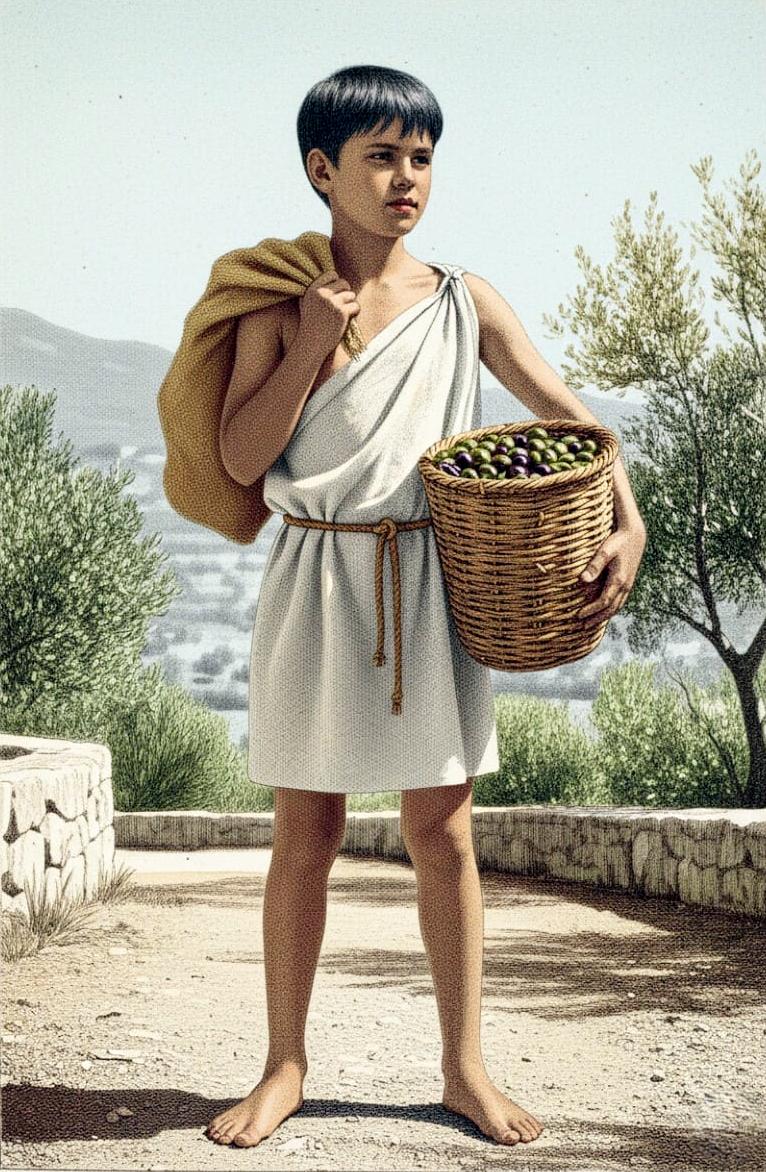
We know a great deal about Greek clothing because of all the available pictorial evidence through vases, pots and the classic sculptures. Ancient Greek clothing was not fitted and shaped for the human body like modern clothing. Rather it was draped over the body in soft folds which can be seen in surviving Greek sculpture. We see much simpler clothing in Greece than would become the case in Rome. In part this reflects the greater richness of imperial Rome and the vast Roman Empire. The Ancient Greeks did not put a great emphasis on their clothing. Clothing was basically made for utilitarian purposes, surely a factor in the simplicity of Greek clothing. The Greeks would take a single piece of fabric and drape it in various ways to prepare for different occasions or adapt to a new fashion. Greek clothing has been described as elegant. In part because of the simplicity. This elegant look was achieved from the careful arrangement of folds along with the complex arrangements of girdles, strapping or belts. The Greeks tended to wear light, loose clothes reflecting the warm Mediterranean climate. The Greek summers can be stifling and thus the less fabric draped on the body, the more comfortable the person was. The Greeks also needed to be prepared for winter weather, especially in the north. Garments included simple tunics and warm cloaks, made of linen or wool. The most basic garment was the 'exomis'. This was the simplest garment, worn by soldiers under their armor and as the only garment by farmers, those who did heavy work, boys, and slaves. It consisted of a cloth wrapped around the body, tied over the left shoulder and fastened at the waist with a belt or rope. Another garment created by the Greeks was the broad-brimmed hat. Some clothing historians believe that the Greek 'petasos' was the first true hat--headwear with a complete brim. It was worn mostly when traveling. It had a chin strap and could be worn hanging down the back.

Navigate the Historic Boys' Clothing Web Site:
[Return to the Main ancient Greek clothing page]
[Return to the Main Greek chronology page]
[Introduction]
[Activities]
[Art chronologies]
[Biographies]
[Countries]
[Photography]
[Style Index]
[Bibliographies]
[Contributions]
[FAQs]
[Glossaries]
[Images]
[Links]
[Registration]
[Tools]
[Boys' Clothing Home]