|
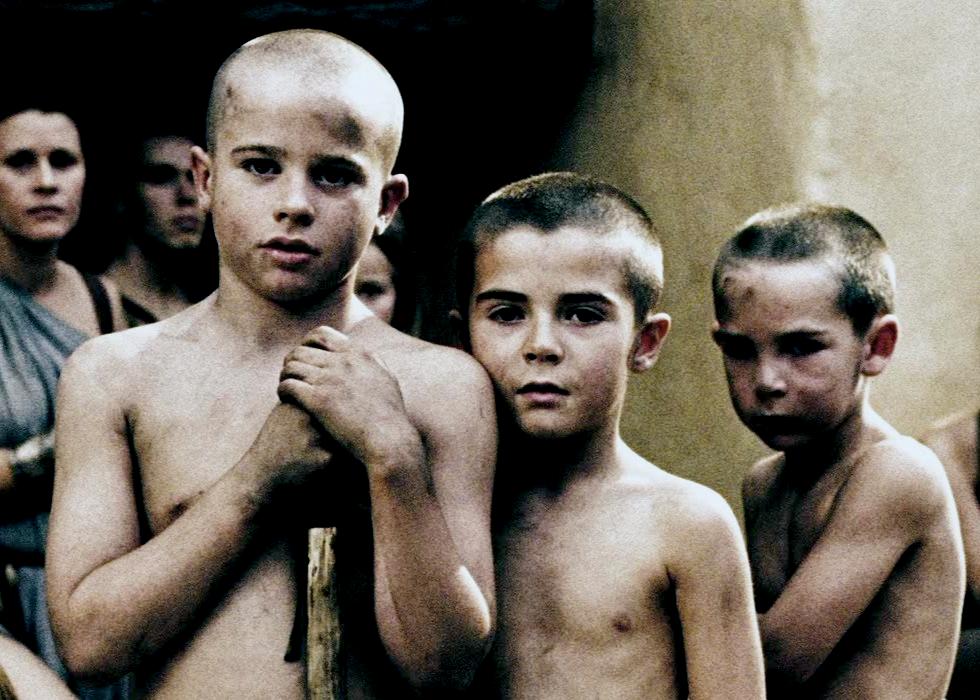
As in the rest of Greece, the education system for Spartan boys and girls was very different. The focus was on the boys and the system was more one of training than educating. Interestingly, the Spartans gave more attention to educating girls than any other Greek state which often largely ignored girls leaving their eduction up nto the parents. But it was the boys' educsation that was radically different. Spartan boys left home at an early age. The lived and studied in severely disciplined groups and closely supervised by officers. Their education and training continued until age 18. The program was designed for boys at each age level and made increasingly strenuous physical demands. The boys of Sparta were obliged to leave home at the age of 7 to join sternly disciplined groups under the supervision of a hierarchy of officers. From age 7 to 18, they underwent an increasingly severe course of training. Spartan boys left their mothers were sent to military school at age 6 or 7 years. They lived, trained and slept in the barracks of the brotherhood that they were assigned to a birth. The boys began a program of physical conditioning. They were taught skills that would be helpful when they began actual military training like survival skills. Sparta also had a very distinctive training program for girls. In fact, sharp contrast to other city states, Sparta provided training for girls and not just training in domestic skills at home. The girls at age 6-7 also began school. As for the boys, it was not an academic program. They received strenuous physical training, including running, jumping, throwing the javelin and discus, and wrestling as well as gymnastics. Much less is known about how the girls were trained. Apparently they lived, slept and trained in their sisterhood's barracks. No one knows for sure if the girls were subjected to as harsh a program as the boys, but this was unlikely even for Sparta.
Spartan boys left home at an early age. The lived and studied in severely disciplined groups and closely supervised by officers. Their education and training continued until age 18. The program was designed for boys at each age level and made increasingly strenuous physical demands. The boys of Sparta were obliged to leave home at the age of 7 to join sternly disciplined groups under the supervision of a hierarchy of officers. From age 7 to 18, they underwent an increasingly severe course of training. Spartan boys left their mothers were sent to military school at age 6 or 7 years. They lived, trained and slept in the barracks of the brotherhood that they were assigned to a birth. The boys began a program of physical conditioning. They were taught skills that would be helpful when they began actual military training like survival skills. Strenuous physical training was a major part of the program which was hard and demanding. It could also be painful. Boys were were taught to read and write, but these skills as well as the arts and critical thought were not an important part of Spartan education. The training was very demanding, even brutal. They boys trained barefoot to harden them. They slept on hard beds and trained at gymnastics and other physical activities such as running, jumping, javelin and discus throwing, swimming, and hunting. The discipline was very strict and punishment both frequent and harsh. The boys were taught to take pride in learning to endure physical pain. Spartan boys were intentionally not well fed. They in effect had to learn how to steal food. This required stealth, cunning, and physical stamina. The boys were beaten if caught, not for stealing, but for being caught. A Spartan legend describes a Spartan boy who stole a live fox which he intended to kill and eat. Spartan soldiers came across him and he quickly hid the fox under his tunic to avoid the punishment and the shame of being caught. The fox chew into his stomach, but he refused to flinch or show pain. did not allow his face or body to express his pain. The schools had a program sharply different from schools in the other Greek city states. Boys were taught to read, but this was not emphasized and many boys did not master the skill. Not only was reading considered unimportant, reading, writing, literature, and the arts were considered basically inappropriate for the soldier-citizen. Some music and dancing were included in the curriculum, but not out of any appreciation of the arts. The Spartans saw military value to both.
Sparta also had a very distinctive training program for girls. In fact, sharp contrast to other city states, Sparta provided training for girls and not just training in domestic skills at home. The girls at age 6-7 also began school. As for the boys, it was not an academic program. They received strenuous physical training, including running, jumping, throwing the javelin and discus, and wrestling as well as gymnastics. Much less is known about how the girls were trained. Apparently they lived, slept and trained in their sisterhood's barracks. No one knows for sure if the girls were subjected to as harsh a program as the boys, but this was unlikely even for Sparta. Whether or not this is the case, it is known that the girls' program was very demanding to help develop healthy vigorous girls. The Spartans were convinced that healthy women in good condition could produce the the fittest babies--very important to the Spartans. Girls also faced a test at age 18. Girls who passed the skills and fitness test, she would be assigned a husband and allowed to return home. In most of the other Greek city-states, women were required to stay inside their homes most of their lives. In contrast, Spartan citizen women could move around, and enjoyed a great deal of freedom, in part because their husbands did not live at home. Girls who failed lost their rights as citizens and became perioikos--members of the middle class.

Navigate the Historic Boys' Clothing Web Site:
[Return to the Main Sprtan education page]
[Return to the Main ancient Greek education page]
[Return to the Main ancient Sparta page]
[Return to the Main ancient Greek page]
[Return to the Main Greek chronology page]
[Introduction]
[Activities]
[Art chronologies]
[Biographies]
[Chronology]
[Countries]
[Photography]
[Style Index]
[Bibliographies]
[Contributions]
[FAQs]
[Glossaries]
[Images]
[Links]
[Registration]
[Tools]
[Boys' Clothing Home]
Navigate the HBC School Section:
[About Us]
[Activities]
[Chronology]
[Clothing styles]
[Countries]
[Debate]
[Economics]
[Garment]
[Gender]
[Hair]
[History]
[Home trends]
[Literary characters]
[School types]
[Significance]
[Transport and travel
[Uniform regulations]
[Year level]
[Other topics]
[Images]
[Links]
[Registration]
[Tools]
[Return to the Historic Boys' School Home]