|
Our mental image of anmcient Roman clothing is dominated by one garment--the toga. It is usuyally depicted in art and modern media (movies and television). We have actually period deppictions, primarily sculture, but some paintings (frescos) as well. We see flowing white garment arranged in countless folds around the body. The toga was worn in count;ess folds over a tunic. We get the idea that Romans in general wore the toga. This is because the sculpgures all depict men flowing togas. But this because the sculptures most depict men of imprtance, senators, philosophers, and wealthy citizens. There was no significant depiction of ordinary Romans. The paintings confirm that they were mostly white. After the fall of Rome and th development of European art, this is also how Roman men were depicted. There are also documentary evidence. Virgil's the epic poem 'Aeneid' refers to Romans as 'masters of the world, and people of the toga'. And Romulus — the founder of Rome — is always depicted wearing a toga.
The toga was worn exclusively by Roman citizens. It conveyed both status and identity. Only Roman citizens could wear the toga. All citizens of whatever class could wear the toga.
Non citizens encluding slaves, exiles, and free noncitizens were not allowed to wear togas, no matter how high their stastus. Wearing atoga to fradulenyly claim to be a citizen was a serious punishable offense.
Romans did not invent the toga and were not the first to wear the garmnent. The toga is most associate with Rome. We see garments that look like togas in some other ancient civilizations, mostly Europeans north of the great river valley civilizations with modern temperate climates. Greeks wore a grment called the 'himation'. This was a rectangular textile draped over the body like a cloak. It was less structured than the Roman toga, but it also conveyed status and decorum. The Etruscans were an older civilization located north of Rome. They significantly influenced the early Romans. The Estrucans wore the tebenna, a garment similar to the toga, but did not havethe status assoiciated with it.
The evolution of the toga span the centuries of Roman life. As Rome evolved so did fashion. The toga throughout the centuries remains a lasting icon of this foundational civilization. In many ways, the toga came to symbolize Roman culture and values. The toga over time became a visual indicator of Roman citizenship, setting Romans from the many diverse peoples that the comnqueres and ruled. Roman fashion borrowed and incorporated elements from the cultures they came in conact with, most of which they conquered. The result was a variety of toga styles and colors that developed over the millennia of Roman life.
Not only did not everyone wear the toga, but it was also was not everyday wear in Rome. This was especially the case for average working-class Romans that did not have high status. The Romans who wore the toga most commonly were wealthy patricians, senators, officials, intelectuals who wore togas to signify authority, status, and respectanility. Average Romans would only weat the toga for special occasions. This included public holidays ceremonies, religious events, or legal abd state proceedings. Not only was the toga imprtant, but how it was worn was just as important. The toga required complex folds and complicated by the heavy bulk of the material. This mean that help was commonly needed to arrange properly.
In the early days of Rome, both men and women of all classes were entitled to war the toga. But with the onset of the principiate, (especially the second century BC), the toga became an exclusively make garment. Here there were a few eceptions, prostitutes and women who had been divorced for adultery wore the toga as a stigma of their ilrepute. Roman women came to wear the stola, this was a long dress worn over a tunic for modesty.
Most Roman togas were white. It should be stressed thatv the sculptures are misleadinh. We tend to see them as white, but many of those sculptures were actally painted, paint that has been lost over time. White symbolizing simplicity and moral virtue, There were, however, colored togas. The colors and embellishments signified a range of roles and socialn ranks. This could be very complicated. These variations and occasion for which they were worn served as a kind of visual language, silently communicating the wearer's status or societal role. It should be stressed that most ordinary Romans, only had one good toga and was not engaged in playing the high status game. The toga praetexta was worn by magistrates and boys of noble birth. It had a purple stripe along the edges. This required an expensice purple dye made by Phoenicians in Tyre from predatory sea snails. Purple became a color associated with both royalty and divine favor. The toga picta was a special garment worn by emperors for special occasions, magistrates during the popular public gladiatorial games, and generals celebrating their great triumphs. The cloth was embroidered with gold and commonlyh dyed a deep purple requiring a lot of theexpebnsive dye. It conveyed imperial authority. There were togas that were associated with paricular events. The toga pulla symbolized mourning. This was a dark colored toga--but but not always black. The toga virilis was a toga of manhood. It was worn by teenagers during their a coming-of-age ceremony. It was worn by boys who became a full Roman citizen. It signified their transition from childhood to adulthood. It was the point that they became a full, adult member of Roman society. The toga candida was a an alrteady white color. It was worn by candidates for public office. It was a bright white toga brushed with with chalk to bring out a stark whitness, symbolizing the candidates purity and integrity.
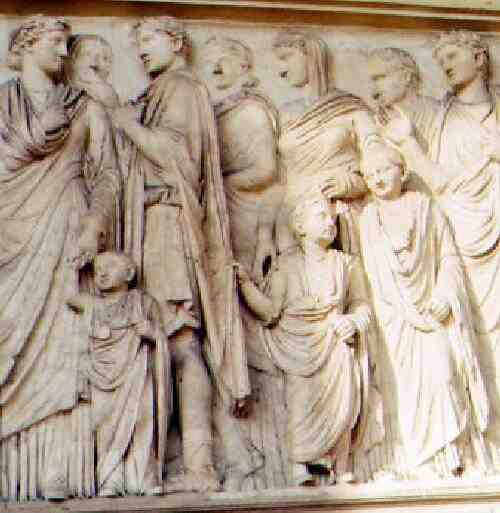
Once a boy became a man, he put aside his childish clothes, and wore an all-white tunic. A boy became a citizen at age 16 or 17. The year was selected by choosing the date which came closest to March 17. Coming of age, becoming a citizen, was quite a celebration. Boys at about 17 years of age would take part in a ceremony in which they were given the adult toga called Toga Virilis. This was often white and the braid symbolising childhood was missing. After putting on his new toga, the boy's proud father would adjust it. The day ended with a dinner party, given by the father, in honor of the new Roman citizen. We do note images of children wearing what look like togas, but this appaers to have been children of important officials in formal occassions. It was not what they regularly wore. The Altar of Peace is a magificent depiction of the Roman elite in their finest togas--including the boys (figure 1). Boys normally would wear short tnics, but for such a formal occassion are dressed in long tunics like their parents.
Gur, O. Selcuk. Daily Life in Ancient Times (Pub. Kuyucu Matbaacilik Ltd.).
Macdonald, Fiona. Ancient Rome (Pub Miles Kelly, U.K, 2002).

Navigate the Historic Boys' Clothing Web Site:
[Return to the Main ancient Rome clothing page]
[About Us]
[Introduction]
[Activities]
[Biographies]
[Chronology]
[Clothing styles]
[Countries]
[Girls]
[Theatricals]
[Topics]
[Bibliographies]
[Contributions]
[FAQs]
[Glossaries]
[Images]
[Index]
[Links]
[Registration]
[Tools]
[Boys' Historical Clothing Home]