
Native American Civilizations: South America--Amazonian Tribes
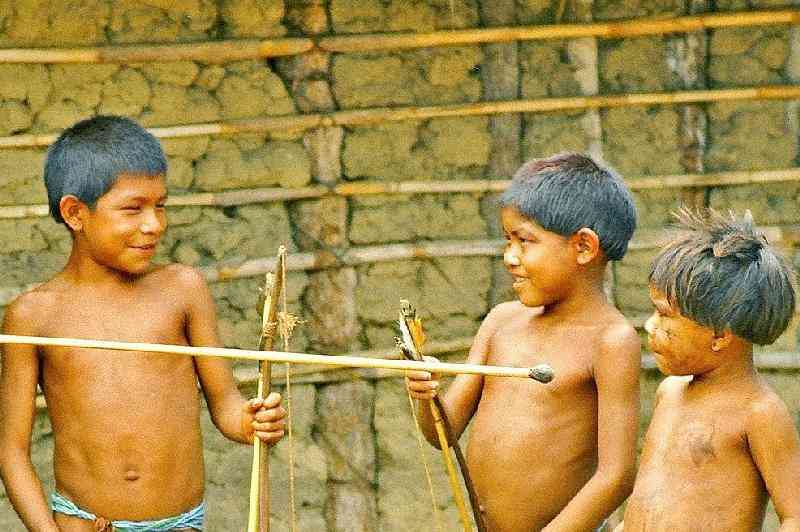
Figure 1.-- The Yawalapiti are another Brazilian Amazonian Basin tribe. They inhabit the Upper Xingu region. Because of this remote location, they were never found in colonial times. The first historical contact with Europeans occurred in 1887. Karl von den Steinen first encountered them in his Amazonian expedition. The photograph here shows a group of boys playing with their bows and arrows. Like most Amazonian people, the boys only wear waist belts. The adobe hut in the background may reflect Portuguese technology rather than their native technology.
|
|
Native Americans in the Amazonian Basin are a very complicated topic which in recent years have become a matter of intence scholarly debate. Anthropologists for years thought seeing the promitive people of the Amazon that there no avanced cultures developed there. One ongoing mystery is that Spanish sources report a very substantial population in the Amazon basin during the 16th century. Francisco de Orellana set out on a quest for gold and soon found himself just trying to survive. He was the first European to travel the entire length of the Amazon and he reported a huge population of highly productive farmers. Historians at first dismissed the Spanish account as fanciful. Modern anthropolgists have begun to reassess this judgement. Some believe there indeed once was a very large population in the Amazon basin practing sophisticated agriculture. The question becomes, why de we now see only primitive hunter-gathers in the Amazon. Some historins believe that the drepedations of Spannish and Portuguese slave hunters drove Amazinian farmers deep into the frst and forced them to adopt hunter-gatherer cultures. Other historians note advances such as pottery first made in the Amazonian Basin as well as cultural exchanges with Pacific coast people that seem to suggest the existetance of advanced civilizations in themazon when civilization aling the Pcific coast and andes wa still in a formative state.
Scholarly Debate
Native Americans in the Amazonian Basin are a very complicated topic which in recent years have become a matter of intence, sometimes acrimonious scholarly debate. It has been common to think of the Amazonian Native Americans as primitive people lot in time and providing a window to the stone age. Anthropolgists visting these people provided portraits suggesting this view. And respected anthropolgists proposed a theory explaining why this has occurred--the inherent ecological limitations of the tropical rain forest. This was the widely accepted view of the Amazon for many years. There is now considerable scholarly reassessment of this view. Continuing archeological finds as well as new methods have provided a great deal of new evidence.
Cultural Level
The major issue today is the pre-Conquest population and culural level of the Amazonian peoples. The earliest repots suggest a very dence population practing settled agriculture. This was how Gaspar de Carvajal described the Amazon (1540s). His account has been dismissed becaused he included an account od women warriors. Researchers today are not as dimissive and some archeologists have found evidence suggesting highly profutive settled agriculture. Some now believe that the primitive tribes in the Amazon today are the descendents of people forced to abandon setteled agriculture by European diseases and Portuguese slave raiders. [Mann, p. 325.] Some believe there indeed once was a very large population in the Amazon basin practing sophisticated agriculture. The question becomes, why de we now see only primitive hunter-gathers in the Amazon. Some historins believe that the drepedations of Spannish and Portuguese slave hunters drove Amazinian farmers deep into the frst and forced them to adopt hunter-gatherer cultures. Other historians note advances such as pottery first made in the Amazonian Basin as well as cultural exchanges with Pacific coast people that seem to suggest the existetance of advanced civilizations in the Amazon when civilization along the Pacific coast and Andes was still in a formative state.
The major cultural groups of the Amazon are the Arawak and Tupi speaking people. Guaraní-speaking people were located to the south in the Paraguay-Paraní basin. Rather than timeless, the Amazon has been the scene of major cultural chnge. About 2,000 years ago, Arawak-speaking people began to migrate north and east into the Amazon and drive Tupí-speaking people to the north and east. The Native Americans today in the Amazon live in small tribal groups. Asessing the various tribal groups once centered on linguistics. Today we have the added tool of DNA studies. It is unclear at this time to what extent these groups are descendents of the priginal pre-Conquest people or new groups after the original Amzonian people were decimanted by European diseases and Portuguese slave raiders.
Sources
Mann, Charles C. 1491: New Revelations of the Ameruicas before Columbus (Vintage Books: New York, 2006), 541p.
HBC

Navigate the Historic Boys' Clothing Web Site:
[Return to the Main South American Native American page]
[Return to the Main Native American page]
[Introduction]
[Activities]
[Biographies]
[Chronology]
[Clothing styles]
[Countries]
[Bibliographies]
[Contributions]
[Essays]
[FAQs]
[Glossaries]
[Images]
[Links]
[Registration]
[Tools]
[Boys' Clothing Home]
Created: 5:52 AM 11/24/2006
Last updated: 8:34 PM 2/10/2009