|
English artists have provided us lovely views of English families in the 18th century. As there was no photography, the number of images is limited. The number of painted portraits is mo where mear the mimber that would become abailable after the invention of photigrapy, but we so have a number of paonted portatits, mostly from the second half of the century. We are mot entirely sure whu there was such a difference differebnce between the two halves of the century. It may reflect the growing eealth in England. Here the Industrial Revolution and the control of India may have been factors. But because most of the family images are portrits requiring expensive commissions, we mostly have views of well-to-do aristocrtic or merchant families. There ere not yet styles specifically for children who mostly wore scaled down versions of what their parents wore. The styles we see are mostly boys once breeched wearing knee breeches with long stockings. This only began to change ar rgevendvofvthe century when we see some boys wearing skeleton suits, some with long pants. Suits could be very coloful, as least for the privlidged classes. Neither boys or adult men wore long pants innthevportraits of the well to do. We are less sure about the the working class which were in the process of moving from the countryside into the growing industrial cities by the end of the century.
William Hoare painted the Trower chikdre, we think in the 1730s. The chikldren are Elizabeth and Thomas Trower painted with a landscape background. We have no idea who the Trower Children were . They look to be about 4-6 years old. We are not sure if they were from Bath or viiting the resort town. Both chidren wear dresses, but different styles. The boy's brown dress has a hint of suit styling while the girl wears a standard white dress. Both wear blue sashes, but ine differently. We are not sure, however, to what extent the difference reflects gender conventions as opposed to non-consequential variation.
Sir William Young, 1st Baronet (1724/5–1788) was a British politician who became prominent because of his family's sugar plantation in the Caribbean which of course wee based on slave labor. He was born on Antigia (1725). His father, Dr William Young, had fled there from Scotland after the Jacobite uprising of 1715. Young had an interest in science and was a fellow of Royal Society. He publishede a book on developing Caribbean island economies.
Because of his knowledge of the Caribben, he was selcted to serve as President of the Commission for the Sale of Lands in the Ceded Islands. The British wantedto create model colonies. This meant the Caribbean sugar islands obtained from France as a result of Britain's victory over France in the Seven Years/French and Indian Wars. He was appointed the first non-military Governor of Dominica (1768). Sir Willian benefitted from his position. He purchased some prime sugar growing sites on Antigua, St Vincent, and Tobago, although he doest not seem to have successfully developed then bnd was badly in debt at the time of his death. He convinced an Italian artist, Agostino Brunias living in London to accompny him to the West Indies to create an enduring legacy of his efforts. He sailed for Barbados (1764) abd would spend 10 years in the West Indies (1764-73), although returining teicec to England. After his first wife died, he maried Elizabeth Taylor (1729-1801). ge was the the daughter of mathematician Brook Taylor. Their large fmily included Sarah Elizabeth, William, Portia, Elizabeth, Mary, Henry, John, and Olivia. The family was depicted in a painting by Johann Zoffany (1766). It was painted on one iofhis trips back to England.
Benjamin West was the first American painter to rise to international prominence. He lead an astonishing life that led him from the American backwoods to the English Royal Academy and acceptance into the glitering halls of English aristocracy. This was an amazing accomplishment for a self-taught, largely uneducated colonial boy.
Potratist George Romney provides us a charming view of Earl Gower's family. The family made a fortine in building canals, the principal method of hauling freight in the 18th century. Romney liked to paint clasical images. Thus the children are done up in Grecian robes rather than the clothes they usually wore. They seem to be enjoyingthe experience.
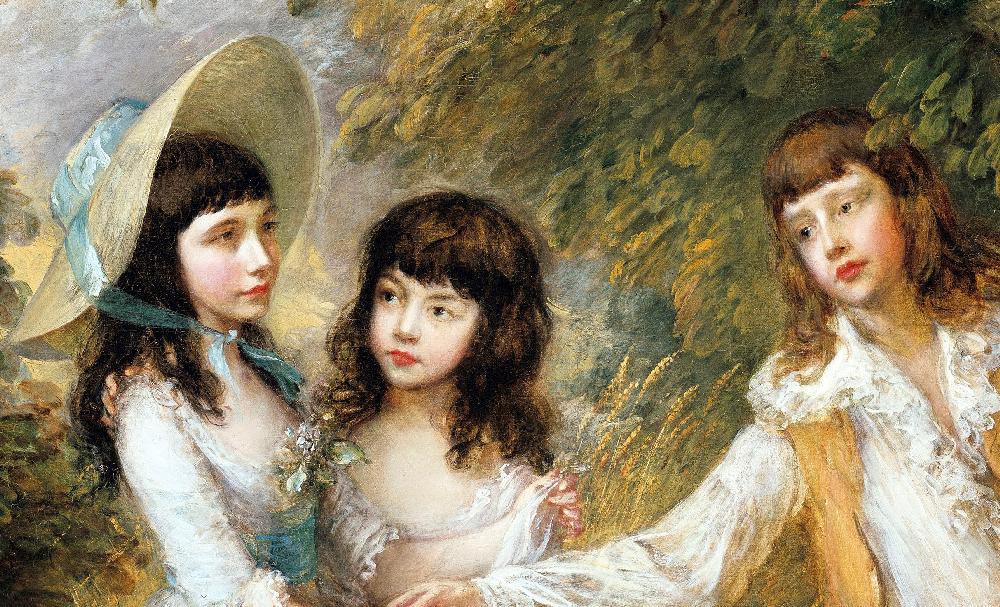
This was one of the last of the magnificent portaits done by famed English portraitist Thomas Gainsborough (1727-88). Charles Marsham (1744-1811) was the son of Robert Marsham, 2nd Baron Romney, and Priscilla, daughter and heiress of Charles Pym. He was educated at Eton College (1753-63) and entered Christ Church, Oxford (1763). He succeeded his father to the barony (1793). He inherited his grandfather's large and hugely profitabke sugar plantations, jointly known as 'Romney's', on the Caribbean island of St. Kitts. The property had been part of his father's marriage settlement to his mother (1742). Throughout the 18th century and into the 19th century it was operated with brutal slave labor. Caribbean sugar plantations were essenrially death camps. The French plabtaions in what is now Haiti were the wirse, but the British camos were akso extrodinarily brutal. Charles as known as Lord Romney between 1793 and 1801 and sat in the House of Commons from (1768-90), meaning during the American Revolution. He inherited his peerage after the death of his father (1793) and was created rge first Earl of Romney (1801). Marsham commissioned a life-size group portrait of his children (Amelia Charlotte, Frances, Harriot and Charles, (July 1787). Commisioning Gainsborough is just obe example of the family's wealth. The children are surrounded by an impressive late summer landscape, presumably part of the Earl's extensive gardens. Setting the portrai in tge garden was in part to create a sence of informality. The children, however, are pictured almost as they do not know that their siblings are present, even the two at the center embracing each other. Having four children sit still For an extended period woukd have been a challenge. So obviously he had them sit separtely (especially fir the faces) and merged them into the portait. Notice that their eyes do not meet. One art expert comments that as a result, 'the composition is lacking in convincing inner rapport'. The children are depicted collecting hazelnuts. The girls and younger boys wear long white dressess in the Empire style. The oldest girl has a large straw hat with blue ribbons.
We see a lot of skeleton suits with open ruffled collars in the 1790s. We begin to see long pants for the first time. This was the first dedicated style for boys. Their fathers all wore knee breeches. Red specially bright was a very poplar color for younger boys after breaching. We are no sure why red was such a poplar color. The girls mostly wear white Empire dresses like their mothers. We do not see boys wearing other bright colors. These of course were boys from aristocratic or wealthy families. We do not see boys from humble families wearing red. A century later these fancy collars would reappear as part of the Fauntleroy craze, but were never worn open like the style in the 1790s.
Britain's preeminent portraitist at the time, George Romney, painted the Willett children (1889-91). The children visited Romney's studio several times preparing for the portrait. Six-year-old John, the family heir, suitably dominates the portrait, standing alongside his two siblings: his elder sister, Anabella, and his younger brother, Henry Ralph. Shortly after this painting was completed, the children's father inherited from a cousin two sugar plantations on the Caribbean island of St. Kitts. These estates, which benefited the children depicted here, depended on the stolen skills and labor of enslaved Africans for the grueling work of planting, tending, and harvesting acres of sugar cane. In 1834, when Britain abolished slavery in its colonies, 351 people living and working on the Willett family property were emancipated.
Court painter John Hoppner has left us a charming image if his three sons preparing to bathe in a brook. The youngest boys are undressing, but the older boy wears an early skeleton suit. These suits had become standard for boys by the 1790s. The boys name was Catherine. Hears a velvet maroon skeleton suit with an open frilly collar. It is a long pants skeleton suit with pants cut above the ankles. Hoppner was from a German immigrant family with court connections.
This James Ward portrait was painted in 1797. He has managed to combine a portrait of a landowners three children, a landscape. and an animal--undoubtedly the father's prize bull. Unfortunately we do not know the name of the family. The title was 'Disobedience in danger'. We are not are sure what that means, perhaps the children were told to stay away from the bull. The girls wear white Empire dresses and the boy a red skeleton suit. We are not sure why we see so many red skeleton suits in period portraits. . It was the only bright color used for skeleton suits.
This portrait is titled 'Michael Bryan and his family" painted by James Ward (1799). Ward was very active at the time, a prolific artist during the Regency and early Victorian period. The painting is apparently considered a 'conversation piece', a genre of portraiture popular in the 18th century that depicts a group in a casual, intimate setting, often outdoors or in a richly fashioned domestic interior. Michael Bryan was an art collector and author of the famous Dictionary of Painters and Engravers. He is pictured alongside his wife and their five young children. he scene is set on a terrace, combining architectural elements with a park landscape and dramatic red drapery. The portrait is representative the Romantic art movement, characterized by a aura of emotion and elaborate composition.

Navigate the Boys' Historical Clothing Web Site:
[Return to the Main English family page]
[Return to the Main English page]
[Introduction]
[Activities]
[Biographies]
[Chronology]
[Clothing styles]
[Countries]
[Essays]
[Girls]
[Bibliographies]
[Contributions]
[FAQs]
[Glossary]
[Images]
[Links]
[Registration]
[Tools]
[Boys' Clothing Home]