|
France began to build a vast colonial empire in the 17th century. It established colonies in North America, the Caribbean, and India. It could have been France that settled North America and that would have had enormous geo-political implications for the 20th century. In the end, not very many Frenchmen wanted to leave the comforts of France and settle in the North America wilderness. In sharp contrast, quite a number of British people decided to cross the Atlantic for a mix of economic and religious reasons. The larger English population, the Royal Navy, and Britain's superior political and financial system proved decisive. France lost North America in the French and Indian War (1754-63), the North American segment of the Seven Years War (1756-1763). Most Europeans at the time thought it was a minor colonial conflict, it turned out to be perhaps the most significant war of the 18th century. France also lost India to the British. Napoleon after obtaining Louisiana from the Spanish, for a time toyed with the idea of reestablishing a North American empire. In the end, largely because of the destruction of the French army in Haiti, he abandoned the idea and sold Louisiana to the United States (1803). After the Napoleonic Wars in the 19th century, France set about building a new empire. The first step was seizing Algeria (1830). Tunisia and Morocco followed later. France was also a major player in the late-19th century Scramble for Africa. France had two colonial regions in Africa. Afrique occidentale française (French West Africa--AOF) consisted of eight colonies: Mauritania, Senegal, French Sudan (today Mali), French Guinea, Ivory Coast, Niger, High-Volta (Burkina Faso) and Dahomey ( Benin). Afrique Équatoriale française (French Equitorial Africa--AEF) included four colonies: Gabon, Middle Congo (Republic of Congo), Oubangui-Chari (Central African Republic) and Chad. The AEF had less infrastructures than AOF because of the equatorial forest, but especially because there are less raw materials. France also acquired Indo-China and Pacific island colonies. One of these was New Caledonia (1853). After World War I, France acquired two League of Nations mandates in the Middle East--Lebanon and Syria. After World War II, France attempted to piece together its empire, but fought two disastrous colonial wars (Viet Nam and Algeria).
France began to build a vast colonial empire in the 17th century. It established colonies in North America, the Caribbean, and India. The extensive North American claims were potentially the most important. As accounts of Portuguese and especially Spanish exploration reached France, French explorers emerged to pursue riches in North America. French exploration in North America were launched by two towering figures: Jacques Cartier (16th century) and Samuel de Champlain (early-17th century). As the Spanish were well entrenched in Mexico, the French pursued areas y to the north of Mexico. New France (Canada) would emerged from the cold waters of the North Atlantic around the St. Lawrence River which cut into he heart of the Continent reaching the Great Lakes. Cartier authorized by King Francis I sailed (1534). His orders were to chart a westerly route to Asia, find gold and silver, and expand French royal prestige. He conducted three voyages (1534, 1535–36, and 1541–42). They were voyages of explorations and they occurred after Cortez conquered the Aztec and the tales of gold-rich Indio-American empires had percolated throughout Europe. Cartier founded no colonies. He founded no colonies. Cartier' explorations laid the foundation of a French Empire. It no longer was seen as a few relatively unimportant Atlantic coastline into a strategic opportunity to colonize an entice continent. his is where Champlain enters the picture. He founded Quebec (1608). It was a strategic settlement on a narrow point of the St. Lawrence. It was chosen for its defensive qualities and its position along the river trade routes. Unlike Cartier’s brief encampments. Quebec was a permanent base—a center for French control of North Americas. They found little gold, but they did find fur, a major trade item at the time. Quebec involved governance, the fur trade, and missionary activity. Champlain's settlement faced many challenges, but the population slowly expanded, but New France was still in the north--modern Canada. To control North America you need the Mississippi River. The Mississippi was discovered by the Spanish. And strangely given their activity in the Gulf of Mexico, they did it overland. Spanish explorer Hernando de Soto was the first European to document the Mississippi River (1541). Spain made no effort to control the Mississippi basin. It was beyond Spain's ability. Spain was unable to even effectively control northern Mexico (the modern southwest of the United States). The areas was still largely controlled by Native American tribes like the Comanche. And the Spanish had largely antagonized the tribes. French explorer René-Robert Cavelier, Sieur de la Salle claimed the area for France (1682) He erected a cross near the mouth of the Mississippi River and claimed the whole of the drainage basin of the Mississippi River in the name of King Louis XIV, giving it its now well recognized name--Louisiana". The boundaries were poorly defined, but stretched from near the Great Lakes to the Gulf of Mexico and from the Appalachian Mountains to the Rocky Mountains. This theoretically pinned the English colonies to a narrow strip east of the Appalachians. The English colonies claimed territory west of the Appalachians--setting up an eventual future showdown. The English were populating their 13 colonies. The French made no real effort to settle Louisiana. Most of the French who came to new France were men who paired with Native American women. This while New France was enormous, it was very lightly populated, especially Louisiana. The stopper in the Mississippi bottle was New Orleans, but it was not founded for decades (1718). This tells you low little economic activity was underway. It could have been France that settled North America and that would have had enormous geo-political implications for the 20th century. In the end, not very many Frenchmen wanted to leave the comforts of France and settle in the North America wilderness. In sharp contrast, quite a number of British people and in many cases families decided to cross the Atlantic for a mix of economic and religious reasons. The larger English population, the Royal Navy, and Britain's superior political and financial system proved decisive.
The showdown between Britain and France finally took place in the Ohio River Valley (a Mississippi tributary). And none other than Virginia militia commander Col. George Washington set it all off--French and Indian War (1754-63), the North American segment of the Seven Years War (1756-63). Most Europeans at the time thought it was a minor colonial conflict, it turned out to be perhaps the most significant war of the 18th century. France also lost India to the British. Napoleon after obtaining Louisiana back from the Spanish (1800), for a time toyed with the idea of reestablishing a North American empire. In the end, largely because of the destruction of the French army in Haiti, he abandoned the idea and sold Louisiana to the United States (1803).
While New France/Louisiana was the primary French colonial enterprise. There were also Caribbean islands and Indian possessions. In the negotiations ending the French and Indian War, France chose to give up New France. Canada went to Britain and Louisiana to Spain, but France retained its Caribbean sugar islands. The most important was St. Dominique (modern Haiti), a tremendously profitable (and brutal) slave colony. Only France would shortly lose Haiti as the result of a slave revolt inspired by the French Reformation (1791). France did retain Guadeloupe and Martinique. Both produced sugar, but in no way at he same level as Haiti. The other major French colonial effort was in India. The whole reason of opening up marine trading routes to Asia was to trade with India and China. When the Portuguese first arrived in India (1498), the Mugal Empire was still a powerful force, although declining. By the 18th century, the Mugal Empire was a spent force. And no major power had replaced it. Britain and France were competing as to who would control India. Here the British force was not the British Army, but the British East India Company's army. It was a complicated process because there were so many Indian principalities. The Battle of Plassey (1757) marked the beginning of British colonial rule in India. The British East India Company defeated the Nawab of Bengal and his French allies, leading to significant territorial gains for the British. The French also aided the Tiger of Mysore who the British defeated in four successive wars (1780s-90s).
The issue of the French colonial empire was definitively settled at Trafalgar with Nelson's destruction of the combined Spanish and French fleets. French and English fleets fought countless battle (18th century). The British generally prevailed in these battles which is surprising given the fact that France was a larger country with a more substantial population and more productive economy. An important factor here was the French religious wars and the suppression of the Huguenots who had been were a major force in the French Navy. .
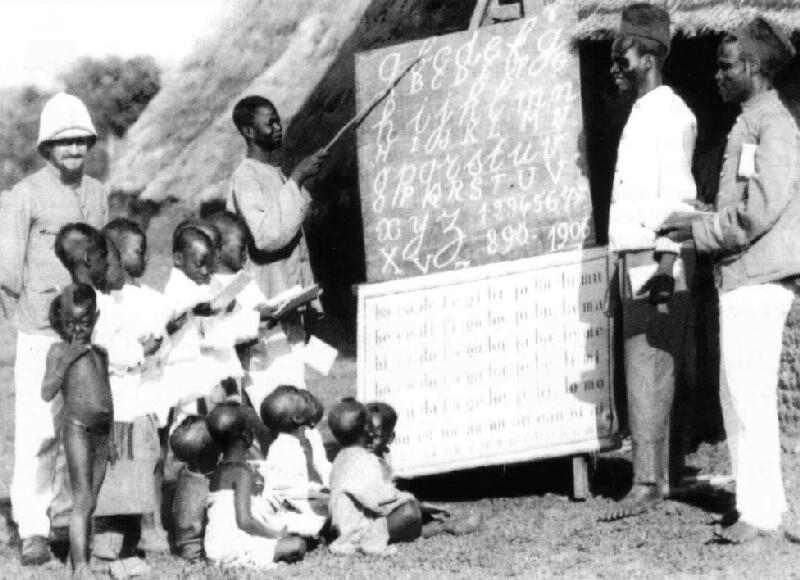
After the Napoleonic Wars and the Bourbon Restoration in the 19th century, France set about building a new empire. This time there would be no serious challenge to the British Empire. The dominance of the Royal Navy was so total that the French decided to operate within the world trading system established by the British. The new French colonial empire would be the second largest in the world. It would be, however, a pale imitation of the British Empire. The blue that colored world maps in competition with British pink, included a huge expanse of barren desert or poor African colonies. And there was no attempt to create a Fracosphere to compete with the British Anglosphere (America, Australia, Canada, New Zealand, and South Africa). The first step was seizing Algeria (1830). The French move into North Africa put a final end to Barbary Piracy. Tunisia and Morocco followed later. France was also a major player in the late-19th century Scramble for Africa. France had two colonial regions in Africa. Afrique occidentale française (French West Africa--AOF) consisted of eight colonies: Mauritania, Senegal, French Sudan (today Mali), French Guinea, Ivory Coast, Niger, High-Volta (Burkina Faso) and Dahomey ( Benin). Afrique Afrique Équatoriale française (French Equitorial Afric--AEF) included four colonies: Gabon, Middle Congo (Republic of Congo), Oubangui-Chari (Central African Republic) and Chad. The AEF had less infrastructures than AOF because of the equatorial forest, but especially because there are less raw materials. France also acquired Indo-China and Pacific island colonies. One of these was New Caledonia (1853). The French colonies played a role in World War I, but not as important as the British Dominions and ultimately America. After World War I, France acquired two League of Nations mandates in the Middle East--Lebanon and Syria. The NAZIs allowed Vichy to retain control of the French colonies, but they soon came under attack from the Free French and British. The first Anglo-American offensive of the War was launched at French North Africa--Operation Torch (November 1942). After World War II, France attempted to piece together its empire, but fought two disastrous colonial wars (Viet Nam and Algeria). The second in Algeria almost tore France apart.

Navigate the Children in Hitory Website:
[Return to the Main European country empires page]
[Return to the Main European colonialism page]
[Return to the French regional page]
[Return to the Main French history page]
[About Us]
[Introduction]
[Biographies]
[Chronology]
[Clothing]
[Disease and Health]
[Economics]
[Environmental issues]
[Feminism]
[Geography]
[History]
[Human Nature]
[Law]
[Nationalism]
[Presidents]
[Religion]
[Royalty]
[Science]
[Social Class]
[Bibliographies]
[Contributions]
[FAQs]
[Glossaries]
[Images]
[Index]
[Links]
[Registration]
[Search]
[Tools]
[Children in History Home]