>
>
|
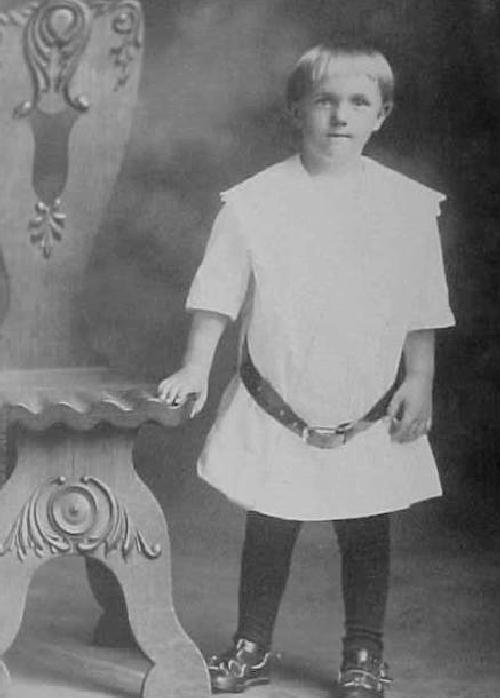
Swedish boys like boys in other European countries wore a variety of skirted garments when younger. We have, however, very little information on skirted garments in Sweden. As far as we know at this time, the styles are very similar to styles in other European countries, but this will have to be determined when we develop a larger archive of Swedish images. The images we have collected show very similar styles to those we have noted in other countries. We note Swedish boys wearing dresses and tunics. Younger boys in the 19th century commonly wore dresses. The sailor tunic suit here looks indestinguishable from those we have seen in other countries (figure 1). The tunic suit here is agood example. We have not, however, yet noted kilts. We are unsure about smocks and pinafores at this time. We do not know if there were any specific Swedish garments or styles.
Younger boys in the 19th century commonly wore dresses. This practice was fairly standard throughout Europe dating from medieval times when dresses first began appearing. We do not have mich information on Swedish dresses at this time. We do not have much information on the prevalence of this convention in Sweden. In America and Britain this conventioin began to shift to kilt suits, a process set in motion by Queen Victoria because of her love for all thing Scottish (mid-19th century). This shift, however, was less pronoubced on the Continent and we see fewer kilt outfits there. We have one family CDV portrait dating from the 1880s or 90s. The family is not identified, but we know thatvthey lived in Skurup, a market town in souther Sweden. The family had two children about 4-7 years old. We see a girl and who kooks like her younger brother. They are wearing very similar dresses with matching petticoats.
We do not know much about tunics in the early 19th century. One portrait from prrhaps the 1870s shows a Swedish boy wearing a very short striped tunic jacket with matching long pants. We have never seen a tunic suit quite like it. We are not sure how common such suits were in Sweden. We note that tunics were very common at the turn of the 20th century. The tunic suit here is agood example. The sailor tunic suit here looks indestinguishable from those we have seen in other countries (figure 1).
We have not so far noted Swedish boys wearing kilts or kilt suits. .Our Sweish archive, howeever, is fairly limited, especially for the 19th centurty.
We are unsure about smocks at this time.
We do not have any information on the 19h century at this time. We assume girls commonly wore pinafores in the lsate 9th century. We are not sure about boys. We note yonger boys in the early 20th century wearing pinafores for ply to protect their clothes, We are not sure how common this was, but the photographic record shows that they were worn. We do not know if there were any specific Swedish garments or styles. The styles we have seen look rather like the play pinafores we have noted in Germany.

Related Swedish Pages in the Boys' Historical Web Site
[Return to the Main Swedish garment page]
[Return to the Main Swedish page]
[Swedish art]
[Swedish choirs]
[Swedish hairbows]
[Swedish movie page]
[Swedish royalty]
[Swedish schoolwear ]
[Swedish youth groups]
Related Style Pages in the Boys' Historical Web Site
[Long pants suits]
[Knicker suits]
[Short pants suits]
[Socks]
[Eton suits]
[Jacket and trousers]
[Blazer]
[School sandals]
[School smocks]
[Sailor suits]
[Pinafores]
[Long stockings]
Navigate the Boys' Historical Clothing Web Page
[Return to the Main sailorsuit country page]
[Introduction]
[Activities]
[Biographies]
[Chronology]
[Clothing styles]
[Countries]
[Girls]
[Bibliographies]
[Contributions]
[FAQs]
[Glossaries]
[Images]
[Links]
[Registration]
[Tools]
[Boys' Clothing Home]