|
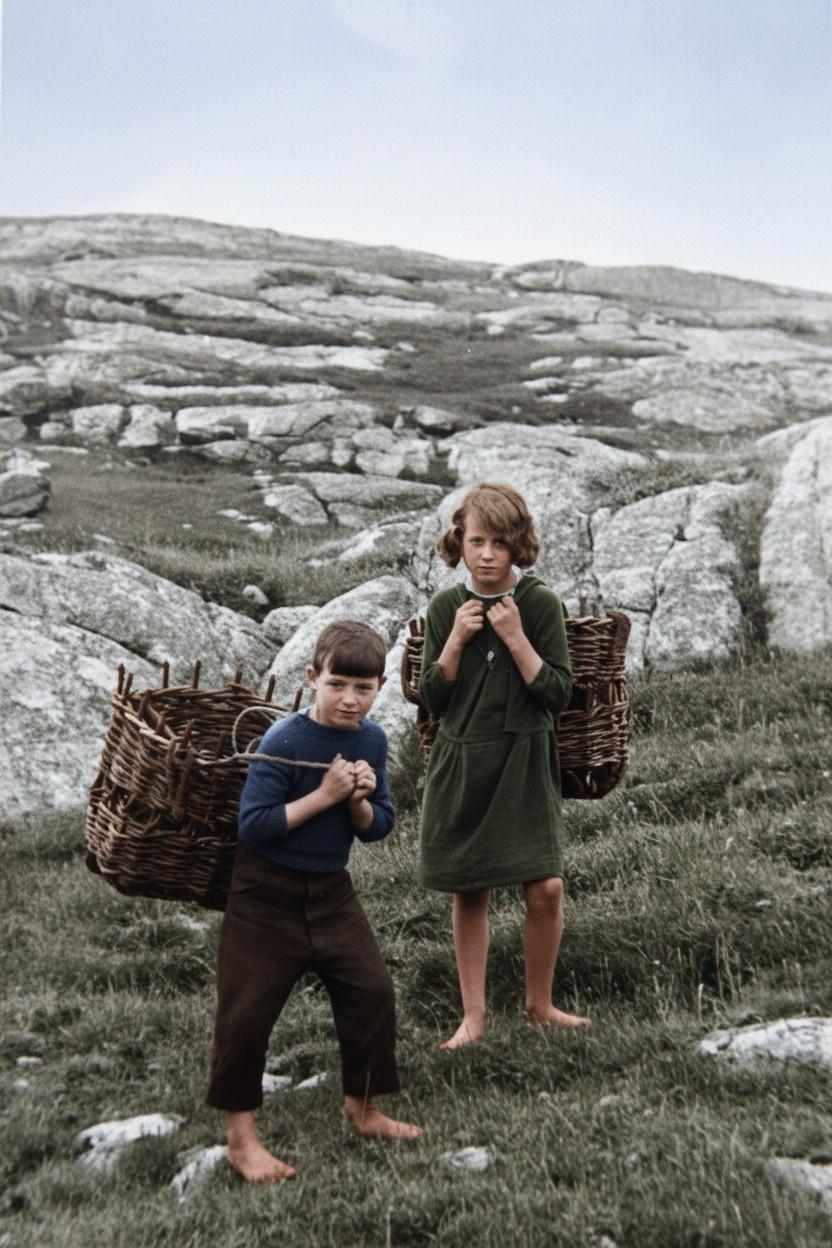
The Scottish islands are mostly located along the western Atlantic coast. The Hebrides are a vast archipelago off Scotland's west coast consisting of over 500 islands. There are both populated and unpopulated islands. They are divided into two groups, depending on their distance from the Scottish coast. They are divided into the Inner and Outer Hebrides, separated by the Minch--a 110km-long, 25–45 mile wide strait. The Inner and Outer groups both have scenic, rugged landscapes, fishing villages, white-sand shell beaches (machair), peat bogs. and Gaelic-speaking communities. They are shaped by a bracing Atlantic, maritime climate, moderated by the Gulf Stream. The Hebrides are known for The Outer Hebrides, or Western Isles, whih extend further into tyhe North Atlantic and stretch some 200 km north-to-south, characterized by a wilder, more westerly, and sparsely populated geography compared to the Inner Hebrides. The main Outer islands include Barra, Benbecula, Berneray, Harris, Lewis, North Uist, South Uist, and St Kilda. The Inner islands include Coll, Mull, Rum, Skye, and Tiree. The Isle of Skye is the most accessible as it is connected to the mainland by a bridge. There is a picturesque harbor at Portree and jagged 3,000-ft. peaks in the Cuillin mountain range. Mineral resources are limited, nut there is a valuable peat resource. The most valuable resouce is the sea providing both coastal and marine resources. The sea provide vital fishing (salmon, shell fish) and seaweed harvesting for biofuels, animal feed, and agricultural fertilizer. There is also efforts ro develop renewable energy (wind, hydrogen, and tidal technologies. The economics of these technologies are proving more challenging than once believed. There are important seabird breeding seabird colonies, seals, red deer, and otters.

Navigate the Boys' Historical Clothing Website:
[Return to the Main Hebrides page]
[Return to the Main Scottish regional: Island page]
[Return to the Main Scottish regional page]
[Return to the Main Scottish page]
[Introduction]
[Activities]
[Biographies]
[Chronology]
[Clothing styles]
[Countries]
[Bibliographies]
[Contributions]
[FAQs]
[Glossaries]
[Images]
[Links]
[Registration]
[Tools]
[Boys' Clothing Home]
Navigate the Boys' Historical Clothing kilt pages:
[Main kilt page]
[Kilt suits]
[Scottish kilts]
[Scottish boys clothing]
[Scottish school uniform]
[Highland dance]
[Pipeband]
[Irish kilts]
[Irish boys clothing]
[Irish step dancing]
[Greek kilts]