|
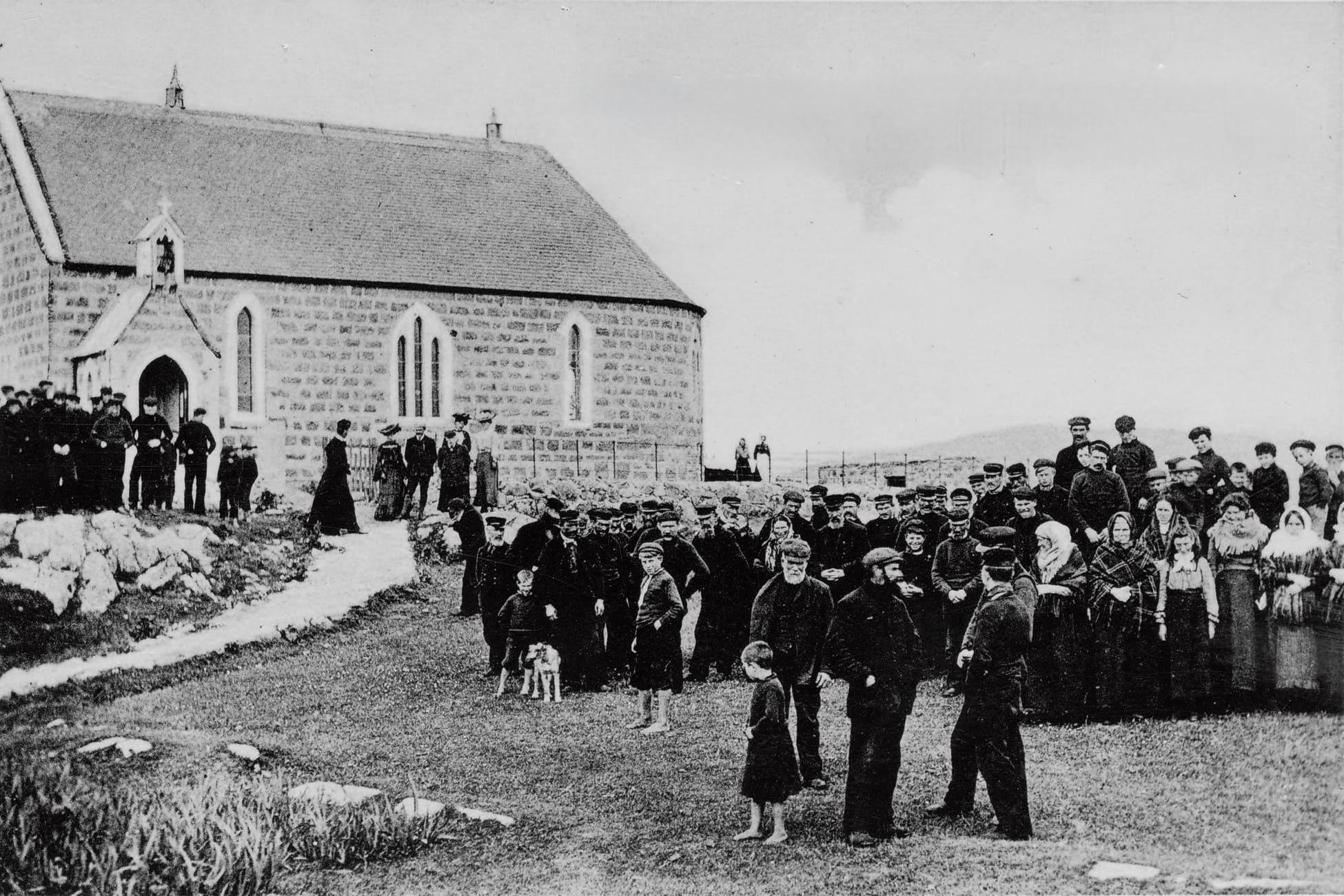
Although called the Hebrides, the Outer Heberies are in reality significantly separated from the Inner Hebrides. They extend further north than the the Inner Hebrides. The Outer Hebrides stretch some 130 miles from Lewis in the north to the island of Barra in the south. The island group form a crescent about 40 miles from the Scottish mainland, farther off shore than the Inner Hebrides. The Outer Hebrides are separated from the Inner Hebrides by the Minch and Little Minch channels in the north and by the Sea of the Hebrides in the south. Many of the smaller islands are uninhabited. Most of the population live on Lewis and Harris. The population declined considerably in the 20th century. As connections increased which the mainland, the islanders became aware of the far greater economic opportunities off the islands. St. Kilda was even abandoned. This interconnected chain of Atlantic islands has appeal for people who really want to get way from civilization. The islands offer neolithic stone structures, medieval churches and even of all things mummies. The most notable site is the neolithic Calanais Stone Circle on Lewis. The Celtic roots run deeper here than anywhere in Scotland. It can be enjoyed today in language, arts, and music. Most Scottish Gaelic speakers are today confined to the Western Isles, especially in the Outer Hebrides, one of the few areas in Scotland where Gaelic is still spoken as the everyday language. The remoteness has allowed the Gaelic speaking communities survive. The main Outer islands include Barra, Benbecula, Berneray, Harris, Lewis, North Uist, South Uist, and St Kilda--a real outlier. The other islands are located close together. St. Kilda is located far out into the North Atlantic. We see a group from Barra in the Outer Hebrides. Barra is the most southerly of the inhabited islands in the Outer Hebrides. Studio portraits like those on the previous page are indistinguishable from mainland Scotland or for that matter England. Once we begin to get outdoor photographs and amateur snapshots around the turn-of-the 20th century, we do begin to see differences. We note portraits from South Uist, Agnes MacDonald and John Angus MacDonald.

Navigate the Boys' Historical Clothing Website:
[Return to the Main Hebrides page]
[Return to the Main Scottish regional: Island page]
[Return to the Main Scottish regional page]
[Return to the Main Scottish page]
[Introduction]
[Activities]
[Biographies]
[Chronology]
[Clothing styles]
[Countries]
[Bibliographies]
[Contributions]
[FAQs]
[Glossaries]
[Images]
[Links]
[Registration]
[Tools]
[Boys' Clothing Home]
Navigate the Boys' Historical Clothing kilt pages:
[Main kilt page]
[Kilt suits]
[Scottish kilts]
[Scottish boys clothing]
[Scottish school uniform]
[Highland dance]
[Pipeband]
[Irish kilts]
[Irish boys clothing]
[Irish step dancing]
[Greek kilts]