|
This ability of children to have bikes began to change after the turn-of-the 20th century, especially in America. The major development was the steadily rising income of American workers. American workers were the highest paid workers in the world. Which is why workers in Europe flocked to America in their millions. It was the opportunity created by market capitalism that attracted them. It wasn't the idea of capitalism, it was the high-paying jobs that capitalism created that attracted them, along with political and religious freedom and the absence of a military draft. Free land also attracted them, but even as the Frontier was closing, they still came because of the jobs that were on offer. The high wages meant that more and more families could afford bikes, at first primarily for adults. By the turn of-the 20th century there were bicycle shops all over America. And then Henry Ford introduced the Model-T Ford, an automobile that the average American worker, but not European worker could afford. By the 1910s as adult interest shifted to automobiles we see the bicycle industry shifting toward children. Affluent middle-class children began acquiring bikes. And of course there were trikes for the younger children. After World War I, bikes become increasingly common, even with working-class children. We begin to see girls with bikes after the War as well. The photographic record shows large numbers of children with bikes. Demographics was a factor. The bike was a little difficult to sort out for big city children. There was no place for it in cramped apartments and the streets were dangerous. It was, however, ideal for the suburbs and small towns. The move to the suburbs which began in earnest after World War I and the Model-T and other cars increased the move to the suburbs. Then the Roaring Twenties intensified these trends. All of this meant that more and more children could have bikes and trikes. The Depression slowed this process down, but after World war II (1941-45), bikes were standard for American children. Bikes were more appropriate for suburban life than they were for the cities. European style bikes with multiple gears became popular (1960s). BMX bicycles inspired from motocross motorcycles became popular (1970s).
By the 1900s decade we begin seeing bikes with many modern features. This ability of children to have bikes began to change after the turn-of-the 20th century, especially in America. The major development was the steadily rising income of American workers. American workers were the highest paid workers in the world. Which is why workers in Europe flocked to America in their millions. It was the opportunity created by market capitalism that attracted them. It wasn't the idea of capitalism, it was the high-paying jobs that capitalism created that attracted them, along with political and religious freedom and the absence of a military draft. Free land also attracted them, but even as the Frontier was closing, they still came because of the jobs that were on offer. The high wages meant that more and more families could afford bikes, at first primarily for adults. By the turn of-the 20th century there were bicycle shops all over America. And then Henry Ford introduced the Model-T Ford, an automobile that the average American worker, but not European worker could afford (1907)
By the 1910s as adult interest shifted to automobiles we see the bicycle industry shifting toward children. Affluent middle-class children began acquiring bikes. And of course there were trikes for the younger children.
After World War in te Roaring Twenties, bikes become increasingly common, even with working-class children. We begin to see girls with bikes after the War as well. The photographic record shows large numbers of children with bikes. Demographics was a factor. The bike was a little difficult to sort out for big city children. There was no place for it in cramped apartments and the streets were dangerous. It was, however, ideal for the suburbs and small towns. The move to the suburbs which began in earnest after World War I and the Model-T and other cars increased the move to the suburbs. Then the Roaring Twenties intensified these trends. All of this meant that more and more children could have bikes and trikes.
The Depression slowed the process of children owing bikes down. A lot of families could no longer afford bikes. .
American began recovering from the Depression (late-1930s). European countries BEGANRECOVERING EARLIER> A factor was the military orders from Europe as war clouds appeared with Hitler becoming increasingly aggressive. Hitler and Stalin launched World War II by invading Poland (September 1939). American factories boomed but because the United States was still neutral. Companies were expanding production, mostly for consumer products including cars for adults and trikes.bikes for the kids. President Roosevelt committed to making America the Arsenal of Democracy (1940). Many companies, however, were no all hat interested in military contracts because civilian orders were finally coming in after the a decade-long Depression. In addition many industrialists remembered how they were attacked after World War I. Many industrialists were attacked as 'merchants of death'. This continued (1940-41). The Japanese carrier attack on Pearl Harbor changed that (December 1941). The production of consumer products requiring metals plummeted. Production of cars and most other consumer products using metals ended for the duration. The War ended (Septeber1945). Even before this the United States military began to scale back orders seeing that the war was ending. American industry began converting to civilian products (1956). But this could not be accomplished over night. Not only did companies convert, but American consumers were flush with cash. Factory workers were well paid, but a lot of what they wanted as not being manufactured in the War years. This changed very quickly after the War. There was also an expanding shift to the suburbs. And suburban families unlike city families had plenty of space for trikes and bikers. Bikes became standard for American children, both boys and girls.
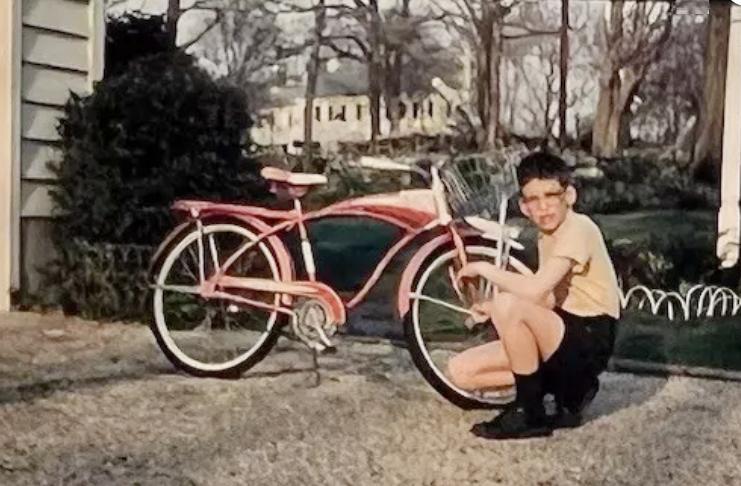
Here we see an unidentified boy with his bike in the driveway of the family home in a leafy suburb, probably in the late-1950s (figure 1). The bike is a popular bike style from the 1950s, perhaps a Schwin. Notice the basket. Color print film was rare and expensive in the 1950s. This was a Kodachrome slide.
European style bikes with multiple gears became popular (1960s).
BMX bicycles inspired from motocross motorcycles became popular (1970s).

Navigate the Boys' Historical Clothing Web Site:
[Return to the Main American bike chronology page]
[Return to the Main American bike page]
[Return to the Main American convences page]
[Return to the Main bike country page]
[Return to the Main U.S. play page]
[Return to the Main U.S. activities page]
[Introduction]
[Activities]
[Biographies]
[Chronology]
[Clothing styles]
[Countries]
[Essays]
[Bibliographies]
[Contributions]
[FAQs]
[Glossaries]
[Images]
[Links]
[Registration]
[Tools]
[ Boys' Clothing Home]