|
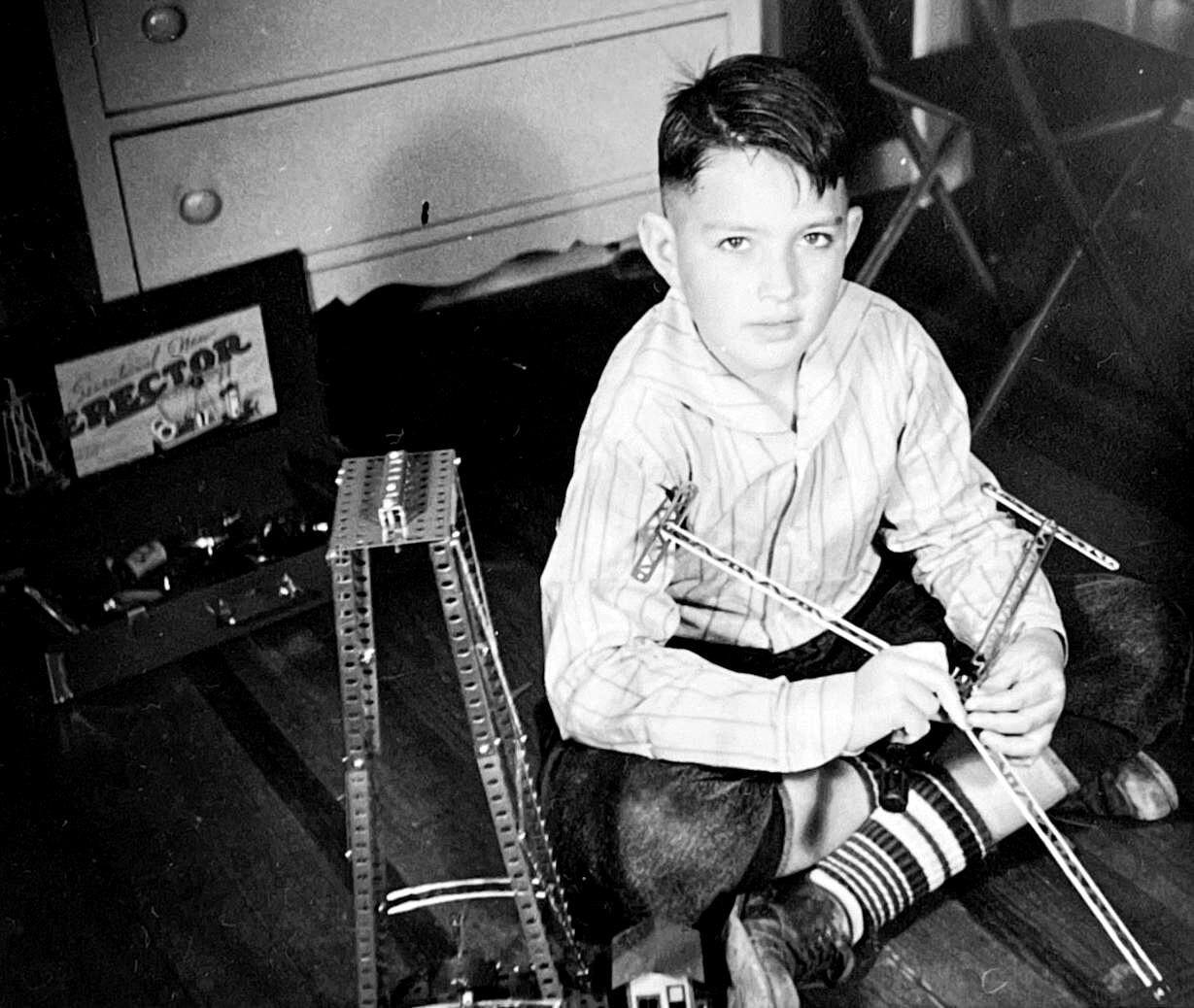
Construction sets beginning with basic wooden blocks were popular. Blocks were used as baby, toddler toys, often with letter or number faces. This made them helpful learning as well as play devices. We are not sure when they first appeared, but we have noticed them in 19th century toy stores. I recall my blocks had ridges that fitted together. Funny, along with my teddy this is among my earliest memories. This presumably was a 20th century innovation. Older children had more advanced construction toys. They have included metal Erector sets, wooden Lincoln Logs, and more recently plastic Lego sets. Erector sets were very popular with boys. Erector Sets were a brand of metal toy construction sets, we think the first metal sets in America. They were by Alfred Carlton Gilbert and first sold by his company--the Mysto Manufacturing Company of New Haven, Connecticut (1913). Erector sets were an immediate hit. The company quickly reorganized as the A. C. Gilbert Company (1916). The company emphasized its appeal to boys and element in future adult life. One 1922 ad read, "Boys Today -- Men Tomorrow! Thousands o young men from 20 to 30 years old, who are today making great strides in n engineering, chemistry [Gilbert also did chemistry sets] and other sciences were Gilbert Toy boys just a few years ago. I have watched their progress with interest and I will tell you that I am mighty proud that my engineering toys have started these boys on the road to success. When I was a boy I loved to play with scientific things myself, but no one made the toys I wanted, so I said that some day for a new generation of boys, toys that I wanted when I was a kid myself." 【Gilbert】 Erector like Lionel trains were an American standards for years. Here we see a boy working with his erector set in 1930s (figure 1). All of the images we have found show boys working with Erector sets. We have no way of measuring, but from a boy growing up in the 1940s-50s, I never knew of a girl who had the slightest interest in Erector Sets. Interestingly, Meccano in Britain bought the Erector brand and consolidated its worldwide marketing with its own brand (1990). Lego seems to have supplanted all the former types of construction toys, excepts for the blocks that very young children play with. Erector was not bothered that it was almost exclusively boys that were interested in their sets. Erector made no effort to attract girls. We suspect that Erector was at he peak of boy exclusivity, even greater than toy guns. In our modern age, this did bother Lego and they made some sets designed to appeal to the, with some limited success, but it is still primarily boys that like Erector sets are interested in Legos. Thisinherent preferences have real life consequences. Jobs in building, ngeineering, and chemistry offer much higher wages than many jobs attracting women like nursing and teaching. Which of course is part of the reason for the male/female wage gap. These construction toys seem mostly national toys--at least in the major industrial countries. They seem more popular in America than any other country. They may reflect the proclivities of Americana, but the higher wages in America meaning more parents could afford expensive toys must also have been a factor. We suspect that a lot of German boys would have loved to have had an Erector set if their parents could afford it. The same toys in Europe had national names, meaning the private companies that manufactured them. Erector sets were called Meccano sets in Britain. There were similar toys in France and Germany. Lego seems the first real intentional construction toy. This seems to be the result of corporate structures withe advent of international companies.
Gilbert, A.C.Erector ad"Popular Science Magazine (November 1922).

Navigate the Boys' Historical Clothing Web Site:
[Return to theMain specific U.S. construction toy page]
[Return to theMain construction toy page]
[Return to theMain speciic U.S. toy page]
[Return to theMain U.S. toy page]
[Return to theMain U.S. activities page]
[Return to theMain country toy page]
[Introduction]
[Activities]
[Biographies]
[Chronology]
[Clothing styles]
[Countries]
[Bibliographies]
[Contributions]
[FAQs]
[Glossary]
[Images]
[Links]
[Registration]
[Tools]
[Boys' Clothing Home]