|
There are a range of elements to a suit jacket. The most obvious suit element is the lapels. Not all suits have lapels, such as the collar buttoning jacket which was very important in the 19th century, cut-away jackets, junior Eton suits. But the major element in modern suits is the lapels and the governing the two major types of suits: single and double breasted suits. Not all jackets that have these elements and they could vary widely among the various jacket types. The major elements of a suit jacket are the back, buttoning, collar, lapels, pockets, quarters, shoulder treatment, skirt (lower half of the jacket), sleeves, and waist suppression. Many of these features are more important on adult suit jackets than on boys' suits. The style or type of a suit was primarily determined by the jacket style. Categorizing suits is a little complicated, but we see several five basic styles that have been worn by American boys. The skeleton suit was popular in the early 19th century. We notice a variety of fancy styles in the 19th century for younger boys. The principal jacket style by mid-century was the cut-away jacket. We also see collar-buttoning jackets. Many of these suits were detailed with military styling. Of course the best known suit style in the late-19th century was the Fauntleroy suit. Older boys' sack suit jackets could be quite plain. One popular style for many years was the Norfolk jacket with pleats and suits. Eton suits appeared in the late 19th century. A juvenile Eton suit became a popular style for younger boys in the 1920s and continues to be worn today.
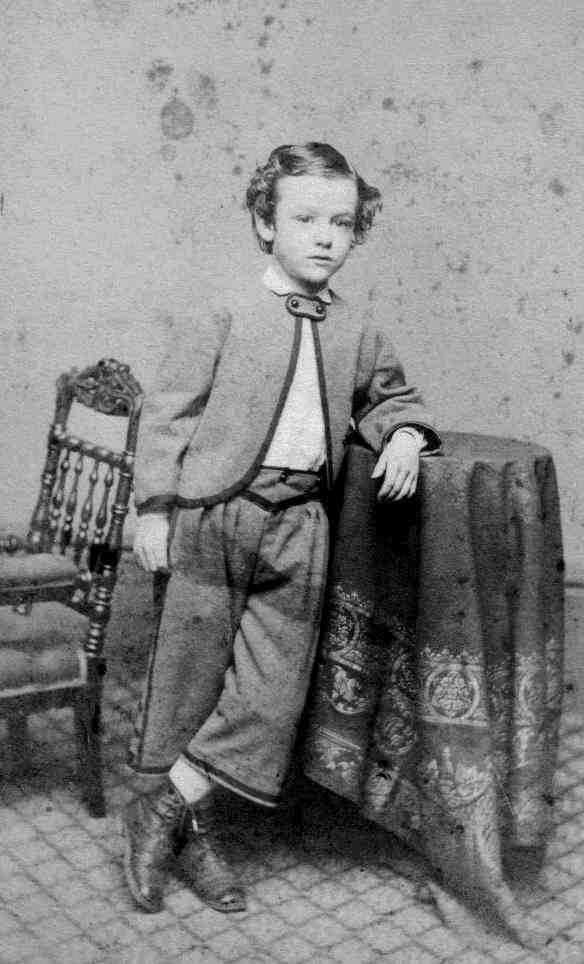
There are a range of elements to a suit jacket. The most obvious suit element is the lapels. Not all suits have lapels, such as the collar buttoning jacket which was very important in the 19th century, cut-away jackets, junior Eton suits. The boy wearing a cut-away jacket here is a good example (figure 1). But the major element in modern suits is the lapels and the governing the two major types of suits: single and double breasted suits. Double-breasted jackets were very common in yhe late-19th century and early-20th century, but after World War I (1914-18), single-breasted jackets dominasted, especially for boys. One fashion expert mentions 37 elements of a suit. The most imprtant elements of a suit jacket are the back, buttoning, collar, lapels (notch, peak, or shawl), length, lining, pockets, quarters, shoulder treatment, skirt (lower half of the jacket), sleeves and sleeve cuffs, and waist suppression. Many of these features are more important on adult suit jackets than on boys' suits. Not all jackets that have the basic elements and they could vary widely among the various jacket types. Some jacket types are similar for boys and adults. Some are identucal. Others are very different. We rely heavily on the phitographic record which provide more information on some of these elements than others. Information on the back and linings is limited.
We see several five basic suit styles or types that have been worn by American boys. The skeleton suit was popular in the early 19th century. The two basic tyoes are single- and double-breased suits, but there are manyb others, some of them imprtant. Cut-away jacjkets and collar-buttoning hackets were major suit tyoes in the 19th century. We notice a variety of fancy styles in the 19th century for younger boys. The principal jacket style by mid-century was the cut-away jacket. We also see collar-buttoning jackets. Age could be a major factor in these suits. Younger boys could wear very different suits than adukts. Older boys could wear suits that lookes like their father's suits. This becane increasingly common in the second half of the 20th century. Many of these suits were detailed with military styling. Of course the best known suit style in the late-19th century was the Fauntleroy suit. Older boys' sack suit jackets could be quite plain. One popular style for many years was the Norfolk jacket with pleats and suits. Eton suits appeared in the late 19th century. A juvenile Eton suit became a popular style for younger boys in the 1920s and continues to be worn today.
Some boys suits in the 19th did not have jackets, but were done with tops or blouses done in suiting material.
We are not entirely about the chronology of these button-on suits. We see them in the 1860s, but are unsure about the 50s and 70s at this time. We have found a number of CDV portraits. Most are undated, but look like the 1860s. They look rather like one-piece suits, but I believe they were two pieces that buttoned to gether. They were suits in the sence that the top matched the bottom, but there was no jacket. Rather the top was a shirt liked top to which the pants buttoned. The suits were often decorated with piping, embroidery, and buttons. We are not sure about the colors. We notice these suits done in a number of styles. Both the tops and pants varied. We notice both long pants and bloomer knickers.
We see collar-buttoning jackets in the mid-19th century through the very early 20th century. This was a very popular style for boys to wear after breeching, They seem to have been done in sizes for school-age children. Some boys might wear intermediate styles like sailor suits and Fauntletoy suits first. They were done in many different styles. Some of these had military syling, especially during the mid-19th century. Elements of Norfolk styling appered in the 1870s, including vertical vents and belts. Some were done as Fauntleroy suits in the late 19th century. A good example of these collar buttoning suits is an unidentified American boy about 1870. While the jackets buttoned at the collar and had collars in the suit material, this did not prevent mothers in the 1880s adding blouse collars and floppy bows. This added more variety to the jackets than the actual styles of the jackets themselves, I am not yet sure about the social-class conventions, but this seems a style that was worn by boys from more modest income families. We note them being worn with both knee pants and long trousers. When they forst appeared in the mid-19th century, knee pabys were not yet very common. We dob't see them commonly being done with knickers.
We notice a variety of fancy styles in the 19th century for younger boys. The principal jacket style by mid-century was the cut-away jacket. Suits with cut-away jackets appeared in the mid-19th century in a range of different styles. Many of these were very plain and other suits were detailed with military styling. Piping, stripes, and embroidery were commonly employed in the detailing. Of course the best known suit style in the late-19th century was the Fauntleroy suit, one without military styling. The cut of the jacket varies as to how sharply the two sides separated. There were also differences in length. Fauntleroy cut-away jackets were especially small to show off fancy blouses to the best advantage. Cut away jackets were connected at the top in various ways. Some buttones near the collar. Others had tab connectors. The cut-away jacket suit was worn with and without vests and with a variety of blouses, both plain and fncy blouses. Ther boy here wers a classic example of a cut-away jacket (figure 1).
We are not entirely sure what to call these jackets. The most destinguiding feture were the half sleeves so we will use that as a description until we find what the contemporary term was. They were worn wih blouses that had long balooning sleeves which can be seen with the wide jacket half-sleeves. Our ininital assessment is that they were not nearly as poopular as other cintemporary styles such as the collar-buttoning military jackets. This was a European style that was worn in America, we thinbk modtly in fashionable northeastern cities. We note them during the mid-19th century. We believe they were worn in the 1840s, but this is difficult to confirm because Daguerreotypes are complicated to date. We have trouble descrimibaring those taken in the 1840s from the 1850s dags. We know these jackets were worn in thr 50s because we have Ambros depicting them. We rarely see them by the 1860s. We are not sure just what to call these jackets. Surely there was aerm, but we have not yet found it. We do not yet have enough examples archived to know just how the jackjets were styled. This was a juvenile style worn by pre-teen boys. We notice girls wearing a similar style with dresses.
The standard men's suit during the Victorian era was the somber frock coat suit. This was not a boys' style, although we see a few boys wearing them. We do, however, see teeenagers wearing them, especially older teenagers. A good example is Clarence E. Summer, we believe in the 1840s.
We notice boys in the early 19th century wearing short jackets. We are not entirely sure about the color, but they were black or dock colors. They were worn with contrasting light-colored long trousers. The suits were simlar to Eton suits, but I am not sure if this was the origin or what they were called at the time. A good example is a boy attending President Jackson's inaguration (1829)
The skeleton suit was popular in the early 19th century. We note American boys wearing skeleton suits. America at the tiome of course was a fashion backwater. Affluent families in America primarily just followed popular styles in Europe, primarily England and France. The population of America was very small at the time. The population in cities, where boys from fashionable families were most likely to wear skeleton suits, was especially small. A good example is Charles Mosley in 1791. His bright red velvet skeleton suit looks just like the ones by European boys from affluent families.
The term tuxedo is variously used. It essentially always refers to some kind of formal dinner jacket. It appeared first in Britain (1860s). And because American men's styles at the time were largely set in Britain, the tuxedo soon appeared across the Atlantic in the United States. Perhaps because of the growing prosperity of industrializing America, we tend to see more Americans wearing tuxedos than people in many other countries. The tuxedo was an adult men's style, but by the 1890s we begin to see American boys wearing tuxedos as well. This of course was quite a whiole after the tuxedo first appeared in America. Here the styles varied and boys tuxedos were more variable than men's tuxedos. Tuxedos for boys were an upper-class styles. Middle-class boys as well as working-class boys did not wear them. And they illustrate an interesting phenomenon among the upper class. We often see upper-class boys in the late-19th and early-20th century wearing very fancy, juvenile styles like the Fauntleroy suit ot hair styles like ringlet curls. But we also see upper-class boys shifting to adult styles earlier than middle-class boys. This of course varied from family to family.
We also see boys' suits done in many different styles. Many of the various styles are historical styles. There was a greater varierty of suit styles in the 19th century than the 20th century. In eralier periods boys might wear a variety of styles. The different styles might be done in the various types of suits. We see Norfolk suits, for example, done as both collar buttoning as well as lapel sack suits. Styles fluctuated over time more rapidly than types of suits. The different types of suits were commonly available in many styles. There were many more styles mentioned in period catalogs, but many were terms used by individual merchants rather than style naes popularly used by the general public. The period catalogs often stressed the fabric nore than any mention of styling. Younger boys might wear Fauntletoy and sailor suits. Older boys might wear Eton, Norfolk, and lapel sack suits. Over time suits have evolved into baically one styyle -- a basic single-breasted lapel style sack suit, although double-breasted suits have never totally disappeared. At the same time, however, fewer and fewe boys tend to wear suits in our iccreasiungly casual world.
Navigate the Boys' Historical Clothing Web Site:
Fancy Half-sleeved Jackets
Frock Coat Suit
Short Jackets
Skeleton Suits
Tuxedos
Styles
HBC

[Return to the Main U.S. suit component page]
[Return to the Main U.S. country garment page]
[Introduction]
[Activities]
[Biographies]
[Chronology]
[Clothing styles]
[Countries]
[Bibliographies]
[Contributions]
[FAQs]
[Glossary]
[Images]
[Links]
[Registration]
[Tools]
[Boys' Clothing Home]
Created: 12:06 AM 1/31/2006
Last updated: 11:23 AM 8/8/2026