|
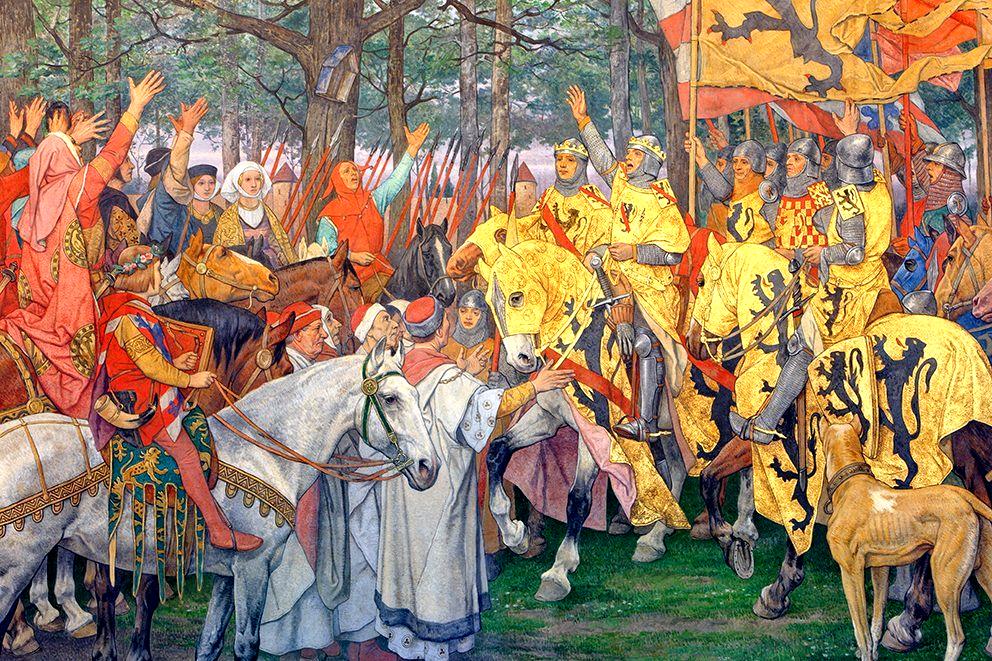
At Courtrai in Flanders, heavily armored Frenmch knights were shockingly defeated by Flemish shopkeepers with only improvised weapons. The Battle is also known s the Battle of the Golden Spurs. It was one of the last battles of the High Medieval Era. Armored knights were still seen as the peak of military power. No force was seeen as capable of standing up to a massed charge of these knights and their huge war horses. It was thought to have been impossible that such a military engagement could be won by pooly armed nd trained peasants or town workers. Major counties were beginning to form out of the fractured principlities of meieval Europe. One of those many principalities was Flanders which was one of the riches pincipality in Europe because of the textile industry that had developed there, centered on towns like Antwerp, Bruges, Ghent, Leuven, and Mechelen, Ypres, and others. These towns with their wealth had managed to gain some rights within the Feudal system. The King Philip IV of France wanred to add the rich towns of Flanders directly to his kindom. They were also important to England because of the Wool Trade. Philip ousted the Count of Flanders who had achieved a degreev of autonomy. Philip annexed Flanders to his kingdom attempting to abrogate the rights the town had been granted. The result was the Franco-Flemish War (1297–1305). Philip occupied Flandes with only limited resistance. This changed with the Matins of Bruges (May 1302). The peopole of Bruges rise up and masacered the French garison as well as french spoeaking people in the town. Philip might tolerate a degree of resistance, but such flagarant action mean that he Flemih hafd to be supressed. As a result he put together a powerful force based on mounted and heavily armored knights supported by bowmen and infantry. Some of the most imprtant French nobels joined the campoaign. The result was Battle of Courtrai, better known as the Battle of the Golden Spurs (July 1302). The towns people of Bruges and other Flemish towns organized a militia force consdisring of membrs of craft guilds with little military training. The had to face the well organized and armed force commanded by Robert of Artois, a seasoned and well respected commander.
Unexpectedly, the poorly armed militia prevailed over the Frenvch mounted force. The decidig factor was that the Flemish moilitia shose to make its stand on broken, masrshy ground surrounded by streams and moats. This meant that the French cavalry charge when it came did noit have the force ancticipated. Robert could have used his archers and infantry, but he wanted the glory of victory for him and his armored knights. This began the 'infantry revolution' (14th century). This involved Bannockburn (1314), Crécy (1346) and Poitiers (1356). The Flemish victory ispart of the reason that the Low Countries were not absorbed by France and are indepedent countries today. .

Navigate the Boys' Historical Clothing Web Site:
[Return to Main decisive medieval battles page]
[Return to Main Serbian royalty page]
[Return to Main Serbian history page]
[Return to Main Albanian hisyory page]
[Introduction]
[Activities]
[Biographies]
[Chronology]
[Clothing styles]
[Countries]
[Bibliographies]
[Contributions]
[FAQs]
[Glossaries]
[Images]
[Links]
[Registration]
[Tools]
[Boys' Clothing Home]