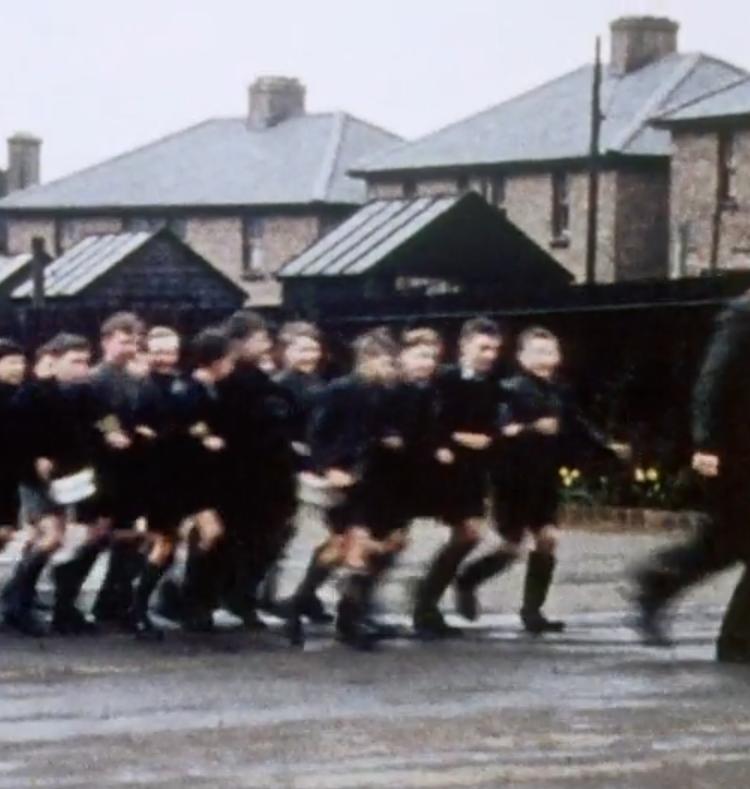
The Luftwaffe's original tactics in the Battle of Britain seem well conceived and obtainable, target RAF airfields in southeastern England and establish air superiority over the planned invasion beaches to support an amphibious invasion. We are not sure if the invasion was possible, but the Luftwaffe had the capability of achieving air superiority over that corner of England. But Hitler was impatient after Göring was unable to destroy the RAF in a few days as promised. Hitler's decision to shift the battle to London and other cities in effect took the battle north beyond the capability of the Luftwaffe. Hitler's focus and mindset was on terror and destruction. He had no real concept of waging a strategic bombing campaign. Here the Allies with a much greater bombing force were subsequently unable to seriously disrupt German industrial production until the final year of the War. Here even the British and Americans which had two decades to work out aerial strategy were unprepared for strategic bombing until well into the War. The Luftwaffe as a service when the War broke out was less than 4 years old. At the time of the Battle of Britain, not only did the Luftwaffe not have a strategic bombing force, no one, neither the Germans or Allies, knew how to conduct an effective strategic bombing campaign. 【Rumpf, p. 41.】 Wars are not won by knocking down houses, The Luftwaffe knocked down a lot of houses, but very few important military targets. And it was done at great cost to important military assets needed for the coming invasion of the Soviet Union. The British people organized. They built bomb shelters in their homes and back gardens (yards) to withstand the bombing. Many of the children were evacuated from the cities. The children that remained were drilled and re-drilled about how to respond when the bombers came. Hitler threw the vaunted Luftwaffe at the British people and they were not cowed. In large measure because of German tactical errors. The Luftwaffe was a tactical force, not suited for strategic bombing. And the Luftwaffe bombing force was not large enough for the tasks assigned, especially when that task was to destroy London. The Luftwaffe was not only a tactical force, it was a force designed for short wars, like the ones in Poland, Norway, and France. In the Battle of Britain, there was no strategic reserve of aircraft in a campaign in which the British were already outproducing the Germans in aircraft. (Unlike the British, Hitler had not yet fully mobilized for war.) There were also no spare pilots in a campaign where they were losing more pilots. (Nor only in air combat, but the fact that pilots who bailed out would be lost to the enemy.) And unlike Fighter Command's Hugh Dowding, Luftwaffe commander Herman Göring not only did not understand modern air war, he lied about the losses. Losses which could not be indefinitely sustained. Modern historians often insist that strategic bombing could never succeed. E take ISSUE with that. But to succeed you need a huge bombing fleet and careful target analysis. Not only was the Luftwaffe bomber strength insufficient, but the Luftwaffe commanders never decided on a dingle sustained objective a pursued in relentlessly. The Luftwaffe attacked shipping, ports, radar towers, airfields, aircraft factories, oil terminals, dikes, and ultimately London--the largest city in the world, but one that was spread out over a huge area. London had a much less dense population than Berlin and other German cities. There were many single family homes and fewer large apartment complexes. This means a larger bombing force was needed. The Luftwaffe did not have that force. They could wreak massive damage, but only at the cost of substantial damage to he attacking force. And none of these multitude of targets were decisively destroyed before moving on to the next target. We see no evidence of the careful taff woek that preceeded the snsequent Ameican strategic bombing campign. 【Hansell】 And Luftwaffe intelligence estimates prepared by Gen. Joseph 'Beppo' Schmid, a close personal friend of Göring, were disastrously wrong. Schmid and Göring never recognized the importance of Dowding's Chain Home System or had an accurate picture of Fighter Command;s force and losses. Instead of analysis Schmid seem to have fed Göring and Hitler what they wanted to hear. The Chain Home System proved to be a battle-winning force multiplier. The Chain Home System positioned he RAF's smaller force in position and at altitudes giving them a tactical advantage. The German pilots crossed the Channel hoping to surprise the RAF. This tactic worked in Poland, Norway, the Netherlands, Belgium, and France. It did not work over Britain. The Germans in essence believed what they wanted to see. The German pilots understood that the intercepting RAF plots were being guided. But Luftwaffe commandeers never acted on their pilots' reports. Put basically, you can not win a war if you expend your force destroying houses. All of this was a huge tactical error that would affect the outcome of the War. The Luftwaffe would never fully recover. especially when a damaged Luftwaffe was hurled at the Soviet Union a year later.
Hansell, Haywoos S. Jr. The Air plan that Defeated Hitker (Higgins-McArthue/Loggino& Porter: Atlanya, Georgia, 1072), 317p.
Rumpf, Hans. Trans. Edward Fitzgerald. The Bombing of Germany (New York: Holt, Rinehart and Winston, 1962), 256p.

Navigate the CIH World War II Section:
[Return to Main Battle of Britain page]
[Return to Main World War II page]
[Biographies]
[Campaigns]
[Children]
[Countries]
[Deciding factors]
[Diplomacy]
[Geo-political crisis]
[Economics]
[Home front]
[Intelligence]
[Resistance]
[Race]
[Refugees]
[Technology]
[Bibliographies]
[Contributions]
[FAQs]
[Images]
[Links]
[Registration]
[Tools]
[Return to the Main World War II page]