|
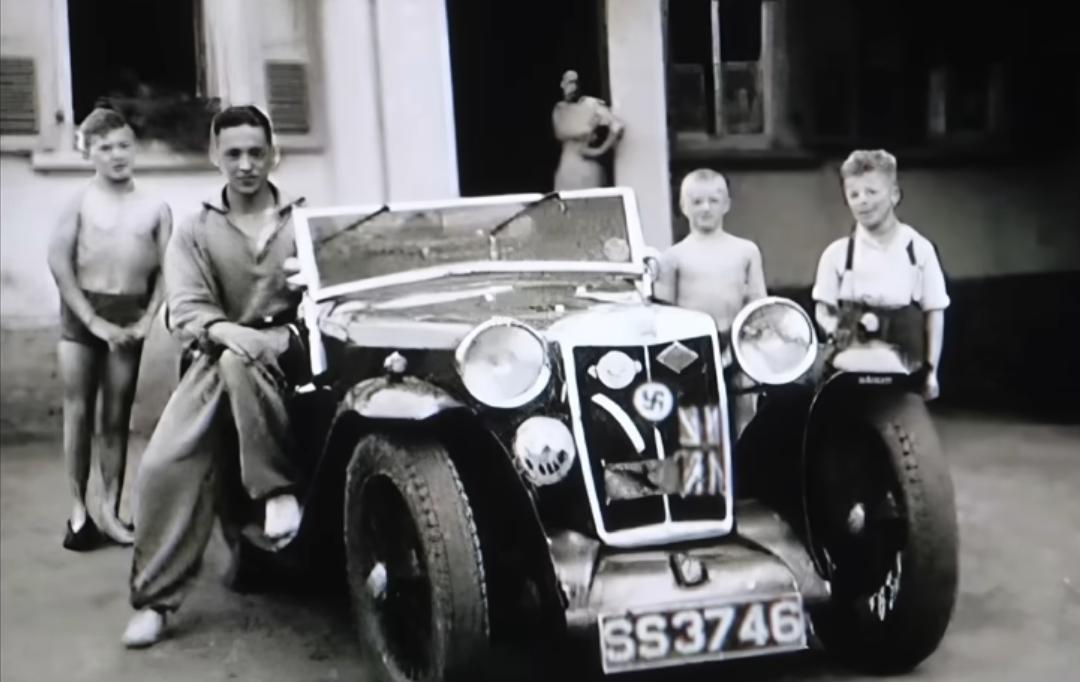
Eric 'Winkle' Brown was one of the most accomplished pilots of World War II. Eeic was born in Hackney (East End of London). He was put up for adoption. For some reason at the time there were few places for adoption in London, but more in Scotland. He was adopted by Euphemia and Robert Brown in Edinburgh. It was his first step toward air adventures. His adopted father was a former balloon observer and pilot in the Royal Flying Corps (RFC). Grrowing upnin the East End heprobably would have had a working-class life experience. But instead he grew up in middle-class circumstances in Scotland. His father had a love of vaviation and Eric seems to have caught the bug. His father took Eric to see the Olympics in Berlin (1936). This was a year after Hermann Göring had announced the existence of the Luftwaffe. Because of his father's World War I service, they were invited to join Luftwaffe social gatherings. They met the flamboyant Ernst Udet, a World War I fighter ace. Udet was a brilliant pilot, but toally unsuited for a high level appointment in the Luftwaffe. At any rate, Udet offered to take Eric up for a flight. Udet gace Eric the flight of his life. He wasn't sure he was going to get back on the ground alive. The RAF had university programs in which Eric particvipated. The Foreign Office was also recruiting in the university. Eric was studying modern languages with a focus on German. They wanted him to spend some time in a German school teaching English to brush up on his German (1938). While in Germany he would spend time in the flying clubs where Hitler Youth boys were learningh to fly. He was there when war broke out. The SS detained him, but after a few days exchanged him for German students studying in Britain. When he got back to Britain he began a RAF career, but somehow got recruited by the Royal Navy air service and began his phemomenal career with the Royal Navy. He eventually became a test pilot. He would fly 487 different types of aircraft, apparently more than anyone else in history. He became a pioneer of jet technology into the postwar era.

Navigate the CIH World War II Pages:
[Return to Main World War II A-L biography page]
[Return to Main World War II biography page]
[Return to Main World War II essay page]
[Return to Biographies A-B]
[Biographies]
[Campaigns]
[Children]
[Countries]
[Deciding factors]
[Diplomacy]
[Geo-political crisis]
[Economics]
[Home front]
[Intelligence]
[Resistance]
[Race]
[Refugees]
[Technology]
[Bibliographies]
[Contributions]
[FAQs]
[Images]
[Links]
[Registration]
[Tools]
[Return to the Main World War II page]