***
war and social upheaval: World War II -- electronic intelligence
World War II: Electronic Intelligence
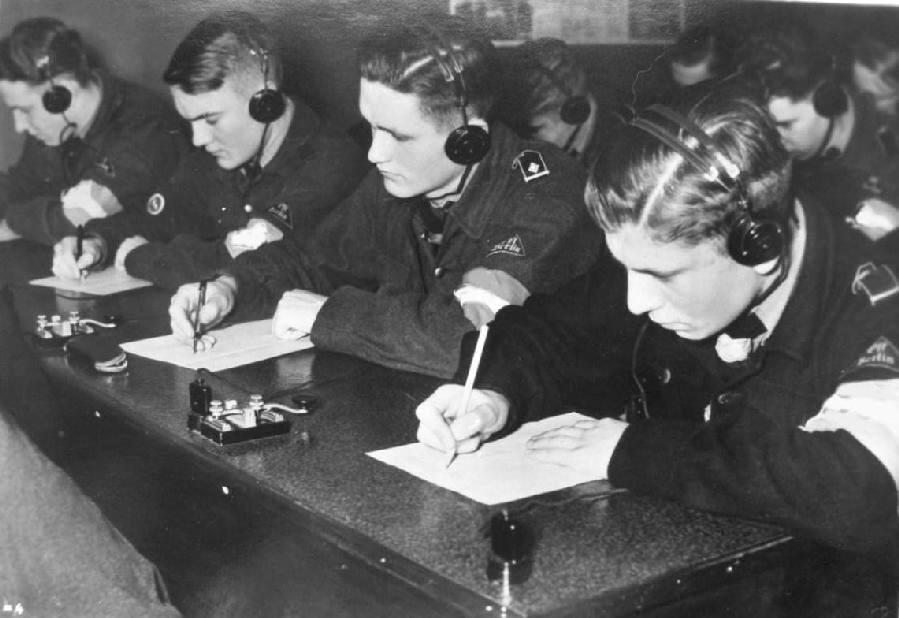
Figure 1.--These Hitler Youth boys are learning Morse Code. The Germans learned after World War I that the British had cracked their codes. As a result, the Reichwehr (predecessor of the Wehrmacvht) adopted a cyphear machine to speedily send and receive coded messages. The Germans believed that the Enigma messages were unbreakale. Enigma operators did not need to know Morse, but they were given strict security instructions that if they had been carefully followed would have mase it much more difficult for the British code breakers.
Intelligence was a matter of substantial importance in World War II. It was of greater importance than in virtually any other major war in history. The primary reason for this was that huge advances were made in radio (wireless) communications. This occurred primarily because of commercial development of radio during the inter-War era. The vast expanse of World War II battelfields as well as the nature of modern mobile warfare required that radio be used. Bltzkrieg required radio communications that could be easily and quickly understood. During World War I, commanders lost control of lead units once they set an offensive in motion. This was no longer the case in World War II. Thus huge amounts of electronic communications were broadcast. Even surrounded units could maintain communications with headquarters. And nothing could be any more insecure than broadcast messages. It meant that vast amounts of vital military communications was up for grabs. It was readily available to any country which was willing to string up radio antenna and invest in training staff to receive and analize the messages. Many mesages were sent in the clear. The most important were encoded. World War II was the first war in which electronic (radio/wireless) messages were a major factor. The telegram became important in the 19th century, but telegram messages sent over wire lines or undersea cables were much more difficult to intercept. They were not impossible (as the British showed with the Zimmerman telegram), but they were difficult to intercept. The major concern in World War II was radio messages, but there was also telegraphic messages sent by cable that were used, mostly by diplomats. And mobile warfare as initiated first by the Germans and subsequently the Allies required vast numbers of easily intercepted (but less easilly decoded) messages. These messages needed to be encoded through a system that could be quickly decoded by the country involved, but would defy code breaking by the enemy. A complicated decodeong system was impossible given the number of messages. Naval warfare also required large numbers of radio messages. Both the Germans and Japanese learned after World War I that their codes had been cracked by the Allies. And the Soviets learned that their codes after the War had also been cracked. As a result, these countries adopted much more elborate code systems. The Germans and Japanese developed cypher machines. The Soviets developed a single pad system. The Germans and Japanese proved particularly vulnerable because they had such confidence in their vaunted cypher machines. And they sent a huge volume of messages which significantly increased the vulnerability of the machines. The Germans also attemptd to read Allied signals. And they had some successes, mostly with British communications. They generally failed at breaking Allied codes. Neither did the Japanese manage to break Allied codes. Very little is known about Soviet code breaking efforts.
World War I armies had a half century to adjust to the telegram. The wireless was a different bmatter. It had enormous military potential far beyound the telegtam. But it was very new and still being developed. It was also very indecure. World War I armies and navies operated largely independently in World War I. This is one reason that navies formed infantry forces (marines). The codes used by combatant armies and navies were different. And there was a need to develop new codes with the deployment of the new wireless. Telegraph codes were relatively secure. Wireless communications were insecure because they could be easily picked up by the enemy. It took some time for the military forces to adjust to this new reality. Codes and encription became necessary for critical messages. The navies were quicker to adjust than the armies. The navies had an easier task in this regard than the armies. Each country varied in how they adjusted to the new realities and the codes which they developed. Developing the codes, however, was only part of the problem. Getting the commanders to use them proved to be a daunting challenge. Major military campaigns were affected by the interception of signals. One incident in fact help being America into the war. The interception of secure information in World war I was no much the result of code breaking as the failure of signals discipline.
Radio
Intelligence was a matter of substantial importance in World War II. It was of greater importance than in virtually any other major war in history. The primary reason for this was that huge advances were made in radio (wireless) communications. This occurred primarily because of commercial development of radio during the inter-War era. Immediately after World War I, radio burst on the commercial scene. It was a huge success. Suddenly people could hve all kinds of entertaiment in their homes, at no cost after the radio was puchased. It soon became common for the family to clusrter around the radio after dinner. Everyone wanted them. Boys built crystal sets because early radios werte expensive. Mass production in America soon brought costs down and by the 1930s, virtually every American family had a radio. A vast new industry came into being. The situation was different in Europe. As in America, virtually everyone wanted one, but only a fraction of the population could afford one. The British had the highest living standards, but even in Britain not all workers had rdios. And the situation was even wose in Germany. As a result, mass production did mot take place. Not only could many Germans not affor radios, but also radios were more expensive than in America. This affected the size of the radion indusyries in the vrious countries. When Hitler camne to power he wanted to improve the livig stndards of German orkers. He could not do thios by significantly increasing wages because that would increase the cost of rearmament which was stressing the German economy. But he attempted to bring down the cost of items. This is how the Volkswagen came into existence. There wre other Volks products. The most suvccessful was the Volks radios. This was a special priority for the NAZIs because they wanted the average German family to hart Hitler's speches and other NAZI propaganda. This all affected the rAdio industries that developed in the World War II combatant countries and that the respective governments could utilize in the war effort.
Telegraphy
The telegram became important in the 19th century, but telegram messages sent over wire lines or undersea cables were much more difficult to intercept. They were not impossible (as the British showed with the Zimmerman telegram), but they were difficult to intercept. Diplomatic messages could be intercepted, in part because the British cut the German cables and they had to use their embassies in places like Sweden and thse went through British posts, including London and the Bahamas. A reader writes, "... all telegraphs leaving America and South and Central Americas went through the British operated and controlled relay station in the Bahamas where any non coded messages but of interest were copied and sent to various British Ministries and/or the PM's Office. Anything that was in code was copied and sent to the British code breakers in Britain. The British had 2,000 people working there, mostly in secret."
Mobil World War II Battlefield
The vast expanse of World War II battelfields as well as the nature of modern mobile warfare required that radio be used. The Germand understood this in 1939. Their targets did not. Bltzkrieg required radio communications at the highest leve. Meaning messaging that could be easily and quickly understood. The World Wae I Western Front after the initial German offenssive (1914) devolved into a basically stactic battlefiekd until 1918. Even so, commanders lost control of lead units once they set an offensive in motion. World Wae II was very different. It invioved vast, fast moving highly mobil armies fighting across vast battlefields. As the Fench leaened too late, World War I motorcycle courriers would just would not do. Radio communmications were required, but this meant that the broadcasts that could be intercepted. While France was lost (1940), the Channel and Churchill's oratory bought time for Britain and the Atlantic even more time for the Americans. The Soviets sought to ally wih the Germans (1939), but this came at a terrible cost when the Germans attacked (1941). Vast distances on the European Steppe bought time, but the Soviets were hapered by a very weak tele-comminications industry. Japan was also hapered by a weak-telecommunications industry, something that might surprise modern readeres. The major Japanese battlefield was China which had virtually no teke-commuications industry and a virtually medieval transport infrastructure. The Japanese thought that the complexities of their language would put the Americans at a disadvantage. This was true to a degree at the front-line level, although the Americans had a ready supply bof Japanese linhuistrs (Japanese -Americans) as well a Navaho code talkers. But the Japanese ssumption proved to be disterously wrong with higher-level coded messages.
Radio Messaging during the War
Here we have to consider both coded and non-coded messages. Most World War II accounts focus far to heavily on coded messahing which in actuality was a small percentage of over all radio communication. Commanders in World War II were more able to maintain control of lead elements than was the case of World War I. At the start of the War, this was particularly true of the Germans. World War II was the first war in which electronic (radio/wireless) messages were a major factor. The principal concern in World War II was radio messages, but there was also telegraphic messages sent by cable that were used, mostly by diplomats. Mobile warfare as initiated first by the Germans and subsequently the Allies required vast numbers of easily intercepted (but difficult to decode) messages. These messages needed to be encoded through a system that could be quickly decoded by the country involved, but would defy code breaking by the enemy. A complicated decoding system was impossible given the number of messages. The German answer was the Enigma machine which they began to introduce at a very early point (late-1920s). The French Army, beloved to be the strongest in the world even after the onset of World War II was still relying on telegraphic land lines (in the Maginot Line) and World War I style couriers for mobile units. When the Germans struck, couriers soon found that the Germans had already taken positions where they were ordered to deliver messages. Naval warfare also required large numbers of radio messages. Here the distances could be even larger, but it was an easy matter to install sophisticated equipment on ships than mobile land units, this was done even in World War I. Coded messages are, however, only part of the World War II story and actually only a small part of what went out over World War II air waves. During World War II, there was no single percentage for how much radio messaging was encoded (encrypted), because it depended entirely on the tactical level and priority of the message and notably the country involved. World War II radios did not have built-in encryption, meaning encryption was a laborious, separate manual or mechanical process. Only practical for a small percentage of military communications. High-level and strategic messaging was encoded. Nearly all high-level communications—such as orders sent from military headquarters to commanders, long-range naval instructions, and diplomatic cables were encoded. Because these signals were broadcast over high-power, long-range frequencies (often via Morse code), anyone with a standard radio receiver could intercept them. To keep them secure, the major powers relied heavily on mechanical cipher machines like Germany's Enigma and Lorenz, the American SIGABA, and the British Typex. But this was a small percentage of military radio. Probably a higher percentage for the Germans with Enigma than any other country. Frontline and tactical messaging was mostly sent 'In the Clear' (Plaintext). On the active battlefields, the vast majority of split-second radio chatter was not mechanically encoded. This was the case of armored and infantry. units: Combat environments were too fast-paced for operators to manually type text through a cipher machine. At the start of the war, only the Germans quipped all of their tanks with radios. This would be a major factor in the shocking German victory over France (1940). Radio units were too heavy for most front-line infantry units (except for the Americans). Short-range voice radios (like those in tanks or platoons) were broadcast 'in the clear' using standard, unencrypted analogue frequencies. Air-to-air and air-to-ground voice communication was almost entirely unencrypted. And at the start of the War, only the Germans had close air support. A factor as to how this developed during the War was the radio industries of the various countries. The Germans had one of the most developed telecommunication industries. In part t because the NAZIs wanted low-cost radios in German homes to be able to better distribute NAZI propaganda. The Americans had an even even larger industry, because of the higher living standards and wages of the public. Other countries, especially the Soviets had small and less sophisticated telecommunication industries because of the low living standards. This all affected the quality of the equipment as well as the actual quantity of equipment that could be provided the military.
Advanced Systems
Both the Germans and Japanese learned after World War I that their codes had been cracked by the Allies. And the Soviets learned that their codes after the War had also been cracked. As a result, these countries adopted much more elborate code systems. The Germans and Japanese developed cypher machines. The Soviets developed a single pad system. The Germans and Japanese proved particularly vulnerable because they had such confidence in their vaunted cypher machines. And they sent a huge volume of messages which significantly increased the vulnerability of the machines.
The Allied war effort was enormously assisted by code breakers. Both German and Japanese codes were broken, providing vital information to Allied military planners. A Polish mathematician played a key in cracking the German military's suposedly unbreakable cipher machine--enigma. The Poles in cooperation with the French were able to construct an enigma machine whicg they turned over to the British just before the German invasion. Additional work done at Bletchly Park allowed the British by late 1940 to read large numbers of Luftwaffe messages. The Kriegsmarina code was also broken, but was more difficult because their operators were more careful to follow pricedures. Many messagesre read because operators did not follow procedures. The Kreigsmarine also added a fourth rotor. Enigma traffic played a vital role in the Allied victory against the U-boats and in the cutting off of Rommel's supplies in North Africa. American breaking of the Japanease naval code was a key element in the naval victory at Midway. It also allowed American pilots to shoot down Adnmiral Yamamoto--the architect of the attack on Pearl Harbor.
The Germans also attemptd to read Allied signals. And they had some successes, mostly with British communications. The Germans were able to read British naval messages in early 1940 which allowed them to counter planned Anglo-French operations in Norway with their successful invasion of Denmark and Norway. They generally failed at breaking Allied codes. Neither did the Japanese manage to break Allied codes. Very little is known about Soviet code breaking efforts. They must have acquired large numbers of Enigma machines. What they did with them is unknown.
Message Volume
As a result of the military needs, huge amounts of electronic communications were broadcast. And nothing could be any more insecure than broadcast messages. It meant that vast amounts of vital military communications was up for grabs. This was important because if properly staffed, volume is an imprtant advantage for code breakers. Secret messages was readily available to any country which was willing to string up radio antenna and invest in training staff to receive and analize the messages. Many mesages were sent in the clear. The most important were encoded.
Surronded Units
Even surrounded units could maintain communications with headquarters.