|
"We are also at this moment occupying the the Faroe Islands, which belong to Denmark and which are a strategic point of high importance, and whose people showed every disposition ton receive us with warm regard.. We shall shield the Faroe Islanders from all the severities of war and esstablish ourselves there, until the moment comes when they will be handed back to a Denmark liberated from the foul thraldom [slavery in old Norse] in to which they hace been plunged by the German aggressors."
Winston Churchill, First Lord of the Amirtalty. Speech in the Commons (April 11, 1940)
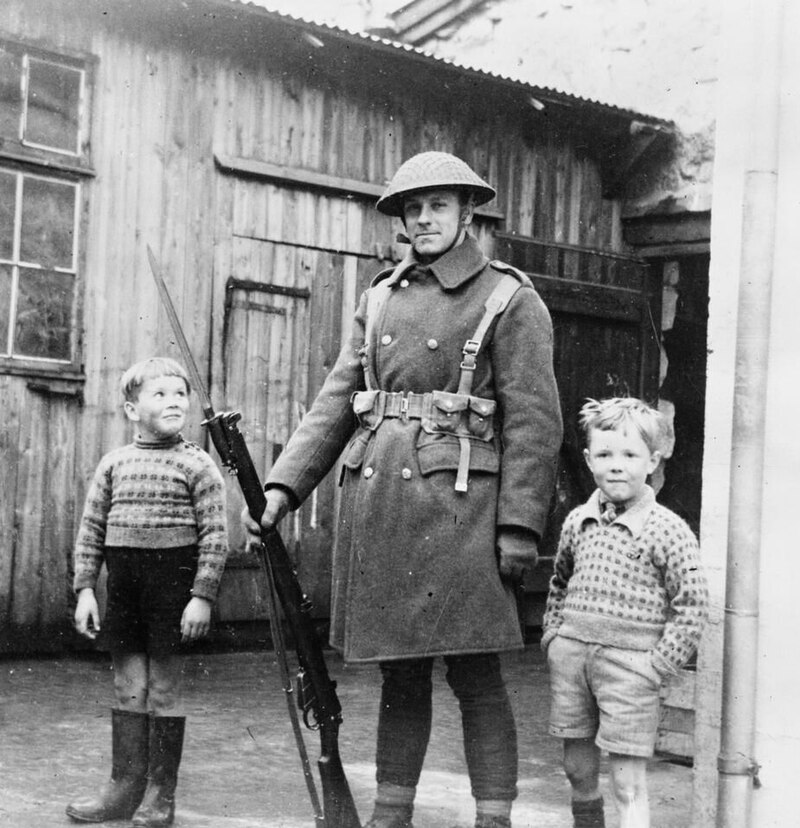
The Faroe Islands are a small group of tiny islands in the North Atlantic Ocean just outside the North Sea. They are located between Iceland, Norway, and the Hebrides and Shetland isles of Scotland. The rugged terrain is dominated by fjords and cliffs with sparse vegetation and only a few battered trees. Despite being located at near Arctic latitudes, they enjoy a subpolar oceanic climate and mild temperatures year-round due to the warming waters of the Gulf Stream. They were a rigsdel ('autonomous territory') of the Danish Kingdom. As a result, they were no plunged into World War I. Denmark was neutral and the Germans respected that neutrality. In addition, The British North Sea blockade kept the Kriegsmarine penned up in he North Sea except for U-boats and a few surface raiders. World War II would be different. The Germans invaded and occupied Denmark (April 9, 1940). As the cables were cut, the Faroese only found out about it by foreign radio broadcasts. Most assumed that they wold be next. Most were relieved when two British destroyers showed up 3 days later -- Operation Valentine (April 12). The Faroese today are the only country that celebrate World War II on the day that they were occupied, not liberated. The celebration is known as Flag Day. (The British were the first to recognize the Faroese flag.) The Germans of course would have liked to have the islands. Hitler reportedly took a personal interest, but there was no airfields to land on and they could not be held given the strength of the Royal Navy. Shortly after HMS Suffolk showed up with a small troop contingent. The Løgtingb after a brief discussion the accepted British protection with a few reservations. A few dissenters favoring independence were out voted. The occupation would be temporary and the Islands would remain in charge of their own domestic affairs. The British would only be in charge of military matters. This was acceptable to the British which recognizing the authority of the Løgting. Actually the Løgtingb had more authority under the British than was the case under Danish rule. The occupation has been described as one of the 'friendliest and politest occupations of all time'. The Danish governor, Carl Aage Hilbert remained in place. The occupying force was mostly Scottish regiments--some 8,000 men. The British sett up some defensive positions, built roads and bridges, and most importantly the Islands' first air field. There were also extensive radar equipment. The Islands between Scotland and Iceland were strategically important in the North Atlantic/North Sea. The islands were a transit area for convoys sailing from America to Murmansk as part of Lend Lease shipments to the Soviet Union during World War II. The British occupation proved very beneficial for the islanders. Faroese fish made a welcomed contribution to the strained British food supply. Some of the more adventurous fishermen made the dangerous, but profitable trip to bring in Icelandic fish. The island economy was based on fishing. And they were able to sell their catch in Britain at higher prices than as part of Denmark. The British built an airfield on Vágar Island, RAF Vagar. After the War it fell into disuse, but is now Vágar Airport. The British set up coastal artillery, some of which are preserved at Skansin Fortress in Tórshavn. There were also five radar stations, at Mykines, Eiðiskollur (on Eiði), Borðan (Nólsoy), Søltuvík (Sandoy) and Suðuroy (Akraberg). There were a few Luftwaffe attacks (largely 1940-41). The Faroese steam trawler Nyggjaberg was torpedoed and sunk during World War II by the German U-701 (March 7, 1942, southeast of Iceland, resulting in the tragic loss of all 21 crew members. The ship was headed to Icelandic fishing grounds. There were other attacks including mines. Some 200 Islanders were killed during the War, a substantial toll given the small population. The British military presence was reduced (1944). After the War, the Islanders negotiated a new status agreement with Denmark making them self governing.

Navigate the CIH World War II Pages:
[Return to Main World War II Atlantic island page ]
[Return to Main World War II island page ]
[Return to Main World War II country page ]
[Biographies]
[Campaigns]
[Children]
[Countries]
[Deciding factors]
[Diplomacy]
[Geo-political crisis]
[Economics]
[Home front]
[Intelligence]
[POWs]
[Resistance]
[Race]
[Refugees]
[Technology]
[Bibliographies]
[Contributions]
[FAQs]
[Images]
[Links]
[Registration]
[Tools]
[Return to Main World War II page]
[Return to Main war essay page]