|
A battle-hardened Japanese Army commander, confident of success, while approching Guadalcanal wrote in his diary:
-- Col. Kiyonao Ichiki
18 August: Landing
20 August: March by night in battle
21 August: Enjoyment of the fruit of victory
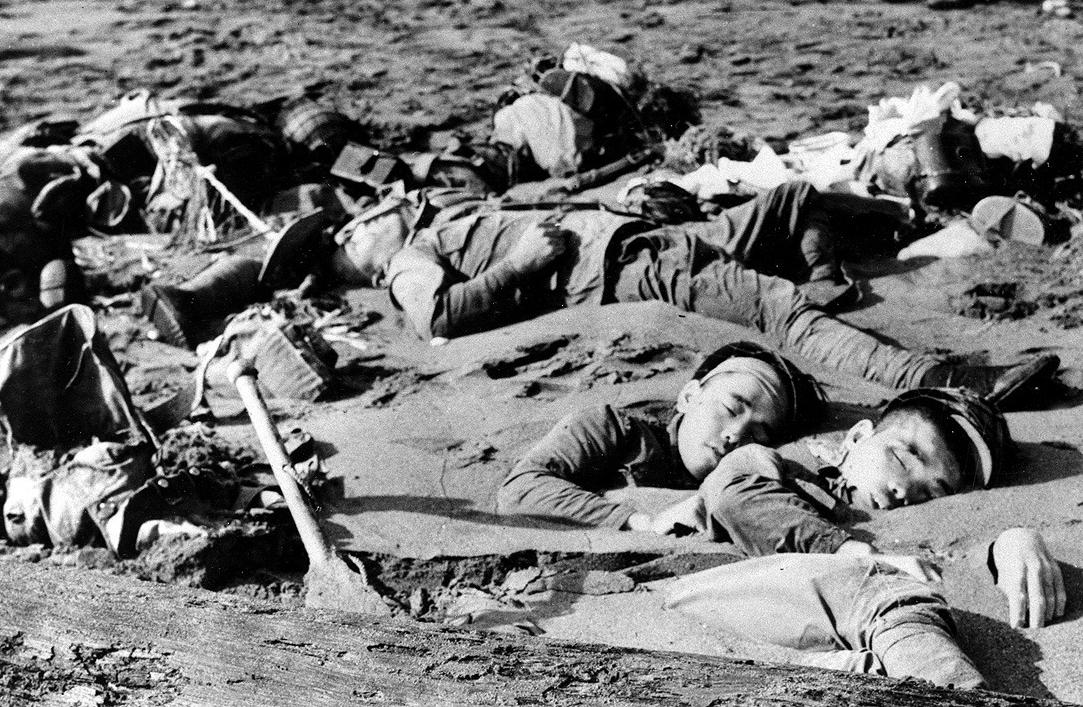
The first battle for Guadalcanal was launched by Col. Kiyonao Ichiki at the Ilu River (thought to be the Tenaru) which the Marines called Alligator Creek. Col. Ichiki was a battle-hardened commander who was involved in the Marco Polo Bridge incident that set off the Second Sino-Japanse War (1937). Andgiven the string of vicrories in Chunaans after
He was also slated to have lead the land invasion at Midway (June 1942). He was no doubt frustrated by the cancellation of the landing and determined to engage the Marines this time. He had no doubts that it would be a quick victory. He and the first echelon of his regiment (917 men ) his men landed at Taivu Point (August 18). 【Hough, p. 291】 At this stage of the War, the Japanese had not yet encountered an Allied force that had successfully resisted them. (The Americans on Bataan fought well, but ran out of supplies.) Ichiki embed with Yamato-damashii (Japanese fighting spirit) was contemptuous of the Marines and chose to attack before reconnoitering the area or any real planning and before he had assembled his full force. Japanese intelligence had badly underestimated the size of the Marine force. Ichiki recklessly pressed ahead with light weapons. He had no doubts that the Marines would break and run when faced with a determined frontal bayonet attack. His battle tactics were to hurl his men across the Ilu River without any artillery preparation. He encountered the Americans further from airfield than he expected. The Americas were dug in with machine guns and light artillery and ready for them. It was a disaster. Ichiki was killed or committed suicide and his force annihilated. There were only about 30 survivors. There would be many additional actions, but after the Tenaru the Americans increasingly consolidated their bridgehead and hardened their defenses. The Japanese were shocked at the result and at first believed that the problem was too small a force was committed. No Japanese commander believed that their tactical doctrine was ill founded. The overall reaction with disbelief, Imperial Army headquarters officers proceeded with plans to deliver a larger force to Guadalcanal to reoccupy the island and seize Henderson Field. 【Frank, p. 158.】 There was no plan to change tactics or reassess American fighting capabilities. For the Americans it wa an introduction to he Japanese. They refused to surrender and even wounded me would try to kill medics attempting to aid them. Gen. Vandergrith reported, "I have never heard or read of this kind of fighting. These people refuse to surrender. The wounded wait until men come up to examine them [...] and blow themselves and the other fellow to pieces with a hand grenade." 【Griffith, p. 107】 he Japanese would torture and kill men they captured. Elsewhere in Asia and Pacific people attacked by the Japanese suffered. The Marines had heard rumors odsuch nehaviot. It has not prepared them for wht hey actially enpcintered . On Guadalcanal, the Japanese found there were consequenes to mindless barbarity. Front line line matines Marines returned savagery with savagery saswell as oberwheaming fire power. It set the character for the Pacific War.
Frank, Richard. Guadalcanal: The Definitive Account of the Landmark Battle (New York: Random House, 1990).
Griffith, Samuel B. The Battle for Guadalcanal (Specially illustrated ed.). New York: Bantam Books, 1981).
Hough, Frank O.; Verle E. Lufwig; Henry I. Shaw Jr.. "Pearl Harbor to Guadalcanal". History of U.S. Marine Corps Operations in World War II.

Navigate the CIH World War II Section:
[Return to Main World War II Guadalcanal fighting page]
[Return to Main World War II Guadalcanal page]
[Return to Main World War II Solomons campaign]
[Return to Main World War II island territory page ]
[Return to Main World War II country page ]
[Biographies]
[Campaigns]
[Children]
[Countries]
[Deciding factors]
[Diplomacy]
[Geo-political crisis]
[Economics]
[Home front]
[Intelligence]
[POWs]
[Resistance]
[Race]
[Refugees]
[Technology]
[Totalitarian powers]
[Bibliographies]
[Contributions]
[FAQs]
[Images]
[Links]
[Registration]
[Tools]
[Return to Main World War II page]
[Return to Main war essay page]
[Return to CIH Home page]