|
Tungsten (W, an74) is perhaps the king of metals. The largest deposits of tungsten were in China. The Germans did not have access to tungsten, but were able to obtain it from neutral Portugal. Shipments became possible after the fall of France. The United States had access to deposits in the Rocky Mountains (California, Colorado, and Nevada). There wee small mines producing very limited quantities when the War broke out in Europe. Unlike the other major industrial metals discussed here, tungsten is not a metal that many people had come in contact with. The name came from Swedish for 'heavy stone'. It is better known in Europe as Wolfram from which the scientific symbol is derived. The density is two and half times that of iron and equal to that of gold. Tungsten carbide is the hardest metal than known--in hardness second only to diamond. It has a tensile strength of 1,510 megapascals. It was a new metal to mankind because only in the industrial age could it be used. It has the highest melting point of any metal--an amazing 6152°F. The vacuum tube became very important in World War II electrical equipment. It was the best materiel for the filament. And it was vital in industrial processes most importantly mass production. Mass production requires hot work stress and machine tools made of high-speed steels. High quality high-speed machine steel tools needed tungsten. The highest quality such tools and precision instruments that measure minute tolerances are made from tungsten alloy steels and tungsten carbides. The German began making armor piercing ammunition with tungsten carbide. This first appeared to the shock of the British in the Libyan desert (February 1941). The round Panzergranate 40 had an aluminum outer casing and a tungsten carbide core. Neither the Americans or British had thought of using tungsten in artillery ammunition. It was too expensive, too hard to machine, and perhaps most importantly too scarce for military needs. The War of course changed that calculation. Tungsten was perfectly suited for penetrating steel armor and killing tanks. The Germans had figured that out and with the fall of France had access to the tungsten they needed. This was not all geology. The German steel giant, Friedrich Krupp Actien Gesellschaft of Essen, extensive research program had included tungsten and held important patents. They sold cemented tungsten carbide under the trade name Widia (like diamond). They has concluded an agreement with the American General Electric Corporation (Carbaloy Company) which had a competing process and patents (1928). Rather than compete which might impact profits, the two corporations which had the most advanced technology agreed to divide the world market. Krupp would get Europe and most of the world. GE would get the United States and Canada. GE/Carbaloy's primary product was the material for cutting tools. And the company hugely increased prices to levels more than 20 times the price of gold ($450 per pound). This meant that few American companies could afford high quality tungsten machine tools. German companies on the other hand were able to afford tungsten machine tools priced competitively. All of this took place before the rise of the NAZIs. At the time that no one imagined another world war was possible. But there were significant industrial consequences of importance when Hitler and Stalin launched the War (1939).
Even before America entered the War (December 1941), there was close cooperation between the United Sates and Britain.
Tungsten (W, an74) is perhaps the king of metals. The largest deposits of tungsten were in China. Unlike the other major industrial metals discussed here, tungsten is not a metal that many people had come in contact with. The name came from Swedish for 'heavy stone'. It is better known in Europe as Wolfram from which the scientific symbol is derived. The density is two and half times that of iron and equal to that of gold. Tungsten carbide is the hardest metal than known--in hardness second only to diamond. It has a utensil strength of 1,510 megapascals. It was a new metal to mankind because only in the industrial age could it be used. It has the highest melting point of any metal--an amazing 6152°F.
The Germans did not have access to tungsten, but were able to obtain it from neutral Portugal. Shipments became possible after the fall of France, opening up rail connections. (June 1940). The United States had access to deposits in the Rocky Mountains (California, Colorado, and Nevada). There wee small mines producing very limited quantities when the War broke out in Europe. There were tungsten in South America and Portugal. America and Britain solved the Portugal problem by buying up the Portuguese tungsten, significantly reducing shipments to Germany . The Portuguese stopped all exports to Germany (1944).
The vacuum tube became very important in World War II electrical equipment. This was all min the era before transistors. Tungsten was the best materiel for the filament because of its high melting point. And it was vital in industrial processes most importantly mass production. Mass production requires hot work stress and machine tools made of high-speed steels. High quality high-speed machine steel tools needed tungsten. The highest quality such tools and precision instruments that measure minute tolerances are made from tungsten alloy steels and tungsten carbides. The German began making armor piercing ammunition with tungsten carbide.
The German tungsten armor piercing shells first appeared to the shock of the British in the Libyan desert (February 1941). The British Matilda tank shredded Italian armor which was part of the failure of the Italian invasion of Egypt (September 1940). The British pursued the Italians into Libya (December 1940). Mussolini pleaded for with Hitler for German assistance. As a result Gen. Erwin Rommel showed up in Libya with the Afrika Korps with its tanks ad tungsten armor piercing shells. The round ( Panzergranate 40 ) has an aluminum outer casing and a tungsten carbide core. Neither the Americans or British had thought of using tungsten in artillery ammunition. It was too expensive, too hard to machine, and perhaps most importantly too scarce for military needs. The War of course changed that calculation. Tungsten was perfectly suited for penetrating steel armor and killing tanks. The Germans had figured that out and with the fall of France had access to the tungsten they needed. We sare not sure how many of these rounds were madean avlble to German tankers.
Pre-War tungsten availability was not all about geography. German steel giant, Friedrich Krupp Actien Gesellschaft of Essen, extensive research program had included tungsten and held important patents. They sold cemented tungsten carbide under the trade name Widia (like diamond). They has concluded an agreement with the American General Electric Corporation (Carbaloy Company) which had a competing process and patents (1928). Rather than compete which might impact profits, the two corporations which had the most advanced technology agreed to divide the world market. Krupp would get Europe and most of the world. GE would get the United States and Canada. GE/Carbaloy's primary product was the material for cutting tools. And the company hugely increased prices to levels more than 20 times the price of gold ($450 per pound). This meant that few American companies could afford high quality tungsten machine tools. German companies on the other hand were able to afford tungsten machine tools priced competitively. All of this took place before the rise of the NAZIs. At the time that no one imagined another world war was possible. But there were significant industrial consequences of importance when Hitler and Stalin launched the War (1939).
Even before America entered the War (December 1941), there was close cooperation between the United Sates and Britain. The British were not at first sure what hit their tanks in Libya. So in addition to their scientists addressing the issue, thy sent shell fragments of the German Panzergranate 40 to the Americans who were working on their own tanks and tank ammunition at the time. The fragments were delivered to the U.S. Army Aberdeen Proving Grounds in Maryland. There metallurgist Harold Rosenberg. He immediately understood that it was not steel, but tungsten carbide. This was one of the hardest materials known to man. Despite this American and British ordnance experts had never considered using it because it was so expensive and not in available in quantities needed for warfare. The fact that the Germans were using it changed lot of minds. It meant that American tankers would have to face these rounds without comparable munition. But it meant that American industrialists had a problem in rapidly creating comparable munitions. At the onset of the War, German machine shops had cutting tools that lasted 10 times longer than the tools in American shops, often made of molybdenum or high-speed steel. But it was not just the frequency of replacement, the tungsten cutting tools could achieve greater precision. This meant that German factories could achieve precision that American factories cold not replicate. .
And it meant that the Germans had the capability of destroying any tank in the Allied arsenal. The Federal Government at the time was not nearly as involved in the economy as is the case today. The War emergency, however, changed a great deal. The U.S. Senate convened hearings to investigate the Carboly monopoly. The Truman Committee investigate a wide range of war-related issues and Carboly was one of them. GE was deeply embarrassed. There were letters showing that GE executives consulted with Krupp about denying licenses to produce tungsten carbide. Memorandum were found about fixing prices and restricting output. Investigators found orders from Krupp instructing GE not to export tungsten carbide to the Soviet Union. At the time the Soviets were an American ally fighting for its life. Carboly executives were grilled President William G. Robins complained about being cast as un-american. Senator Truman pointed out that GE's agreement with Krupp led to the war-time shortages of tungsten carbide when that metal was desperately needed by American fighting men. The Committee's conclusion was that the GE-Krupp cartel agreement had retarded the development of the American machine tool industry and left American industry unprepared for the industrial needs of modern war.
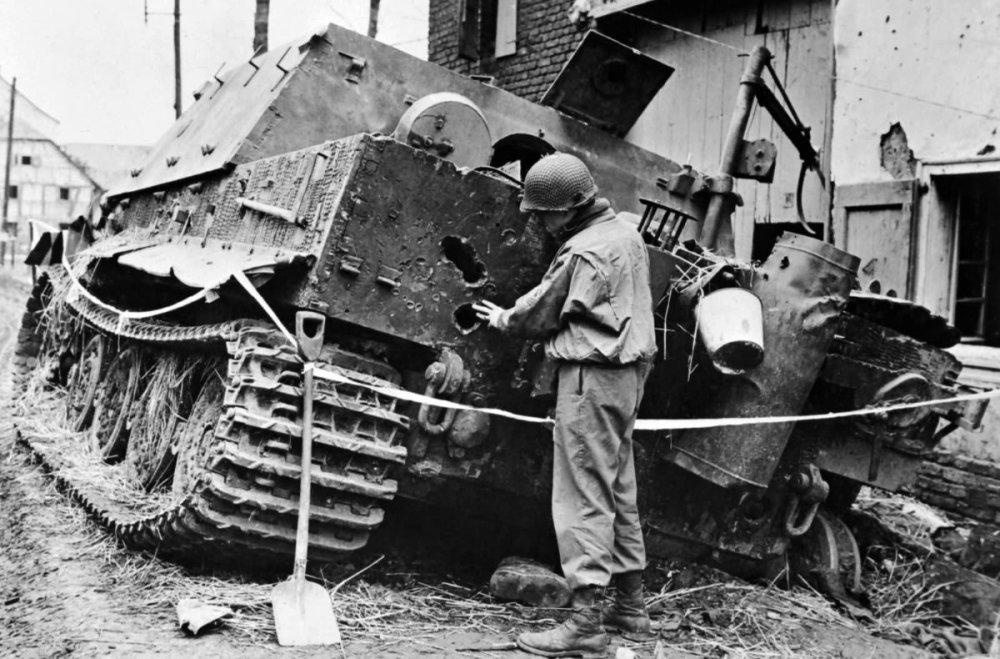
The Army Ordinance Department was already working on American armor piercing shells. A team led by Chrysler engineer Ralph Palmer. They set up in an empty warehouse in Detroit with the assignment of designing armor-piercing tungsten ammunition. The Army was already working on armor piercing ammunition. But nothing was going to be as effective as tungsten shell. The first problem was getting enough tungsten to work with. America was tooling up for war and companies producing war material including tanks, artillery, ships, and air craft all wanted tungsten carbide cutting tools. One alternate was South America which had tungsten deposits, but that would require time. time American tankers did not have. Palmer found a small company in Pennsylvania. Kennametal was founded by Philip M. McKenna in the Latrobe, Pennsylvania area (1938). The company had evolved from Vanadium Alloys Steel Company (VASCO), founded in 1910 by the McKenna family. The research director of VASCO, metallurgist Philip McKenna developed and received a patent for a tungsten-titanium carbide composition -- Kennametal. He formed Kennametal, Inc. to market the alloy. Tungsten was hard to obtain because of the GE-Krupp cartel. So the company worked recycling industrial scrap. Their product, known as 'Kennametal', was introduced (Late-1930s). The company described it was 'much harder than the hardest tool steel'. It could be used for high-rate steel cutting. The company formed Kennametal of Canada Ltd. to produce Kennametal for Canada and Britain (July 1940). (Neutrality legislation complicated American sales to Britain and Canada.) Kennametal during the War produced artillery shells produced in the United States. They were machined tooled with Kennametal. 【Research and Engineering Pace Company】 Kenna metals was producing several hundred pounds a month. Palmer negotiated a contact (March 1942). The War Production Board financed a massive expansion from 6 to 200 employees. Within a year it was producing more tungsten carbide than any other operation in the country except Carboly itself. This gave Palmer's team the tungsten needed for testing. Obtaining the tungsten was, however,was just part of the problem The more complicated problem was designing the shell. Palmer did not have an intact German shell to go on. Palmer's team and Kenna metal worked on the problem together. The first prototype was a 37mm projectile with a pencil size tungsten core -- the T-30. It was a failure in Aberdeen test firings (August 1942). The tungsten crystalized a part of the bonding process and fractured upon striking the target. The term worked on he problem for months. The solution came (January 1943). It was a small layer of copper. The perfected shell was the T-4 which the Army designated the M93 HVaP. Production began soon after (Spring 1943), but only small numbers because of limited supplies of Tungsten. The decision was made to allocate the HVaP shells to tank destroyers. These were at first guns mounted on armored car chassis, but eventually light, highly maneuverable tanks like the M-18 Hellcat were available. Tanks got standard steel core armor piercing rounds. They worked in the Panzer Mark IIIs and IVs, but not on the Panthers and Tigers. The first HVaP rounds did not reach American tankers the final months of the liberation of France (September 1944). The first engagement took place in Loraine--the Battle of Arragcourt. The American Shermans and tank destroyers went up against a force consisted of mostly Panthers, but bu this time of the war the Germans were fielding less well trained crews. At the end of he 11 day battle, the Germans had lost nearly 200 armored vehicles including over a 100 Panthers. The Americans lost less than 30 Shermans. . .
Latrobe Bulletin (December 15, 1952). This source says50 cent of Amerixab artillery shells. This sounds very high.

Navigate the CIH World War II Section:
[Return to Main World War II specific strategic metals page ]
[Return to Main World War II strategic metals page ]
[Return to Main World War II food, raw, material, and enrrgy page]
[Return to Main World War II strategic materials page]
[Return to Main World War II economics page]
[Return to Main strategic bombing campaign page]
[Return to Main World War page]
[Biographies]
[Campaigns]
[Children]
[Countries]
[Deciding factors]
[Diplomacy]
[Geo-political crisis]
[Economics]
[Home front]
[Intelligence]
[Resistance]
[Race]
[Refugees]
[Technology]
[Bibliographies]
[Contributions]
[FAQs]
[Images]
[Links]
[Registration]
[Tools]
[Return to Main World War II page]
[Return to Main war essay page]