|
War with the United States was a huge risk. The fact that the Japanese would risk war with such a powerful country speaks to the importance of oil. As the War played out, most authors think that it was y was pure insanity for Japan to go to war with the United States. This is especially the case because a naval war by definition is an industrial war, and Japanese industry was dwarfed by American industry. The Japanese military was incensed by the Washington Naval Accords (1921) which limited naval spending. Actually even though Japan was assigned a lower quota and America and Britain, it was advantageous to Japan. Japan did not have the financial capability to build much more than it did, but it allowed American and British building, especially American building which could have built much more. Even so, the Japanese decision is not as insane as it seems today. That was because the Japanese thought the Germans who were only miles from Moscow had destroyed the Red Army, And if that was the case, the Japanese case for war was much more reasonable. The only hint that he Red Army was not destroyed, the Counter-Offensive before Moscow came only as the bombs were falling on Pearl Harbor, meaning that there was no going back--the die had been cast. oil was intrinsically at the heart of the Pacific War. It was thw major reason why the Japanese launched the Pacific War. It determined the dirction if the Japanese advance. It had a hge impact on bth he Japanese and American conduct of the War. The Americans had it and the Japanese did not. It wold lead to the deindustrialization of Japan.
Japan invaded China proper (1937). This increased Japan's need for oil, but the IJA was not heavily motirized so the increased demand wasnot massive. And the IJN which does require oil for fleet movement did
not have a majaor role in the fighting in China. The Japanese were studying how to benefit from the developing conflict in Europe, as they had done in World War I. Given their alliance with Germany and long held goals, he Strike North faction was focused on Soviet Siberia. Major battles fought with the Red Army on the border of Soviet dominated Mongolia convinced the Japanese that they did not have the military capability to deal with the Red Army (July 1939) Then without consulting the Japanese, Hitler signed an alliance with Stalin (August 1939). The Japanese were aghast, and never fully trusted the Germans again. Hitler and Stalin launched the War by invading Poland (September 1939). But the Japanese never anticipated the Soviet Union being a German ally. As a result, the Strike South Fraction rose in prominence. It is thus only in late 1939, that the idea of launching a Pacific naval war became to take shape. Japan at the time was primarily concerned with China and its inability to achieve a military solution. America and Britain were beginning to take war in China seriously and offering the Nationalist regime some assistance.
President Roosevelt and most Americans continued to hope that the Allies (Britain and France) could deal with the Germans, requiring only material report. The French Army was widely seen as the most capable in the world. The German Western invasion and Fall of France shocked the world (June 1940). The resident moved the Pacific Fleet to Pearl Harbor (June 1940). The United States had been increasing naval spending, but on a still limited scale. The two Ocean Navy Act, opened the flood gates. Japan realized that once these ships began reaching the fleet, Japan could no longer compete, but ships take time to build. And the major ships authorized included the Essex-Class carriers and Iowa -class battleships would not begin reaching the fleet until 1943. Congress passed the Export Control Act, giving the President the authority to control exports of raw material and equipment of military importance. With the fall of France, French Indo-China was virtually defenseless. The Japanese demanded access to northern Indo-China. in part to prevent material aid from reaching Nationalist China. America diplomatic messages became increasingly critical. American code breakers broke Japanese Purple (diplomatic) code and thus able to understand Japanese moves. Actual commercial acts of consequence followed.
The war in China was draining Japan, a serious economic burden, but the country was no nearer to defeating the Nationalists which had with drawn into he country's rugged interior. Japan neighbored American diplomatic notes and commercial sanctions. Then they moved troops into South Vietnam until the oil embargo was issued (July 194). The Hull Note made it clear that the United States as demanding that Japan end its aggression in China and withdraw from the country. Hard line Gen. Hideki Tojo was appointed prime-minister (October 1941). He decided on war unless the United States essentially accept Japanese control of China. Japanese carrier aircraft struck Pearl Harbor lunching the Pacific War (December 1941). The United States immediately ordered its submarines to conduct unrestricted submarine warfare.
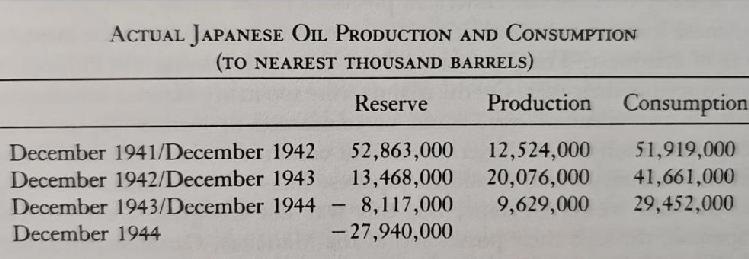
Fleet opeations beginning (December 1941) required massive quabtities of oil. Japan very quickly carved hout a huge area of te SRZ. After that the major orioblem was getting the oil and other resources fromthe SRZ to the war factories on the Home Islands, Both Japan and the United States were prepared for a commerce war like the German U-boats were waging in the Atlantic. . Japan did not think it as an effective use of its submarine force. The United States which had been critical of German U-boat tactics saw the submarine as a fleet scout mission. Its captains were not trained to be aggressive nor did they have a dependable, well tested torpedo. As a result in 1942, the Imperial Navy operated primarily on ts reserves (figure 1). Because of leadership issues and torpedo problems, the American submarines had almost no impact on he crude oil being shipped from the DEI and British Borneo. The old fields were seized in tack, but the refineries were damaged. Repairs were complicated when a ship carrying equipment and experts was sunk. The Japanese began to use their submarines to supply isolated island garrisons, something only marus had the capacity to do.
The Japanese increased oil production somewhat, but consumption declined. The Japanese fleet was largely inactive in (1943). No major fleet engagements occurred. battles were fought. The Unites States Navy finally solved its torpedo problem (late 1943) and the U.S. submarines finally began sinking marus in numbers by the end of the year. This was facilitated by breaking the maru code. Japanese convoys/marus reported their position daily. While some oil did get through to the Home Islands. Japanese occupation was disaster for the people of Southeast Asia and he South Pacific. The economies of the region depended heavily on the British merchant marine withdrew with the Japanese conquest. The Japanese marus which replaced them, only carried Javanese military freight. Thus local economies collapsed.
American summaries destroyed the Japanese maru fleet. This included oil tankers. Oil ceased arriving from the SRZ. The situation was so bad, that the major Japanese ships had to be based in Singapore near the oil fields. Also not reaching the Home Islands were mineral ores and food. And the end of 1944, the Japanese maru fleet no longer existed. Allied bombers also began hitting oil refineries in the DEI. Japan began he War with the finest cadre of naval aviators-in the world. They were meticulously trained. The last important carrier battle of the War was the Battle of the Philippines Sea (June 1944). The result was the Great Marianas Turkey Shoot (June 1944). The Japanese pilots were slaughtered because they were so poorly trained. This was the case because fuel was not available for their training.
The American submarines had a problem in 1945, they had run out of targets. They were reduced to using their deck guns to sink sampans and fishing boats. There primary use became picking up downed American flyers. The marus that had not been sunk, stated in port. When the Yamato sailed on its final mission (April 1945), only enough fuel was loaded to get to Okinawa. American B-29 bombers began doping acoustic mines. This centered on the Kanmon/Shimonoseki Straits separating Kyushu. This largely ended coastal maritime traffic.

Navigate the CIH World War II Section:
[Return to the Pacific War: Japan and Oil page]
[Return to the Road to War in the Pacific]
[Return to the Word War II Japanese strategic concept page]
[Return to the Main World War II Japanese page]
[Return to the Main World War II oil page]
[Return to the Main World War II page]
[Biographies]
[Campaigns]
[Children]
[Countries]
[Deciding factors]
[Diplomacy]
[Geo-political crisis]
[Economics]
[Home front]
[Intelligence]
[Resistance]
[Race]
[Refugees]
[Technology]
[Bibliographies]
[Contributions]
[FAQs]
[Images]
[Links]
[Registration]
[Tools]
[Return to Main World War II page]
[Return to Main war essay page]