|
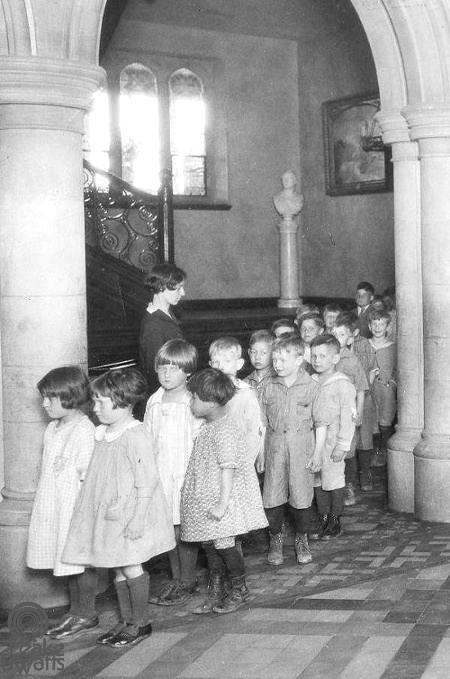
The Leake & Watts Orphan House was a historic New York City charitable institution founded in 1831 from the bequest of John George Leake (1831). It was designed as a Greek Revival temple in Morningside Heights. The original 1843 building still stands today on the grounds of the Cathedral of St. John the Divine. Wealthy Manhattan lawyer John George Leake died without heirs (1827). He left his estate to Robert Watts, provided he change his last name to Leake. When Watts died before he could inherit, the funds were used to establish an orphanage. In the legal papers of John Leake was an unsigned and undated draft of a will in his handwriting, in which he left money to create a home for orphaned children, and assigned his friend, John Watts, to administer the home.The orphanage opened its doors in a large facility designed by famed architect Ithiel Town at West 112th Street and Amsterdam Avenue (1843). The institution outgrew its Manhattan space and relocated to a 30-acre campus in Yonkers, New York. Over the 20th century, it shifted from strict institutional dormitories to a 'cottage system'. Leake & Watts introduced a 'cottage system'" of smaller group residences. At the time it was an innovative approach. They began calling the Yonkers facility the Leake and Watts Home School (1924). The Tivoli facility became the Leake and Watts Farm School; it provided both vocational farm training and a summer camp. Leake and Watts expanded its mission (early-1930s). In addition to orphans, it served dependent children from broken homes. A Social Service Department was established addressing children's therapeutic needs (1937). A new Foster Home Department placed children in community foster homes (1944). The organization eventually evolved into a massive human services agency. Today, the charity operates under the name Rising Ground.

Navigate the Historic Boys' Clothing orphanage pages:
[Return to the Main American individual orphanage page]
[Return to the Main orphanage page]
[Return to the Main U.S. orphanage page]
[French]
[Polish]
[Russian]
Navigate the Historic Boys' Clothing Web Site:
[Introduction]
[Activities]
[Biographies]
[Chronology]
[Cloth and textiles]
[Clothing styles]
[Countries]
[Girls]
[Topics]
[Bibliographies]
[Contributions]
[FAQs]
[Glossaries]
[Images]
[Links]
[Registration]
[Tools]
[Boys' Clothing Home]