|
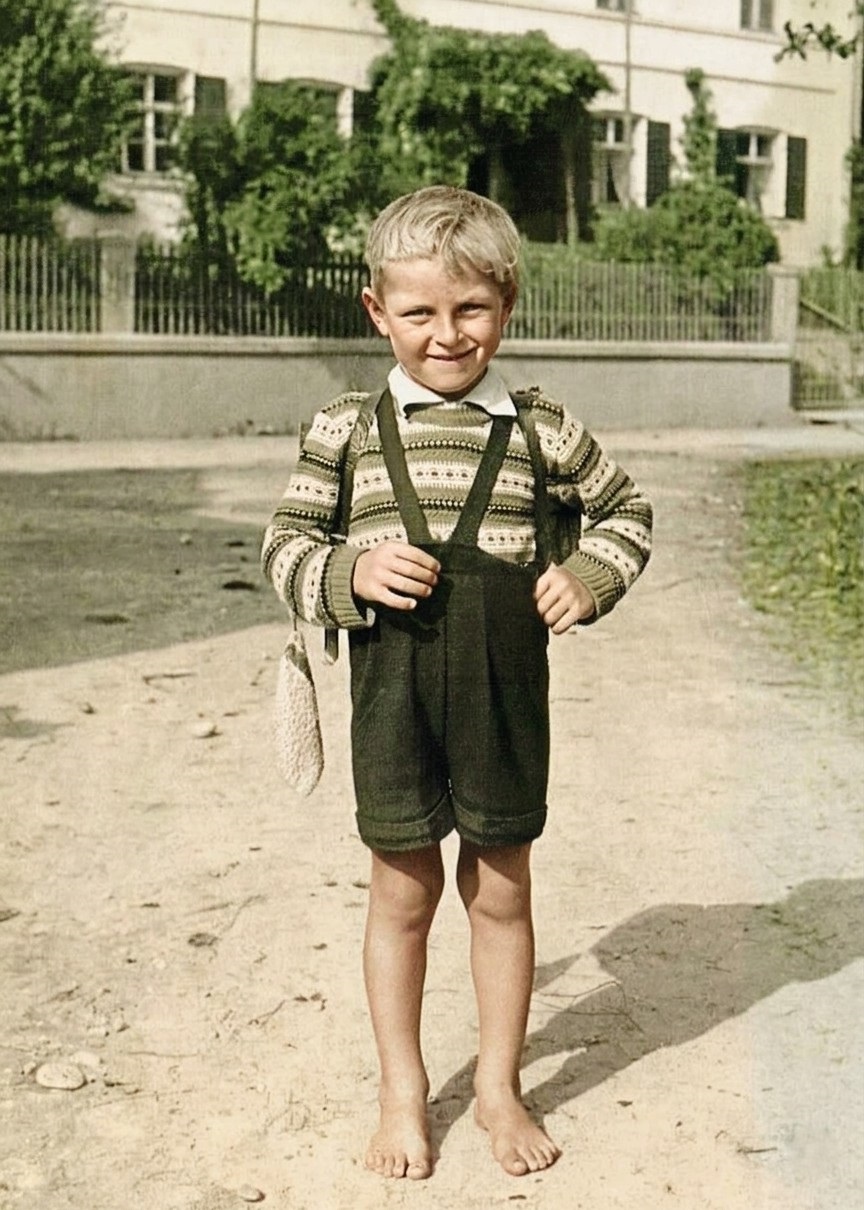
Most German children walked to school. Germany rapidly industrialized beginning in the mid-19th century and by the 20th century was an industrial powerhouse. As a result. the population rapidly urbanized. The primary children thus lived close to their schools and walked to school. The working-class largely lived in apartments and with a high density population schools could easily built within walking distance. There were also middle-class suburbs, but we believe most middle-class children also walked to school. We are less sure about secondary school students. A relatively small number of children continued on to secondary school until after World War II (1939-45). This meant that the students often lived some distance from their schools, beyond walking distance. We think many students took public transport. Some may have also used bicycles. This was a middleclass option as few working-class childen had bicycles, but few working-class children atended secondary school. Very few children were driven to school. Automobile ownership was not widespread in Germany, ironically until after World War II. There was also a sizeable rural popultion. German industry was highly concetrated in western Germany--the Ruhr Valley in particular was heavily industrialized.

Related Chronolgy Pages in the Boys' Historical Web Site
[Main Chronology Page]
[The 1880s]
[The 1890s]
[The 1900s]
[The 1910s]
[The 1920s]
[The 1930s]
[The 1940s]
[The 1950s]
[The 1960s]
[The 1970s]
[The 1980s]
[The 1990s]
[The 2000s]
Related Style Pages in the Boys' Historical Web Site
[Main school uniform page]
[Main country page]
[Long pants suits]
[Short pants suits]
[Socks]
[Eton suits]
[Jacket and trousers]
[Blazer
[School sandals]
Navigate the Boys' Historical Clothing School Uniform Pages
[Return to the Main coming and going to school transport page]
[Return to the Main coming and going to school]
[Return to the Main German school activities page]
[Return to the Main School Uniform Page]
[Australia]
[England]
[France]
[Germany]
[Italy]
[Japan]
[New Zealand]
[Scotland]
[United States]
Navigate the Boys' Historical Clothing Web Page
[Introduction]
[Activities]
[Biographies]
[Chronology]
[Clothing styles]
[Countries]
[Bibliographies]
[Contributions]
[FAQs]
[Glossaries]
[Images]
[Links]
[Registration]
[Tools]
[Boys' Clothing Home]