|
The development of Ukrainian education in complicated by changing boundaries (20th century). After World War I, There was a brief period of disorganized independence during the Civil War. Ukraine failed, however, to achieve independence during the Russian Civil War (1919-21). Ukraine was absorbed into the Bolshevik Empire. Poland did achieve its independence after World War I (1918). And there were Ukrainians in eastern Poland, especially southeastern Poland. With Communist control, the educational system was significantly expanded. This increased educational opportunity to workers and peasants. During the 'korenizatsiya' (nativization) policy, the Soviet government actively promoted Ukrainian language and culture. Ukrainian was widely used as the primary language of instruction in Ukrainian schools. Resistance to he Communists, especially the collectivization of land led Stalin to adopt brutal measures to enforce compliance. He engineering a genocidal famine to destroy the Ukrainian peasantry (1931-32). Germany during the World Wars briefly occupied Ukraine (1917-18) and (1941-43) occupation. Many Ukrainians at first welcomed the Germans, but the NAZI Operation Barbarossa became a war of annihilation. Hitler was not about to allow any form of a Ukrainian state and brutally suppressed Ukrainian nationalists. Education ceased under NAZI occupation. The NAZIs saw no useful purpose in educating Ukrainian. Basically the Ukrainian education system was dominated by Tsarist and then Soviet control. In both instances there was an effort to suppress Ukrainian nationalism and culture and education was used in this process. Ukraine itself was culturally divided between an Orthodox east and Catholic west. The Catholic west had a stronger degree of contact with the West than most other Tsarist provinces except the Baltics and Poland -- countries which briefly obtained their independence after World War I (1914-17). The Soviets re exerted control after World War II. The Soviet state shifted its focus toward the integration of a unified Soviet identity, which led to a Tsarist-like policy of Russification. While Ukrainian remained a required subject (Ukrainian Language and Literature) in many schools, Russian became the dominant language of instruction. he availability of Ukrainian-language schooling declined sharply. By the 1980s, the vast majority of urban and industrial schools taught in Russian, while Ukrainian instruction was increasingly marginalized or relegated to rural areas. Although Ukrainian subjects were taught, parents in some regions had the option to request an exemption from Ukrainian classes, whereas Russian was universally mandatory. Ukrainian emigrants and exiles preserved educational and cultural records abroad, as reflected in archives like the Ukrainian History and Education Center, which holds extensive 20th-century collections. The Ukrainian immigrant community in the United States was especially important. An independent Ukraine only came into existence after centuries of subjugation with the dissolution of the Soviet Union (1992).
The Tsarist era extended into the 1910s with little change. Then World War I broke out (1914). This led to the Russian Revolution and the end of Tsarist rule (1917). Within months the October Revolution occurred and the Bolsheviks seized power. After World War I, There was a brief period of disorganized independence during the Civil War.
Ukraine failed to achieve independence during the Russian Civil War (1919-21). Ukraine was absorbed into the Bolshevik Empire. Poland did achieve its independence after World War I (1918). And there were Ukrainians in eastern Poland, especially southeastern Poland. With Communist control, the educational system was significantly expanded. This increased educational opportunity to workers and peasants. During the 'korenizatsiya' (nativization) policy, the Soviet government actively promoted Ukrainian language and culture. Ukrainian was widely used as the primary language of instruction in Ukrainian schools. By the end of the decade, Stalin had seized dictatorial powers. He launched the First Five Year plan which included collectivization (1928-32). In a similar upheaval during the French Evolution, French peasant gained worshiper of the land they worked. This at first happened in Russia and Ukraine, only the Russian and Ukrainian peasants did not hold it for long. The Bolsheviks in the 1920s promoted Ukrainization as part of the Korenizatsiia policy, aiming to win over Ukrainian masses by using the Ukrainian language in schools, universities, and public life. 【Bondarchuk, Mykolayovych, Danylenko 】 By the end of the 1920s, over 90 percent of children in the Ukraine attended Ukrainian-language primary schools, and most newspapers and books were published in Ukrainian. This was a major shift from Tsarist policies.
The Soviet Ukrainization policies of the 1920s had led to the expansion of Ukrainian-language education, cultural institutions, and teacher training programs, which significantly promoted the Ukrainian language and some aspects of national culture. The early 30s priced to be the peak of Ukranization. Resistance to the Communists, especially the collectivization of land led Stalin to adopt genocidal measures to enforce compliance. Stalin was shocked by the level of resistance to his policies in Ukraine. He seems to have blamed in in part on the Ukranzation policies of the 1920s. Stalin issued the the infamous resolution "On grain procurement in Ukraine, the North Caucasus and the Western region" (December 14, 1932). It marked the end of Ukrainization. The NKVD began 'subduing by hunger', exporting grain and food from Ukraine, looting and destroying elevators and agricultural machinery. Stalin engineering a genocidal famine to destroy the Ukrainian peasantry (1932-33). At the same time, the Russification of the population was resumed,in particular: schools began to be taught in Russian again and Ukrainian books were being confiscated from libraries. 【Holodomor Museum】
Many Ukrainian schools were closed or converted to Russian instruction, especially in regions with smaller Ukrainian populations
Ukrainian-language books and teaching materials were confiscated, and Ukrainian-language education was restricted,
Soviet authorities used education to promote Soviet ideology and loyalty, replacing national cultural content with pro-Soviet curricula. .
In some areas, especially in the Ukrainian SSR, Ukrainian-language schools persisted to ban extent, but their numbers and influence declined sharply after 1932.
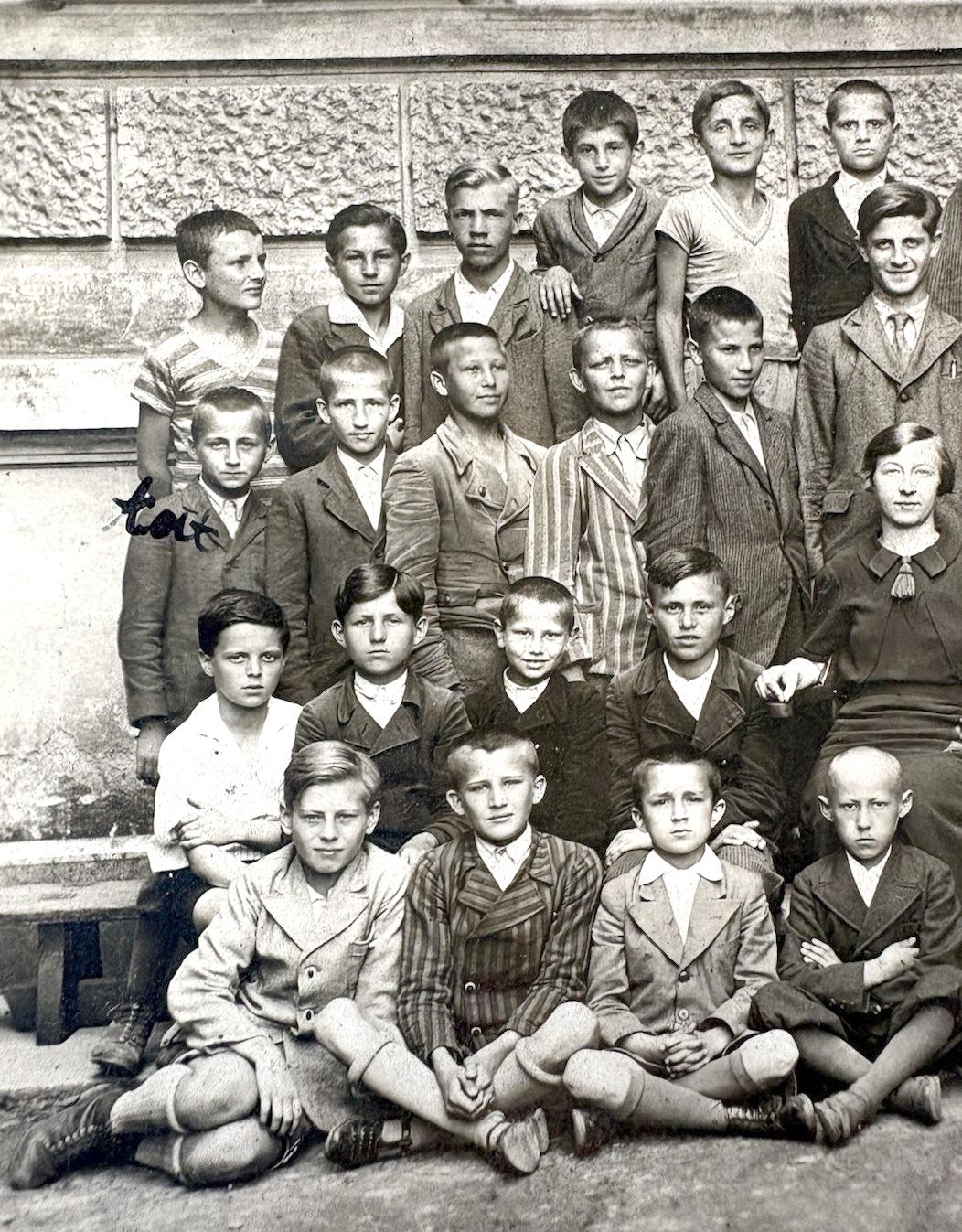
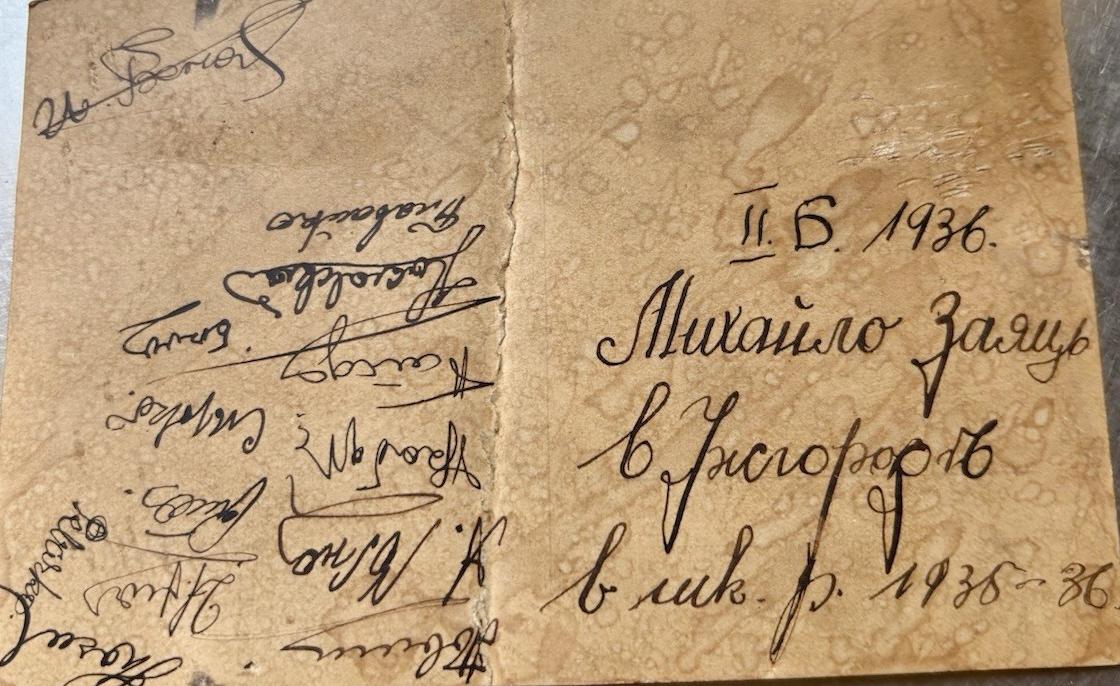
Here we see younger secondary school students in 1936 (figure 1). These boys probably attended primary schools being taught in Urania, but in schools, especially secondary schools, by 1936, he language of instruction was Russian. You can see their teacher in the center. This was a dangerous time for teachers. Fortunately for many, the Russian and Ukrainian languages are similar Slavic languages, but there are differences and more importantly at he time wider political considerations. There are many similarities between the Ukrainian and Russian languages, as the two nations have been connected politically and geographically for centuries with Russians being the governing nation. In some aspects, however, Ukrainian is more similar to Slovak or Polish than to the Russian language. The Ukrainian intelligentsia, including most writers and a third of its teachers, were targeted as part of the Holodomor. 【Malko】 The NKVD saw supporters of Ukrainian cultural and educational initiatives as threats to Soviet authority. Those who resisted or just perceived as loyal to Ukrainian national aspirations were arrested, sent to labor camps, or executed. This meant that many Ukrainian-speaking teachers, especially those active in the 1920s–early 1930s, faced dismissal, imprisonment, or death, especially if they were politically active or openly critical of Soviet control.
World War II broke out with the German and Soviet invasions of Poland (1939). Ukraine was at first little affected, but the border countries which the Soviet Union as a NAZI ally were substantially impacted. This changed when Hitler ordered the invasion of the Soviet Union (1941). Ukraine was totally occupied by NAZI armies. The Ukrainians as first received the NAZI armies as liberators. The NAZI Operation Barbarossa was in fact a war of annihilation. The NAZI plans were genocidal--Generalplan Ost. There was no room in NAZI Europe for any kind of Ukrainian state. Ukrainian nationalists were arrested. The Ukrainians watched the Germans murder Jews, unlike in Poland it was done openly. Some Ukrainians began to wonder, "Are we next?" Under German occupation all educational activities ceased. The NAZIs saw no point in educating what was to become a Helot population. The NAZIs wanted the land and resources of the East--not the people. Theu were to be removed (killed) or enslved. And there was a potential down side to educating Ukranians . Educated people are more difficult to control. The primary concern for most Ukrainians under German control was obtaining food.
Germany during the World Wars briefly occupied Ukraine (1917-18) and (1941-43) occupation. Hitler was not about to allow any form of a Ukrainian state and brutally suppressed Ukrainian nationalists. Education ceased under NAZI occupation. Basically the Ukrainian education system was dominated by Tsarist and then Soviet control. In both instances there was an effort to suppress Ukrainian nationalism and culture and education was used in this process. Ukraine itself was culturally divided between an Orthodox east and Catholic west. The Catholic west had a stronger degree of contact with the West than most other Tsarist provinces except the Baltics and Poland -- countries which briefly obtained their independence after World War I (1914-17).
The Battle of Kursk ended any German hope of retaining Ukraine(1943). Soviet armies cleared Ukraine of the last vestige of NAZI control (1944). The Soviets re exerted control in Ukraine after World War II (1945).
The Soviet state shifted its focus toward the integration of a unified Soviet identity, which led to a Tsarist-like policy of Russification. While Ukrainian remained a required subject (Ukrainian Language and Literature) in many schools, Russian became the dominant language of instruction. The availability of Ukrainian-language schooling declined sharply. The Ukrainian immigrant community in the United States was especially important.
By the 1980s, the vast majority of urban and industrial schools taught in Russian, while Ukrainian instruction was increasingly marginalized or relegated to rural areas. Although Ukrainian subjects were taught, parents in some regions had the option to request an exemption from Ukrainian classes, whereas Russian was universally mandatory. Ukrainian emigrants and exiles preserved educational and cultural records abroad, as reflected in archives like the Ukrainian History and Education Center, which holds extensive 20th-century collections.
An independent Ukraine only came into existence after centuries of subjugation with the dissolution of the Soviet Union (1992).
Bondarchuk, Petro, Andriyovych Mykolayovych, and Viktor Mykhailovych Danylenko. "Українізації політика" [Ukrainisation policy]. Encyclopedia of History of Ukraine (in Ukrainian). (Kyiv: Institute of History of Ukraine, (2026).
Holodomor Museum. "Національний музей Голодомору-геноциду" (2022).
Malko, Victoria. The Ukrainian Intelligentsia and Genocide - The Struggle for History, Language, and Culture in the 1920s and 1930s (2024).
Nahrybelniy, Ya. "Formation an Development in Ukrainian Lands in 19th-20th centuries in he context of modern historical and pedagogical researches," Innovative Solution in Modern Science (2020) Vol. 2, No. 38.

Related Chronolgy Pages in the Boys' Historical Web Site
[The 1880s]
[The 1930s]
[The 1940s]
[The 1930s]
[The 1940s]
[The 1950s]
[The 1960s]
[The 1970s]
[The 1980s]
Related Style Pages in the Boys' Historical Web Site
[Long pants suits]
[Short pants suits]
[Socks]
[Eton suits]
[Jacket and trousers]
[Blazer]
[School sandals]
Navigate the HBC School Section:
[Return to Main Ukranian School Chronology page]
[Return to Main Ukranian School page]
[Return to Main Ukranian School page]
[Return to Main European school uniform page]
[Return to Main school uniform page]
[About Us]
[Activities]
[Chronology]
[Classrooms and buildings]
[Clothing styles]
[Countries]
[Debate]
[Economics]
[Garment]
[Gender]
[Hair]
[History]
[Home trends]
[Literary characters]
[School types]
[Significance]
[Transport and travel
[Uniform regulations]
[Year level]
[Other topics]
[Images]
[Links]
[Registration]
[Search]
[Tools]
[Return to the Historic Boys' School Home]