*
Russian school activbities: physical education gym
Russian School Activities: Sports and Physical Education
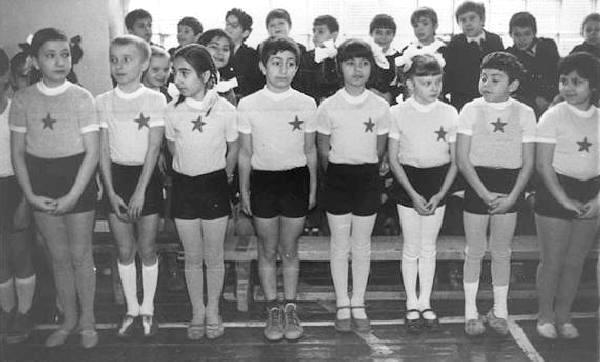
Figure 1.--Here are two photographs of a Soviet gym class taken in 1979. A lot of children look Caucasian so I suppose the photographs were taken somewhere in North Caucasus region. Note that some girls and boys wear tights although the North Caucasus is in the South of Russia. Winters high in mountains can be really severe and parents wanted to keep their children warm.
The history of physical education in Russia is an interesting topic. There has since the creation of the modern Russian state by Ivan the Terrible been torn between joining the liberal West and the the cotinuing strenth od their authocratic traditions. And this historic conflict has manifested itself in many aspects of Rusdsian life, including gym classes. In the West gym and sport gradually becme seen as a valuable activity
in its own right and sport which developed primarily in Europe became an emensely popular activity. Important Russian authors like Vissarion Belinsky (1811-48) saw that physical activity was important in the development of mental capabilities. The Russians were not enamored with the sports that developed in the West and social thinkers like Belinsky promoted Russian folk games. Subsequent social theorists like Nikolai Chernyshevasky (1829-89) and Nikolai Vobrolyubov (1836-61) endorsed and expanded on Belinsky's ideas. These influences can be find in many Russian authors like Leo Tolstoy (1828-1910). One author researching Soviet sport writes, "The concern of such thinkersfor the health andf physical development of Russian childrenled to the formulation of theories about harmonmious and balanced development of the physical and mental apects of human life that were to be taken up more fully in Soviet times." [Riordan, p.44.] The Russian Revolution (1917) is commonly seen as asharp break with the Russian past. It was in many ways, but there were also many traditional trends which continued to influence Soviet society. Russian thought on physical education was influential outside of Russia. The Sokol gymnastics movement endorsed these ideas as was a way of expressing nationalist sentiment in Germanic/Austrian empires. And after the Revolution, these Russiuan traditional ideas influenced the Soiviet attitude toward physical education and sport.
Western sports were seen as bourgeois and Soviet educators promoted Eussian folk ganes as well as 'production gymnastics and mass physical fitness displays--a popular artifact of most totalitarian systems. (Today such displays are still seen n North Korea.) Affter World War II with Stalin's xenephobia at its peak there was a camopsaign to purge any Western termns from Soviet sport. Then as the Cold War heated up, Soviet attitude toweard sport shifted. The Olympic Games were seen as an area of competition. And this meant the Soviet Union had to promote the samne Western sports that they once vilified. Physical fitness became virtually a state religion. Millions of citizens take part in an elaborate system of athletic instruction and awards and the system now focused oin Western sports. The interesting aspect of this effort concerning Soviet children. While official propaganda clained that the Soiviet Union was to uplift the down-trodden masses, physical education did not emerge as a mass effort to bring the jous of sport to the average child. Rather the emphasis was on finding those few gifted individuals and provide them with coaching and trainng so that they could comete on the internationl level. The Soviet sports machine produced an athletic elite of awesome proportions which regularly demonstrated their prowess at the Olympic Games. The dark side of this was the drugs administered to the athletes, including quite young girls. Sovie gym classes ater Workld war II tended to focus on Olympic sports such as gymnastics.