|
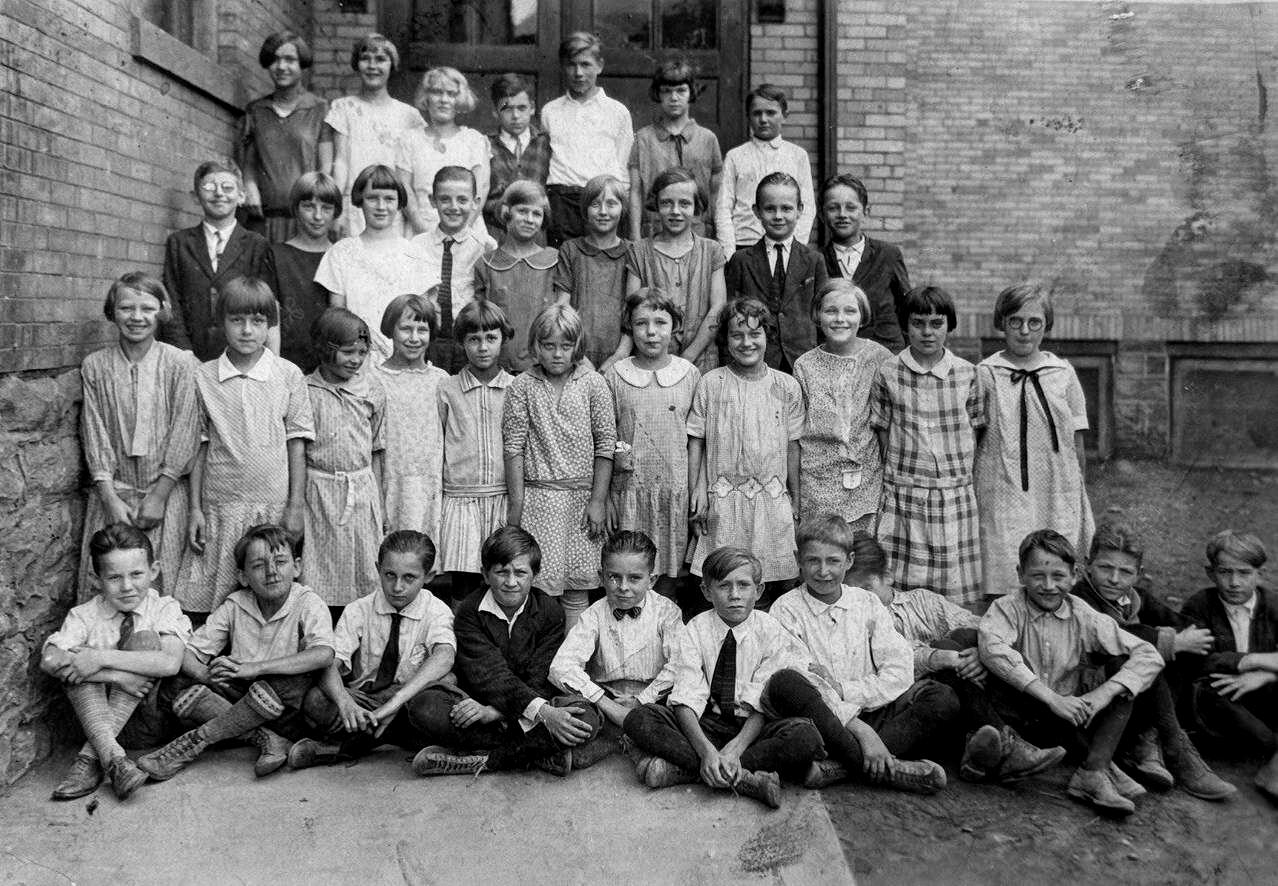
Primary education in America had been a largely an 8 year program in rural school. This means children 6-13 years of age. This finally changed in the 1920s as the poplation becme increasibgly urban. In city schools, 6 years became the norm for primary scgools. A 6-year program means children 6-11 years of age. The 1920s was the decade that American finally shifed to a majority urban country. This meant that more children were being educated in city porimaries which meant mostly schools with 6 year programs before passing to junior highs or some kind of middle school. Primary sdchools began with 1st grade when the children were about 6 years old. This has become the standard around the world. Some city schools had Kinfdergartens, but most children began school with 1st grade at age 6 years. 1st graders are usually easy to spot. The other grades are more difficult to ientify precisely unless indicated. And states were faced with the need to transition away from small rural schools which were expensive to operate.

Related Chronolgy Pages in the Boys' Historical Web Site
[Return to the Main American 1920s school level page]
[Return to the Main American 1920s school page]
[Return to the Main American 1920s]
[Return to the Main American 20th century school page]
[Return to the Main American 1920s page]
[Return to the Main American 1920s Activities page]
[Return to the Main Chronology Page]
[The 1900s]
[The 1910s]
[The 1920s]
[The 1930s]
[The 1940s]
[The 1950s]
[The 1960s]
[The 1970s]
[The 1980s]
[The 1990s]
[The 2000s]
Navigate the Relate Boys Historical Clothing Style Pages
[Return to the Main U.S. country page]
[Long pants suits]
[Short pants suits]
[Lederhosen]
[Kneesocks]
[Eton suits]
[Jacket and trousers]
[Blazer
[School sandals]
[Page/Dutch boy bangs]
Navigate the Boys' Historical Clothing School Uniform Pages
[Return to the Main U.S. School 1920s Chronology Page]
[Return to the Main U.S. School 20th century Chronology Page]
[Return to the Main U.S. School Chronology Page]
[Return to the Main U.S. School Page]
[Return to the Main National School Page]
[Australia]
[England]
[France]
[Germany]
[Ireland]
[Italy]
[Japan]
[New Zealand]
[Poland]
[Singapore]
[Scotland]
[Singapore]
Navigate the HBC School Section
[About Us]
[Activities]
[Chronology]
[Clothing styles]
[Countries]
[Debate]
[Economics]
[Garment]
[Gender]
[Hair]
[History]
[Home trends]
[Literary characters]
[School types]
[Significance]
[Transport and travel
[Uniform regulations]
[Year level]
[Other topics]
[Images]
[Links]
[Registration]
[Tools]
[Return to the Historic Boys' School Home]