|
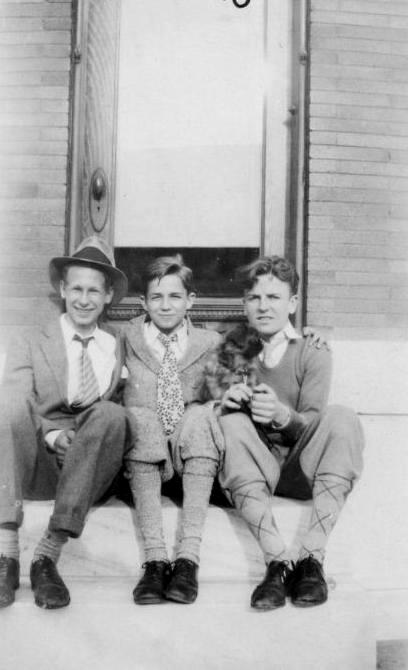
American boys in the 1930s mostly wore knickers with knee socks. They had shifted from the long-stockings worn by boys and girls for decades. We note boys wearing dark knicker suits for their confirmation in 1932. The knickers we see in the 1930s are almost all ones designed to be buckled below the knee along with the the new knickers with elasticized cuffs at the knee. And in the 1930s they tended to be worn with knee socks rather than long stockings that were still common in the 1920s. Here there were age and gender factors. Younger boys and girls were the most likely to wear long stockings rather than knee socks. This was a major shift from the 1920s when long stockings were still dominant. This is easier to tell than it sounds. Most long stockings were solid colors. Knee socks were mostly done in bright multi-colored patterns. Although not entirely the case, it is a valid rule of thumb. The photographic record clearly shows that the great bulk of the boys wearing knickers in the 30s wore them with these boldly patterned knee socks. There were many different patterns. They were more popular with boys than girls. These bold knee socks appeared in the 1920s, but were not very prevalent until the late-20s. This was true even when boys were wearing suits. An exception here is formal occasions. Some mothers insisted on conservative solid colored stockings matching the suit. Here it is difficult to tell if older boys were wearing long stockings or knee socks. Another major shift in the 1930s was that boys began wearing knickers with ankle socks, especially during the summer. We begin to see this in the mid-30s and it became increasingly common as the decade progressed. A good example is the Lincoln School in 1936-37. An exception to all of this was boys going barefoot. This practical was declining, but still fair fairly common during the summer, especially in rural areas. But knickers were not very popular in rural area. There boys ere more likely to wear overalls.
American boys in the 1930s mostly wore knickers with knee socks. They had shifted from the long-stockings worn by boys and girls for decades. The knickers we see in the 1930s are almost all ones designed to be buckled below the knee along with the the new knickers with elasticized cuffs at the knee. And in the 1930s they tended to be worn with knee socks rather than long stockings that were still common in the 1920s. This was a major shift from the 1920s when long stockings were still dominant. The photographic record clearly shows that the great bulk of the boys wearing knickers in the 30s wore them with these boldly patterned knee socks. There were many different patterns. They were more popular with boys than girls. These bold knee socks appeared in the 1920s, but were not very prevalent until the late-20s. This was true even when boys were wearing suits. This process can be followed ith some precission. While potraits and snapshots are commonly not dated, we can warch fshion trends develop in he mail order catalogs and clotthng advertisements during the 1920s, 1930s, and 1940s. We not only see actual adverts, but illustrations showing the hosiery worn with pants.
We note boys wearing dark knicker suits for their confirmation in 1932. There there were age and gender factors. Younger boys and girls were the most likely to wear long stockings rather than knee socks. Long stockings did not suddenly disappear. But very quickly boys turned to knee socks. We doubt bit was the bright patterns that changed their minfs. BUt long stokings were a lot of bother. And children, especially boys, do not like a lot of bother. They have whst the boys see as much more imprtant matters on their minds.
This is easier to tell than it sounds. Most long stockings were solid colors. Knee socks were mostly done in bright multi-colored patterns. Also the turn over tops of knee sock can often be seen. Although not entirely the case, it is a valid rule of thumb. The two bous wearing knickerrs here are clealy waring knee socks.
An exception here is formal occasions. Some mothers insisted on conservative solid colored stockings matching the suit. Here it is difficult to tell if older boys were wearing long stockings or knee socks.
Another major shift in the 1930s was that boys began wearing knickers with ankle socks, especially during the summer. We begin to see this in the mid-30s and it became increasingly common as the decade progressed. A good example is the Lincoln School in 1936-37. This vegan a generlprocess of knee socks gradually becoming hosiery associate wih girls.
An exception to all of this was boys going barefoot. This practical was declining, but still fair fairly common during the summer, especially in rural areas. But knickers were not very popular in rural area. There boys ere more likely to wear overalls.

Navigate the Boys' Historical Clothing Web Site:
[Return to the Main U.S. 1930s knicker page]
[Introduction]
[Activities]
[Biographies]
[Chronology]
[Cloth and textiles]
[Clothing styles]
[Countries]
[Topics]
[Bibliographies]
[Contributions]
[FAQs]
[Glossaries]
[Images]
[Images]
[Links]
[Registration]
[Tools]
[Boys' Clothing Home]
Navigate the Historic Boys ' Clothing Web chronol ogical pages:
[The 1900s]
[The 1910s]
[The 1920s]
[The 1930s]
[The 1940s]
[The 1950s]
Navigate the Historic Boys' Clothing Web style pages:
[Jackets]
[Long pants suits]
[Blazers]
[Kilts]
[Sailor suits]
[Short pants suits]
[Ring bearer/page costumes]
[Eton suits]