|
The Maya are one of the best studied of the major pre-Colombian native American civilizations. Unlike the Aztecs and Incas, the Maya were a much older civilization which had passed its peak by the time of the encounter with Europeans. The Maya first appear in the Yucatan Peninsula about 2600 B.C. They became a civiization of major importance about 250 AD in what is now southern Mexico, Guatemala, western Honduras, El Salvador, and northern Belize. Unlike the Inda and Aztecs, the Maya were not a centralized imperial state. There virtually independent city states were connected by extensive trade routes. The Maya show evidence of assimilating the technology and culture of previous civilizations which had developed to the north in moden Mexic, especially the Olmecs. The Maya are especially noteworthy for their achievements in astronomy, mathematics, accurate calendars, hieroglyphics, and archectecture. Mayan hieroglyphics,probably of Olmec origins, was the most sophisticated writing system in Meso-America. The Mayan archetectural heritage is especially impressive. Many sites in the Yucantan and northerm Central America include temple-pyramids, palaces, and observatories. The Maya especially venerated the jaguar and built temple-pyramids to the being they saw as the Lord of the Underworld. As with the other Meso-American civilizations, these edifaces were built without metal tools, beasts of burden, or even the wheel. Mayan agriculture was especially impressive as methods such as storing rainwater in underground reservoirs dealt with the limited available groundwater. The Maya were also accomplished weavers and potters. The Spanish encountered the Maya centuries after their classical era, unlike the Aztec and Inca who were in their acendancy. The decline of the Maya is one of the great mysteries in archeology. There are numerous theories. Increasingly archelogists are coming to believe that the decline was a more gradual process than was once believed. The process appears to have involved expanding populations which required overcultivation of available land resulting in decling yields that could not support dense populations.
The Maya along with the Aztec and Inca are the three best known pre-Colombian Amerindian civilizations. The Maya are, however, destinctive because of the time gap between them and the other two great Americn civilizations. The Aztec and the Inca were at their peak and destroyed shortly after contact with the Spanish conquistadores. The Maya on the other hand florished as a destinctive people more than a milenium before contact with The Spanish. Unlike the Aztecs and Incas, the Maya were a much older civilization which had passed its peak by the time of the encounter with the Europeans. The Mayan civilization flourished over large areas of northern Central America and souththern Mexico for an incredible 3,500 years. The Maya during the classical era made stunning cultural advances (200-900 AD). Most impressively they had a fully developed writing system (with hieroglyphic and phonetic elements) and incredibly sophisticated mathmatics--the two conerstones of civilization. The Maya finally ended with the Spanish conquest, but resistance continued for more than two centuries. The Maya are one of the best studied of the major pre-Colombian Amerindian civilizations, in part because they had a writing system. Modern research using new techniques is now naking major discovering over turning established assumptions about the Maya.
The Maya appear to have originated as an offshoot at the Olmec people. For many years archeologistzs studying Ntive American civilizations saw the Maya as the "mother culture" of Mexican pre-Colomvian civilizations. Gradually scholars armed with improved dating techniques and improved archeoligical methods have come to see the Olmecs as much more important than had earlier been believed. The Olmecs are best known for their huge carved stone heads. For years little more was known about the Olmec. Recent work has uncovered some information about this enigmatic early people.
The basic conclusion is that the Olmec pre-dated the Maya. They developed a complex society centuries before the Maya and appear to have influenced the Maya and other later Native American civilizations. The relationship between the Olmec and Maya as well as the Olmec's relationship with other early Native American civilizations is still not fully understood and much discussed among Native American scholars.
The Maya first appear in the Yucatan Peninsula about 2600 B.C. Archeologists begin to see evidence of an important evolving culture aboy 1500 BC. This is an era that has been poorly understood and researched. Archeologits are today finding increased ecidence of a rich cultural heritage far more advanced and sophisticated than previously believed. One important site from the pre-classical period is El Mirador in Guatemala. El Mirador was a great metropolis and may have been ???, the center of origin of the Mayan once thought to have been mytholgical. Another is a small site--Cival. Althogh not a great metropolis, a wonderful temple with elegant sculptures of what is believed to be the Sun God was found there. A magificent mural was found at an even smaller site of San Bertolo that included hyroglyphs showing the beginning of Mayan writing. It is one of two known Mayan murals of an importance and the only one from the pre-classical period. Kings once thought as mythological are increasingly believed to be atual historical figures. Arcelogists now believe they know the mames of kings dating back as far as 500 BC, kings such as Gret Firey Jaguar Paw. The pre-classical civilization appears to have collsapsed because of an ecolgical disaster. Deforestation stripped the hillsides and clay washed into the swaps that had been the source of rich soil that had supported agriculture. One archeolohist, Richard Hanson, believes that the production of lime plaster to use in coating the great monumental structures significantly contributed to the deforestation.
The Maya became a civiization of major importance about 250 AD in what is now southern Mexico, Guatemala, western Honduras, El Salvador, and northern Belize. Progress in deciphering Mayan glyphs have provided fascinating details about Mayan history. We now know that something very significant happened in the 4th century AD. At first it was thought that invaders arrived from the West, presumably Teoteouacan. It is now believedthat it was probably a faction that had been defeated and returned after forming an alliance with Teoteouacan. Their war leader appears to hsve been a teensager--Fire is Born. Besides military sucess, there seemns to have been a substantial cultural transfer. The Mayan classical era is generally seen to have flourished from about 200-800 AD. Some date the Classic Maya civilization to a briefer period (750-900), but this migjt be seen as the Golden Age. Most great civilizations have a kind of Golden Age. Many of the best known Mayan sites are in the tropical forest of the eastern Peten or Mayan lowlands.
The decline of the Maya is one of the great mysteries in archeology. There are numerous theories. Some postulate invasions and a sudden decline. A few sites show a rapid collapse and charred remains suggesting a war or peasant revolt. This is not, however, the general pattern. There are scholars that identify the religion and waring city states as a reason for the decline. Some climate change and or crop failures. Increasingly archelogists are coming to believe that the decline was a more gradual process than was once believed. The process appears to have involved expanding populations which required over cultivation of available land resulting in decling yields that could not support dense populations. Archeologhists agree that the Maya at the peak of the classical era densely populated their homelasnd. Some archeologists believe that the monumental building in particvular required vast amounts of lime resulting in deforestation that stressed the enviroment. Other researchers believe that climate change, especially declining rainfall may have been a major factor. [Haug]
The Maya following the �collapse� of the southern Maya lowland city-states reappear in the northern Yucatan. Here they built great ceremonial sites at Chicheb-Itza and Uxlum as well as a large number of smaller sites. The era is variously dated from 900-1000 AD to the advent of the Spanish in the early-16th century. Archaeologists in recent years have begun to reecaluate the Mayan Postclassical period. Earlier the Post-Classical era was viewed as one of decline and demise after the great Classical era. The culture od the Classical era did not disappear. Rather the Maya migrated from from the central lowlands to the northern highlands. This migration and the reasons for it is poorly undersrood.
Archaeologists divide the Post-classical into two periods: the Early Post-classic (A.D. 900-1250) and the Late Post-classic (A.D. 1250-1519). The Early Postclassic is dominated by Chich�n Itz� in northeastern Yucat�n. The Late Postclassic is the period in which Chich�n Itz� fell and Mayapan rose. There also seem to be expanding maritime trade around Yucat�n and further afield to Cuba and Central America. (The Spanish would encounter some of these Mayan traders.) Chichén Itzá, Mayapan, and Izamal (also written Uxmal) dominated Yucantan at the start of the Late Post-classical period in an uneasy balance of power in the northern Yucatan (1000-1100). Gradually the northern Maya lowlands began to fragment politically. The Lord of Chichén Itzá was Chac Xib Chac. The lord of Mayapan was Hunac Ceel. A war broke out between Chichén Itzá and Izamal. War between Mayan city states were common, but often limited and ceremonial. This war developed in a serious conflict (about 1100). The Itzá clan was driven from from Chichén. As a result the Itzá migrated south out of Yucatan and settled in Petén (modern northern Guatemala). The Cocom family had played a major role in the war against Chichen and came to dominate Mayanpan. They were able to insist that that the leaders of all the important Mayan city-states live at Mayapan--much as Louis XIV insisted that French nobels live at Versailles. The resulting political arragement has been called the 'League of Mayapan' which included 16 city-states. The Xiu clan led a revolt against the Cocoms (1441). The Cocoms were sacrificed ritually and their followers driven out of Mayapan. The result was the collapse of the the League of Mayapan. This is the Mayan period that was contempraneous with the Aztecs. The Xiu wanted independence and did not have the capacity to dominate the area beyond their northeastern stronghold. The Maya again became divided along rival city states engaged in rivalries and wars. This was the state affairs in the Mayan lands when the Spanish arrived (early-16th century).
Unlike the Inca and Aztecs, the Maya were not a centralized imperial state. The Maya are perhaps better described as people and culture than a politicial entity. Maya culture was composed of independent city states connected by extensive trade routes. There was intermitent warfare between these cities states ruled by kings with absolute power. War was an integral para of Mayan life. So little was known about the Maya that important anthropoligists though that in contrast to the Aztec, the Maya were a peaceful people. The recently discovered Mayan paintings leave no doubt about the martial ethos of Mayan courts. Some Maya cities were conquered by others, but no large kingdoms ever were created. The most ambitious effort to unify the Mayan city-state was the League of Mayapan (1194-1444). There was no real effort, however, to create a centralized state. Its demise left the Maya badly fragmented just before the Spanish arrived.
The Maya show evidence of assimilating the technology and culture of previous civilizations which had developed to the north in moden Mexic, especially the Olmecs. The Maya are especially noteworthy for their achievements in astronomy, mathematics, accurate calendars, hieroglyphics, and archectecture. Mayan hieroglyphics,probably of Olmec origins, was the most sophisticated writing system in Meso-America. The Mayan archetectural heritage is especially impressive.
The Maya were phenomenal mathematicians. They were not only interested in numbers, but they were truly obsessed with numbers. The devised a calendar of remarkable accuracy, much more accurate than the Europen calandar, a phenominal achievement for a stone age people. Maya mathematics was based on a system of 20. And they understood the concept of zero--a key concept in mathematics..
The Maya were Mesoamerica�s only civilization which developed a written language, a system based on Hieroglyphics. The Mayan system of hyroghyphics like that in Egypt was interwoven with religion. Unlike Mesopotamia where writing developed part because of a need for economic record keeping, Mayan hyroghyphics seems much more associated with religious ceremony. Partly as a result, Spanish priests after the conquest set out to destroy these texts and were largely successful (16th century). The texts were written on a kind of paper made from the bark of fig trees and were easily burned. Only a few of these texts called codicies survived. They are named after the European cities with museums that recovered them. The most important is probably the Dresden Codex. Anthropologists in the 19th centurymwho began to study these texts found it difficult to dechipher. They only succeeded after World War II. A Soviet linguist played a major role here working on material looted by the Red Army at the end of the War. Archaeologist George Stuart was interested in the Maya Hieroglyphics. He had a son called David. He took the boy with him on field trips to Maya archaeology sites. The boy became interested in their writing and became a junior archeogist. All the time learning more and more about this unreadable language. Scholars in the West and Communist word had formed different theories about the Maya language. The West thought the images reprecentEd concepts. The Russian scholars thought the images were phonetric. David eventually made a great discovery that was a break through in reading the Maya hierglyphs. He discovered that sets of images represented the same sound.
Many sites in the Yucantan and northerm Central America include temple-pyramids, palaces, and observatories. Many cities are built on an axis toward the rising sun of the autumn equinox. Some scholars see the monumetal structures in the city centers evolving toward structures designed to give a small elite the best view for the ceremonies associated with the equinox and thus reflect the evolving social structure. The Maya especially venerated the jaguar and built temple-pyramids to the being they saw as the Lord of the Underworld. As with the other Meso-American civilizations, these edifaces were built without metal tools, beasts of burden, or even the wheel.
The most important crop on which Mayan civilization was based was maize (corn). A crop developed in mesoamerica. And because it is the grain which most efficentlky converts sun energy is th most importnt crop in modern agriculyre. Many areas inhabited by the Maya were not rich agricultural areas. Poor soil limits normal agicultural yields. Yet Mayan agriculture supported a large population and important cities. Mayan agriculture was especially impressive as methods such as storing rainwater in underground reservoirs dealt with the limited available groundwater. Modern resesearch is finding increaing evidence of intensive agricultre which turned the Mayan Lowlands into a breadbasket, supporting a greater population than once thought possible. The Maya were also accomplished weavers and potters.
The question of pre-Colombian Amerindian populations in the Americas is today a hotly debated subject. Modern research is suggesting that the population was much higher than previously thought. The impact of the diseases that ravaged the Americas with the arrival of the Europeans have led academics for years to make rather small estimates. New work is suggesting much larger numbers in both north and South America. Some suggest, for exmple, a substantial Amazonian popultion. Recent work with lasers of all things is causing some researchers to up the estimated Mayan population. For years most scholars had placed the Mayan at its peak in the classical era (200-900 AD) at a few million, some as low as 1 million. The Fundación Patrimonio Cultural y Natural Maya (Pacunam), a Guatemalan nonprofit organization, has promoted reaearch in the Mayan Biosphere Rserve in northern Guatemala. With the services of the University of Houston National Center for Airborne Laser Mapping, laser enabled Light Detection and Ranging (LIDAR) technology is enabling researchers to peer benath dense jungle vegetation and spot bumps in the landscape. They look like rocky mounds and are overgrown with vegetation, but on the ground, archeologists who previously tramped over the area with little to show are now finding quarrys, collapsed structures, palaces, roads streets, homes, and other structures. [Seidel] One archeolohist has even found a lost pyramid and important ceremonial centers. Mayan experts are begininning to significantly increase popultion estimates. One expert has suggested a population approaching 10 million. [D. Davies] And we have noted other estimates of 15 million. That may not sound like a large number in today's highly populated world. But in the world of the first millenium, 10-15 million was a very substantial figure. In comparison, the population of the Roman Empire is esrtimated to have been only about 60 million. And the Maya were only one of the Amerindian peoples living in an area a fraction of the Roman Empire. Of course the collapse of the classical Mayan populaion was not the result of European diseases, but rather enviromental issues as a result of over exploitation of available resources.
Maya religious beliefs are today well understood because of cracking of the Mayan codices that survived the Spanish destruction of Mayan writings. It should be understood, however, that there was never a Mayan Empire with centralized authority like the Aztec and Inca Empires. Rather the Maya were a collection of city states some of which at times had great power and authority,but never and empire. with centralized political and religious control. And Maya city states were exposed to varying foreign influences. And the Maya had a much longer history than the other great per-Conquest peoples--basically spanning more than two millennia. The religion expressed in the codices surely had many distinct features dating to the end of the Mayan era and could have had had many differences from the earlier eras of Mayan civilization. Most significantly, the importance of the various deities in the Mayan pantheon must have varied over time. Mayan scholars debate endlessly over different aspects of the Mayan religion. Simply stated, the Maya belived just about everything in the world contains k'uh -- meaning sacredness. This is a basic animist concept. K'uh and k'uhul explain the spirituality of both inanimate and animate objects both living and non-living objects based on the essential divine life force of existence. Maya belief include the the creation and sanctity of not only human beings, but the earth itself. This divine sanctity appears in the Maya creation myths. Itzamná (God D) is commonly identified as the supreme god who created the world and seem to have been regarded as the most powerful god in the universe. This is a departure from many polygamous religions, his power as not based on brute power. Rather power was due to knowledge of writing, food, medicine, and other important areas. He is the deity that taught Mayan civilization and how to worship the gods. Itzamná and his mate Ix Chel gave birth or created all the many other gods. He seems to have been linked to the the sun god Kinich Ahau. Although t should be stressed that the importance of the various deities and their linkages varied over time. Also important is the Corn god. The Popal Moo (creation epic) centers on the corn cod. Corn of course was at the center of the agricultural economies of Meso-America. He or she was at the center of the Mayan cosmos. He is killed by the Lords of Death, but rescued by his children, the hero twins. Central to Maya religious beliefs is human, blood sacrifice. The Maya believed that they had to appease their gods with blood, both human and animal. They saw this as necessary for the continuation of life and prosperity of their society. Huitzilopochtli, the primary god of war and the sun, is often associated with human sacrifice. Tlaloc, the rain associated with fertility, as well as other gods also notably demanded human sacrifice. Some authors believe that the Maya primarily sacrificed high-status captives and more common captives were used for labor.
The Maya loved color. Temples and palaces were painted bright colors. The Maya liked to paint. Most of their painting was on stucco and part of their decoration of the interior of palaces and temples. Almost all of this was destroyed by the Spanish. The major examples of Mayan painting are tomb paintings discovered by modern anthropologists. These paintings as well as pottery and sculptures provide visual depiction of clothing. All of the Mayan art we have seen, however, depicts adults, thus providing no visual depictions of children.
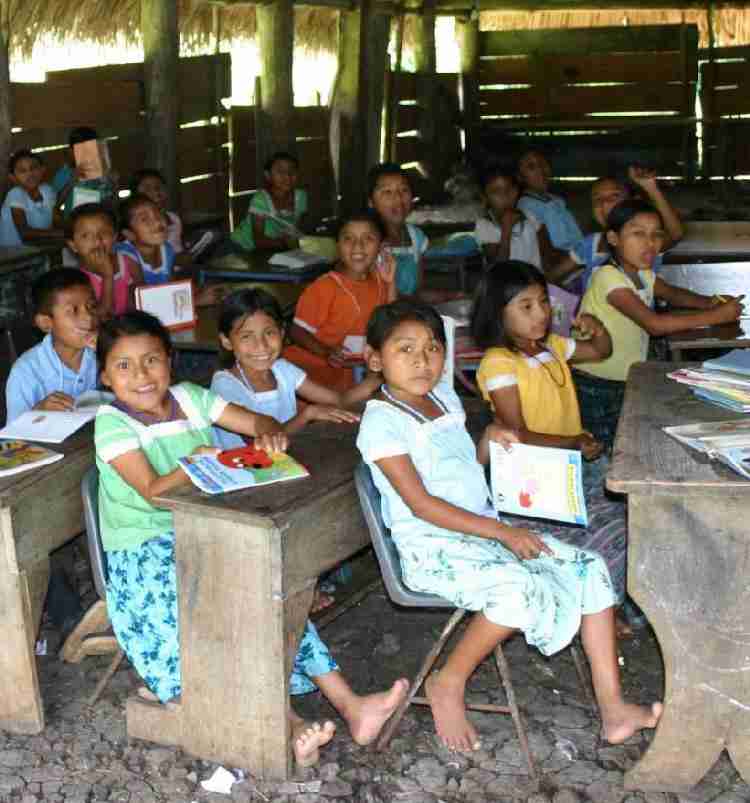
The classical Maya are known to have operated schools for the children of the upper classes. The younger sons of the nobility were trained as artist-scribes. Not a lot is known about these schools. Some Mayan scribes were women. Thus upper-class girls were presumably also educated in these schools. There msy have been separate schools for boys and girls. Unlike thge AZtecs, there was no attempt to educatee the common children. The great mass of the population was educated at home where parents trained the children. Boys learned the skills of his father. Most Maya were peasant farmers, but there were also artisans. Girls learned domesric skillsd. The youngesr children were cared for at home by their mother. At about age 4-5 years, boys would venture out from the home with their fathers. Boys would have a white bead tied in threir hair. This meant that he had passed from infancy and toddlerhood and had begin to learn from his father in the fields or perhaps on hynting expeditions. Girls had a red shell tied around their waist.
For those of us who have traveled in Yucatan and other areas of the Mayan lowlands, there is an awarness that there was not a great need for clothing through much of the year. The situation is somewhat different in the Mayan highlands. Much of the available information on Mayan clothing is more about the colonial era than the pre-Colombian era. The classic Mayan government for women is the huipil, a kind of blouse worn since ancient times. It is essentially a simple square or rectangular, the easiest shape to weave. There is a hole in the center for the head. The cloth is then folded in half and the sides stitched up except for the arm slits. The huipil is worn over a skirt normally tied with a woven belt. The neck area of the huipil was elaborately embroidered with beautiful designs meant to representing the Mayan cosmos, the gods and their helpers. Women in cooler areas of the Mayan highlands added a tzute, another rectangular garment worn over the shoulders both for warmth as a kind of shawl as well as decoration. Women have persisted on wearing garments worn by the ancient Maya. Modern Mayan men have for both political and economic reasons moved more toward European-styled clothing. There are still some influences from ancient times. The embroidered loincloth worn by the ancient Maya can today be seen in embroidered sashes or belts. Men also wear the embroidered tzute over their shoulders. We have no details yet about specific clothing styles for children
The Spanish encountered the Maya centuries after their classical era, unlike the Aztec and Inca who were in their acendancy. The most important Mayan tribes by the time of the Spanish conwquest were in Yucatan and ajacent Guatemalan highlands. This area became the major battlefield.
The Spanish conquest of the Mayan lands began with the invasion of Utatlan (1524).
The Spanish having conquered the Aztecs had many advantages. They had deceloped teactics useful in fighting Native American proples. And they had the advantages of modern weapons (firearms and steel swords), armor, and horses.
Inter-tribal rivalries aided the Spanish.
Unlike the Aztecs and Incas, there was no powerful centralized state or recognized imperial leader.
The battle ground was very different. The battles against the Aztecs and Inca were fought at high alditudes in climastes that were not unfamiliar to the Spanish. Yucatan in conbtrast was a semi-tropical jungle. Gunpowder might becomes sodden and metal rusts. Disease was a major factor. In Mexico and Peru, European diseases devestated the Native Americans. The Maya ere also affected, but in Yucatan the Spanish were also affected by tropical diseases to which the Amerindin people had some immunity.
Cortez and Pizarro had largely surprise; the Aztecs and Inca who had no direct contact with Spaniards before the conquistadors landed. The element of surprise was a major factor in the stunning Spanish victories. But the Spanish had come in contact with the Maya before the conquest of the Aztecs, Not only was the Spanish element of surprise not as strong with the Maya, but well before the arrival of the Spanish, the Maya had begun to migrant out of the cities and to live in smaller bands in the jungle. This meant that a major problem for the Spanish was to actually find the Maya.
Before the major Spanish Conquistadores arrived, guerillas began harrsing Maya communities. Thus the Maya retreated into the hungle, taking provisions with them. Thus the Spanish had difficulty bringing the Maya to battle. They also had difficulty recruiting native labor to carry their equipment and provisions.
Cortez had fought set piece battles on flat plains. This was ideal for the Spanish to use their horses and firte arms to maximum advantage. There would be no such battles in the Yucatan jungles. What the Spanish wanted was what proved effective in Mexico--take the emperor hostage. The problem with the Naya was that there was no emperor.
Maya history was one of rival city states, esentially principalities, without a strong centralized state. This meant that the Maya were never as poweful as the Aztec or Inca. It also meant that could not be defeated as easily--there would be not dramatic, swift take over of the non-existent Maya state.
Hern�n Cort�s after the conquyest of the Aztec begins exploring Yucat�n (1519). He did not find the riches encounteed in Mexico. He encountered the Itz� people in Pet�n (1524).
It would be, however, another experienced Conquistador that would launch the conquest of the Maya--Francisco de Montejo.
Montejo was a veteran of both Grijalva and Cort�s expeditions. There were still dreams of finding great wealth in the Yucatan. He petitioned the King for the right to conquer Yucat�n and was granted permission (1526).
He landed in eastern Yucat�n (1527). The first encounters were peaceful. The local chiefs were aware of the Spanish vctories against the Aztecs. When Montejo moved inland, however, he found deseted villages and as he moved deeper into the jungle was harried and then attacked. He built a coastal fort at Xamanha (1528). He then went to Mexico City to recruit more men enticing them with stories of golden booty.
Montejo returned with a larger army (1531). This time he attacked the western coast of Yucantan, seizing the city of Campeche wher he estanlished a fortified position. From Campeche he diuspastched his son Francisco Montejo (The Younger) to move inland. He did not encounter major resistance. Some Maya princes allied themselves to him, at least when confronted by his army. He reached Chichen Itza near the eastern coast. He declared this the Royal capital of Spanish Yucat�n. The Maya after only a short peeriod revolted. Montejo's force was neseiged and eventually force to narch to the eastern coast and flee by boat to Honduras. Some accounts suggest that Gonzalo Guerrero, a 1511 ship wreck survivor, helped lead the Maya resistance.
Montejo's father in Campeche was doing no better. Not only was he beseigned, but finding little gold, many of his men wanted to seek their fortunes elsewhere. Montejo withdrew from Campeche, seeking refuge in Veracruz (1535). This meant that Yucantan was back in Mayan hands.
A factor in the protracted effort to conquer the Maya was that they did not have the vibrant, rich cities and golden riches that Cortez found in Tenochititlan (Mexico City). Thus Spanish Conquistafores were not drawn to the campign as was the case in Mexico.
Montejo The Elder was now in his late-60s and no longer able to actively campaign. He turned his royal charter over to his son Montejo The Younger. The now experiened Montejo the younger launched the third Spanish invasion of Yucat�n with a larger force (1540). Montejo was able to take advantage of an important dynastic feud (1540). He established his capital in the Maya city of T'ho which he renamed M�rida (1542). From here he began the conquest of the Maya. The lord of the Tutal Xiu of Man� faced with Montejo's army converted to Christianity. This was a major step as the Xiu dominated much of western Yucat�n, They became the ally Montejo needed to complete the conquest. Before the Xiu alliance, the Spanish controlled only the areas in which their army was present. With the Xiu on their side, major areas of Yucatan cme under their control. It allowed the Spanish with Xiu allies to proceed to conquer western and southern Yucatan. Otherv Mayan princes pledged loyalty to Montejo and Spain, but rebelled when it became apparent what this meant. Fighting in the Yucatan ensued for several years.
A major battle between the Eastern Alliance and the Spanish-Xiu Alliance completed the conquest and decided the fate of the Yucatam (1546). There would be periodic revolts in Yucatan, but Spanish control was never in doubt. The Maya continued to resist in the south, the Pet�n region and the Guatemalan highlands. The Spanish effort to conquer and pacify the Maya was not completed until the surrender of the capital of Tayasal on Lake Pet�n Itz� (1697). After the open hostilities ceased, the Spanish established ecomiendas which essentially reduced the Masya to feudal serfs.
Coe, Michael. The Maya.
Coe, Michael and Rex Koontz. Mexico: From the Olmecs to the Aztecs.
Davies, Diane.
Davies, Nigel. The Ancient Kingdoms of Mexico.
Haug, Gerald. Nature (January 2006). Haug group researched sediments in China and Venezuela. They studied the Cariaco Basin along the coast of Venezuela. While outside the area of the Maya, there are climatic similarities and at least suggest that this line of research may be productive within the area inhabited by the Maya. The team led by Haug suggests that weak monsoons in China may have been a factor in the demise of the T'ang which disappeared at about the same time as the cassical Masya.
Seidel, Jamie. "Lost Mayan cities in Guatemala discovered in laser probe of jungle," News Corp Australia Network (February 5, 2018).
"Cracking The Maya Code," TV documentary.

Navigate the Children in History Website:
[Return to the Main Meso-America page]
[Return to the Main great Native American civilizations page]
[Return to the Main Native American page]
[About Us]
[Introduction]
[Biographies]
[Chronology]
[Climatology]
[Clothing]
[Disease and Health]
[Economics]
[Freedom]
[Geography]
[History]
[Human Nature]
[Law]
[Nationalism]
[Presidents]
[Religion]
[Royalty]
[Science]
[Social Class]
[Bibliographies]
[Contributions]
[FAQs]
[Glossaries]
[Images]
[Links]
[Registration]
[Tools]
[Children in History Home]