|
Japanese children's clothes, as do the clothes chosen for children in other countries, reflect large social, political, and economic trends. Often these trends are difficult to assess and isolate. In Japan these forces have been much more obvious. The Japanese militarists who seized control of the country proceeded to outfit children, boys and girls, for the new public education system in military uniforms to be regimented for building a new Japan. Japanese children made the transition to western dress
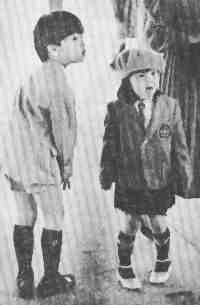
before many of their parents. After the cataclysm of World War II (1941-45) the Japanese again turned to Europe choosing briefly cut short pants to please their mother's fashion sense and their father's desire to toughen them up. The power of tradition is no where more obvious than the fact that secondary school boys continue to wear Prussian cadet uniforms 125 years after Prussia disappeared and after enduring one of the most cataclysmic military defeats in modern history.
The Japanese archipelago is located off East Asia, East of China and Korea and south of what became the Russian Far East. it is on the outer edge of the Asian continental shelf. The country is made up of of several thousands islands, only a few of which are of any importance. The major islands are Honshu, Hokkaido, Kyushu and Shikoku. Honshu with its Kanto Plain being by far the most important. The Sea of Japan separates the Asian continent from Japan. Mountain chains run down the spine of the major islands. This divides Japan into two major regions, one fronting on the relatively placid Sea of Japan and the other fronting on the not so pacific Pacific Ocean. The area of the Japanese islands is relatively small, comparable to modern Germany or the American state of California. The problem for Japan is that much of that land, about three quarters half, is mountainous--the primary source of wealth until well into the 19th century. Japan's mountains did provide an important resource--timber. Japan's northernmost islands are located on a similar geographical latitude as Milan or Portland, while her southern most islands are on a similar latitude as Florida. Meaning that there are substantial climacteric conditions between north and south. Japan is located along the Pacific Ring of Fire and where several continental plates meet, resulting in earthquakes and volcanic and activity. (Mt. Fuji is one of the world's most perfect and best known volcano.) There are frequent earthquakes as well as hot springs. Another geographic disadvantage was the absence of major rivers which are important in many countries as avenues of commerce. The combination of mountainous terrain and narrow breath of most of the islands meant that this was not the case in Japan. Japanese rivers are generally steep and swift, and unsuitable for navigation except for a small length of their flow. Thy did innodern tiomes offere a asource of power--hydro electric power as the hirv sorings lead to geo-thermal power. Another major disadvantage was the lack of important natural resources. Japan's island location did provide a degree of protection, defeating even the Chinese emperor sand the Mongols. Only with the Americans and the Pacific War did Japan's island defenses fail.
Japan with the assistance of the weather was one of the few countries to wiyhstand the Mongol onslaught. Its island have allowed it to develop a destinctive civilization, if rent by internal war for long periods. Unlike many countries, Japan managed to strictly control European traders and military expansion. The Industrial Revolution change this by providing Europeans industrial and military power that the traditional civilizations of Asia could not resist. India was the first major Asian area to sucumb to European expansion. After the Napoleonic Wars, Europe began to use its growing military power to expand into Europe. China's weakness was made manifest in the Opium Wars. Following the Opium Wars in short order the other civilizations of Asia were brought within the otbit of the world economy dominated by Europe. Commodore Perry openedcJapan with his famed black ships. The reaction in Japan, however, was radically different than that of the rest of Asia.
Japan unlike China faced major obstacles to developing a productive economy. There were very few natural resources and limited arable agricultural land. Medieval Japasn was a very conservative society with son following his father in the fields ot trade. The arrival of the Europeans and spread of Christianity began fed on existing forces which were destabiling society (16th century). The Shogun decided to liquidate the Christians and expel the Europeans, except for a small Dutch trading community. Foreigners who landed in Japan were executed which tended to limit foreign commerce. This continued until the arrival of Commodore Perry and his black ships (1853). Insightful Japanese leaders observing what was hapening in China, realized that they would have to modernize or be taken over by the foreigners. The first step was the Mejii Restoration which ended the Shogunate. Thus super-isolated Japan became the first Asian country to introduce Western methods and industrialize. The relationship between industry and military power was clear. The country, however, took to economic moderization much quicker than to political modernization. Japanese leaders influenced by 19th century European colonization concluded that their country would need a colonial empire to provide both raw materials and a masrket for industrial production. This attitude became particularly entrenched within the military. The result was first a long-drawn out war in China and then unable to defeat China, the Japanerse military decided to attack the United states. While Japan had built a sizeable industrial establishmednt, it was dwarfed by American industry. The result was the bloody Pacific war and national disaster. One of the great economic success stories of the 20th century was the recovery amd modernization of Japan following World War II. From the American occupation, Japan emerged both an economic powerhouse and a modern democratic country. Japan experienced economic stagnation (1990s). And the lost decade has become two lost decades. Japan today is one of the most important industrial nations. Demographic trends with the aging population is creating major problems.
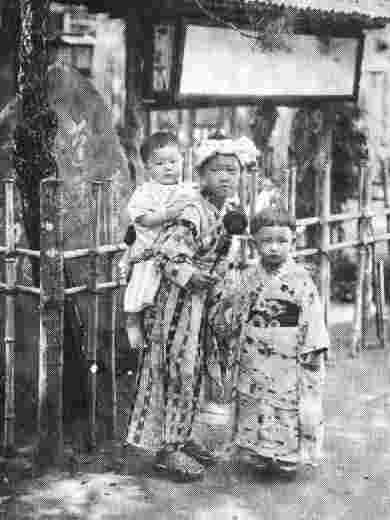
Japan until the Meenji Restoration (1867) was a largely feudal society. We do not have much information on clothing before the Menji Restoration, but it was traditional costumes that were as far as we can tell largely unchanged over hundreds of years. Japanese people today dress up in these traditional outfits, but it should be remembered that the traditional outfits worn by most Japanese people were much more plain than the fancy costimes and bright colors commonly worn today. After the Menji Restoration you begin to see Western dress, especially in the cities. To some extent it was seen as an aspect of moderniization. Western-style school uniforms were adopted for the new national school system. It was not until after World war II that Western dress became widely worn in the countryside. Even though Japan was occupied by the Americans, European-style clithes becne very popular for children in Japan. The short pants Japanese boys wore became destinctive by the 1970s. Beginning in the 1990s, Japanese children began to wear many of the same stules popular in American and Europe. Traditional clothes have not disappeared in Japan and are often worn by children for special occassions.
Japanese boys wore traditional in the 19th century. The Menji Resoration (1868) began a process of modernization in Japan, but boys for the most part wore traditional clothing in the late 19th and early 20 centuries. Girls were even slower to change. Japanese boys in the 20th century, especially after World War I (1914-18) have generally wore Western clothes. The transition to modern or Wstern garments was slower in rural areas than in the cities. Boys have, however, worn suits much less than American and European boys. Headwear has been different. Few Japanese boys have worn smocks, except for schoolwear. Boys wore a wide range of shirts. Casual "T"-shirts or other casual styles were very popular. Boys commonly wore short pants. Initially long baggy ones, but after Japan's defeat in World War II the European fashion of briefly cut shorts became very popular. Leather shoes have been worn much less than in Europe. Boys generally wore sneakers after World War II, except for very formal occasions.
|
We do not have much information about Japanese hair styles at this time. Our archive of Japanese hair styles is still relatively limited. We note many boys wearing cropped hair in the early 20th century. I am not entirely sure why this was so common. I believe the schools reqyuired it. The cut has a military look to it. This continued after World War II, but generally disappeared in the 1950s. Since then the principal hair style has been bangs. Here both boys and girls wear bangs. There are several ways of curring bangs. Some boys wear short hair so the bangs are not very pronounced. We also note a kind of shaggy bangs as well as bangs that are very sharply cut.
Photography began in Europe and America with the opening of Daguerreotype studios (1840s). Very little of this or other Western technology filtered into Japan as the Shogunate kept the country closed to the West. There was only a small Dutch trading post in Nagasaki where foreign trade and contacts were allowed under extremely limited conditions. It was here that the Japanese saw their first photographic portraits--Daguerreotypes. It is believed that a Dutch photographer took the first photograph in Japan. His identity and when he took that photograph appears lost to history. Only after Japan was opened to the West by Commodore Perry (1853) did modern refinements like photography begin to filter in to the country. Here because of their existing contacts, the Dutch helped introduce photography to Japan. Other foreigners soon were involved in this process. As this began to occur in the 1850s we see processes like the Ambrotype entering Japan. Thus most early Japanese photographs are Ambrotypes rather than Daguerreotypes. In fact there are very few Japanese Daguerreotypes. The cased photographs in Japan were done in wood. Within a few years Japanese pioneers like the physician Matsumoto Jun (1832-1907) began to study photography with a Dutch colleague. Much of the earliest work occurred in Nahasaki. His adopted son, Uchida Kuichi (1844-1875), studied photography under Ueno Hikoma in Nagasaki and opened a studio there. Many Japanaese city did not have photographic studios until the 1860s. Uchida moved his studio to Yokahama near Tokyo and acquired the reputation as the best photographer in Tokyo. He was granted a royal commission to photograph the Emperor Menji (1872). Most early photographers were foreigners. A particularly important one was the Venetian-British photographer, Felice Beato (1840-1904), who took beautiful images illustrating the Japanese lifestyle. Most Japanese photographers in the 19th century was more focused on portraits. We are not sure when the first albumen print was made, but surely it must have been during the 1860s. Even so, we notice ambrotypes still being made in the 1880s. The Ambrotype process in the West was displaced by albumen CDVs and cabinent cards in the 1860s. The number of Japanese photographers gradually increased and there were soon many Japanese studios (1870s). Japanese studios gradually replaced the Europeans (1880s). With the development of simple, inexpensive cameras, amateur photography became a popular hobby as was the case in the West.
We have just begun to develop information on the clothes worn by Japanese boys involved in various activities. In most instances Japanese boys wear the same garments and styles associated with these activities as are common in the West. There are some activities in which traditional dress is worn. Sports outfits are virtually identical, primarily because the sports themselves have been imported from the West. Sports are popular in Japan, but the very rigorous academic program means that Japanese children have less time for sport than Western children. And the schools do mot emphasize sports like mny American schools. The primary exception to the Western sports tradition is of course sumo wrestling which is somewhere between a Western sport and a Japanese cultural ritual. There are also the martial arts, but unlike sumo, martial arts have become popular in the West. One fascinating topic is the many festivals in Japan. They are very popular abnd the participants dress up in a wide-range of colorful costumes, including the children. Here the boys seem more involved than the boys. The arts are another important area. We note boys wearing Western garments with a destinctive Japanese look for some fine arts avtivities, especially music. We do have pages on music in Japan, both information on choirs and bands. The music children seem involved in appears to be mostly Western music. We have noted a Japanese popular music group, but do not know much about them.
|
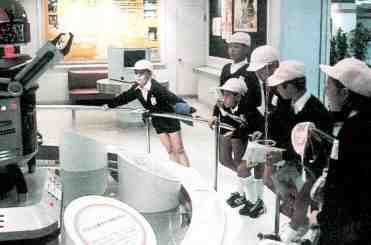
Many Japanese children have worn uniforms, especially school uniforms. This was not common in the 19th century. We see some boys wearing cadet-style school caps with kimonos, but rarely full uniforms. This changed with the 20th century. Many Japanese boys in the 20th century wore uniforms. Uniforms varied in primary school, but many city schools had simple uniforms. They were less common in rural areas. Unifoorms were worn at secondary schools. Boys wore cadet uniforms and girls sailor outfits. This us still common today. Some boys joined youth groups. The Scout movement was more limited in Japan than in America or Europe. There was also a nationalist youth movement, but we know very little about it at this time. School uniforms are still common in the 21st century, although the conventions are varied in primary schools. Most secondary schools, however, continue to have uniforms.
Family images are an espection interesting section of HBC. Images of families provide insights as to the clothing worn by not only boys at different times, but also the other members of the family. Thus there is a great deal of useful clothing information in these images. Family images also provide fascinating insights into life style trends, in some instances the inside of Japanese homes. Here we have just begun to collect such images, but have acquired several interesting images showing Japanese families in various decades. We now have a nimber of 20th century images. Much larger numbers of images are available for the 20th century, especially after World War I. The phiotographic record shows a remarkable remarkable transition from large families and trasitional clothing to small nuclear families and Western dress. This is essence the visual record of the transformation of a backward, agricultural society to a modern industrial nation.
Japan is an archepelago composed of islands of different sizes, including many small, uninhabited islands. Modern Japan is divided into 47 prefectures. Some are islands, but the more important islands are divided into separate prefectures. Traditionally Japan has been divided into eight regions. The archepelago streaches from Hokido on the north to Okinawa in the south. Shakalin has been contested with Japan. Hokkaidō is the northen-most region. It is a large island with many small islands. The largest city is Sapporo. Densely populated Honshū is divided into several regions. Tōhoku is the northern region of Honshū. The largest city is Sendai. Kantō is eastern Honshū. The largest cities are Tokyo and Yokohama.
Chūbu is central Honshū which includes Mt. Fuji.
Kansai or Kinki is west-central Honshū. The largest cities are Osaka, Kobe, and Kyoto. Chūgoku is western western Honshū. The largest cities are Hiroshima, and Okayama. Shikoku is another island region. The largest cities are Matsuyama, and Takamatsu. Kyūshū is another island region. It is the most southerly of the main islands. The largest cities are Fukuoka and Kumamoto. The Ryukyu Islands are part of Kyūshū. One of the largest of the Ryukyu Islands is Okinawa, the site of the apocolyptic World War II battle. Of all the islands, the Ryukyu/Okinawa are the most culturally dectinct because of its relatively recent incorporation into Japan by samuris (17th century).
Japan has one of the most homegenous populations in the world. This is in part due to a strong social bias toward homogeneity As a result, the Japanese have been largely intolerant of ethnic and cultural other differences. This is reflected in immigration laws which have strictly comtrolled the entry of foreigners. As a result, there does not seem to be a very large minority population. There are three domestic minorities:
the Hisabetsu Buraku, Ryukyuans, and the Aniu. The largest minority group are the hisabetsu buraku meaning discriminated communities. They are also referred to as the burakumin. This is not an ethnic minority, but rather the descdents of outcast occupational groups like butchers, tanners, funeral directors, and others. They are similat to untouchables in India. In Japan's conservative feudal society, sos took on their father's occupation and thus became hereditary. A factor in the occupations involved are related to Buddhist prohibitions against killing and Shinto attitudes toward pollution. During the Tokugawa Shogunate such hereditary soccial controls became more formalized and these people were required to live apart from the rest of society in designated buraku. The Meiji government abolished legal descrimination, but social descrimination continues. Another minority group are the people of the Ryukyuan Islands (including Okinawa). The Ryukyuans are more of a cultural than an ethnic minoroty. Of all the Japanease people, the Ryukyuans are the most influenced by Chinese culture. This is a geographic matter as the islands are the portion of Japan closest to China and chronologically the last area conquered by the Japanese.
The smallest minority group is the Aniu. Their language is destincr from Japanese. The Ainu were circum-polar hunting and gathering population related to coastal peoples in Siberia and Alaska. They inhabited northern Honshū as late as the Nara period (8th century AD). As Japanese settlement expanded north, the Ainu were pushed northward. The Meiji Government confined them to a reservation in northern Hokkaidō. Since World II a sizeable Korean population has become established in Japan. This is the only important foreign minority in Japan. There have been Chinese communities.
We do not have many personal accounts from Japan yet. Hopefully we will hear more from our Jpanese readers so we can expandcthis section. The language barrier here may be a problem. Many Japanese readers are hesitant to make a submission in English. We note an Ambrotype portrit of Okuda Michitaro in the 1880s. Ambros were still being made in Japan long after they havec been dusplaced by CDVs and cabinet cards in the West. He wears traditional clothing and has a traditiinal swept-back hair style. He looks to come from a wealthy family. Perhaps he was tutored at home. We note another wonderful Ambrotype portrait of Matsuda Komataro who looks ready to set of for school in 1885.
We note a portrait of four Osaka boys in 1936. A first we thought they were brothers, but the dealer tells us that their names appear to be different. We do not know much about them, but theeir choice of clothing is interesting. A Japanese reader has provided us a fascination account about his experiences as a National Boy during World War II.

Navigate the Boys' Historical Clothing Web Site:
[About Us]
[Introduction]
[Activities]
[Biographies]
[Chronology]
[Clothing styles]
[Countries]
[Topics]
[Bibliographies]
[Contributions]
[FAQs]
[Glossaries]
[Images]
[Links]
[Registration]
[Tools]
[Boys' Clothing Home]
Navigate the Boys' Historical Clothing Japanese pages:
[]
[Return to the Main Asian country page]
[Choirs]
[Department store catalogs]
[Monarchy]
[Movies]
[Music recitals]
[School uniforms]
[Scouts]