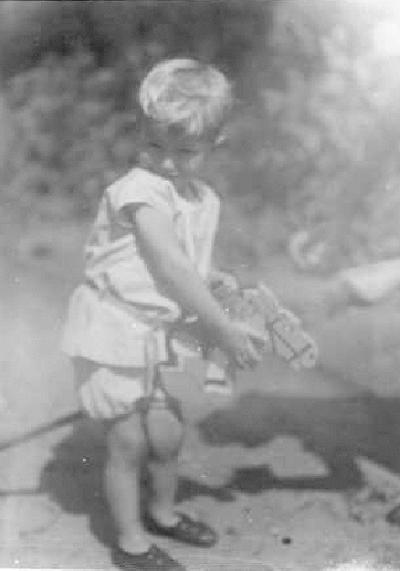
Figure 1.--Here I am n a romper outfit when I was about 5 years old. I don't remember, however, actually wearing it. |

|
I was born in 1928. I grew up in a small village in a rural farming community. I can recall rather well the kind of clothes that we boys wore at the time, including what was worn at out local school. As a small boy I wore rompers or "speelpakjes" as we called them. I wore rompers until I went to school when I was 6 years old. utch boys mostly wore short pants and knickers. Only older teenagers wore long pants. Most of our trousers were woolen, cotton or corduroy of good quality, because they had to be indestructable. Sailor suits were not common. I grew up in the country with farm kids. I think sailor suits were more common with city children. Most of us had a Sunday outfit, usually a shirt and jacket that would match the shorts or long trousers. We usually wore no caps, only sometimes a "bivak muts" (balaclava) in the cold winters. Only the eyes were visible. I do recall that we did have rather British looking peaked caps for special occassions. I found this picture of my school, taken on a summer day in 1935 or 36. Our school was a very small rural school. The German occupation did not affect Dutch boys' or other fashions for that matter, because textiles were rationed and pretty soon
there was no fashion to speak of. At the end of the War we all were wearing rags. In 1945 I did not even have shoes anymore. My first long trousers I got from a Canadian soldier who had them sent from
Canada to me. I was 16.
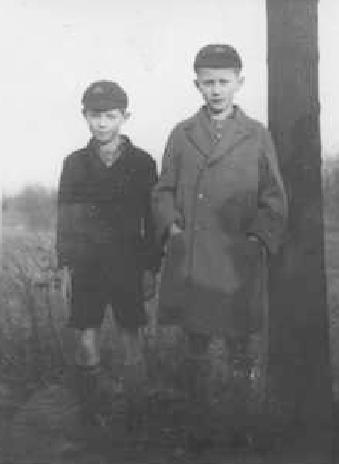
Here is a portrait of my grandfather, Johann Christoph Friedrich Stück, when he was a youth.
My grandfather was born 1865 in Cassel, Germany (now spelled Kassel). I thought the photo of grandfather standing next to that old clock is very interesting. I did not known my grandparents on my father's side as we lived in the Netherla]nds. My mother's parents wjo were Dutch I remember very well (and fondly)
They lived in Utrecht, my native city.
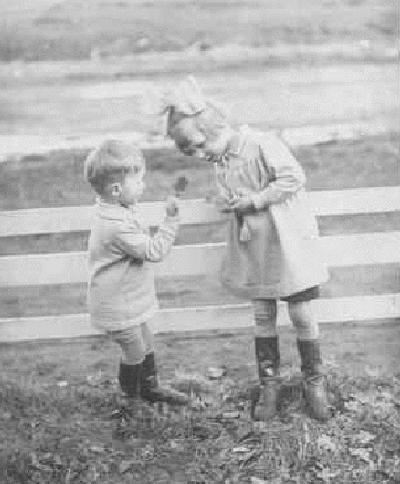
As a small boy I wore rompers or "speelpakjes" as we called them. I wore rompers until I went to school when I was 6 years old. Only boys wore "speelpakjes" as far as I know. In the picture with my sister we are wearing the same boots and more or less the same smocks or similar or more expensive jerseys. My mother often bought garments made by Bleyle, a company that produced high-quality but rather expensive garments. I don't remember the color of these garments. Unfortunately I don't remember wearing these garments. I have only the photographs to go by. I don't remember what the top of the smocks were like.
Dutch boys mostly wore short pants and knickers. Only older teenagers wore long pants. Most of our trousers were woolen, cotton or corduroy of good quality, because they had to be indestructable. Those pants were made in the Netherlands. The colors of our shorts and trousers were conservative: brown, grey, black or dark blue. Boys never wore bright colors like red, yellow or even green.
We all wore short pants. Even older boys wore shorts in the summer. In the mid-1930s when I went to school we also wore short pants to school. The colors of our shorts and trousers were conservative: brown, grey, black or dark blue, never red, yellow or even green. When the weather got cold in the winter, however, most of us began wearing "rijbroeken" (riding breeches). Nobody wore shorts in the winter unless they had long stockings over the knees, because the weather was too cold. Some younger boys did wear shorts with long stockings. Corduroy shorts were especially common.
Riding breeches were worn by nearly all the boys at school in the winter. They are different from knickers. "Rijbroeken" looked a little bit like what jockies are wearing, only much less wide on the sides. They came halfway the shins and they had 3 buttons at the end of the legs. You pulled your long stockings over them just up to under the knees. Those pants were usually woollen, often suede or corduroy and also conservative in color.
|
Later when I was 12-13 years old, knickers were ashionable. Knickers were called plusfours in Holland, also golf trousers. They closed just below the knees. You had to wear nice stockings
with them, often with some sort of a design. Most boys of my (high)school were wearing them. When I arrived in the U.S. in
1959 I was wearing shorts and people were staring at me. At that time no American adult male would wear shorts (only at the tennis court perhaps).
Sailor suits were not common. I grew up in the country with farm kids. I think sailor suits were more common with city children.
Most of us had a Sunday outfit, usually a shirt and jacket that would match the shorts or long trousers.
We wore woollen socks or stockings. Clothes were of good quality at that time. They were supposed to last.
|
We usually wore no caps, only sometimes a "bivak muts" (balaclava) in the cold winters. Only the eyes were visible. I do recall that we did have rather British looking peaked caps for special occassions.
I found this picture of my school, taken on a summer day in 1935 or 36. Our school was a very small rural school. We only had two classrooms. My sister, who was 2 years older than me, was taught in the same room. She is the girl on the far left with the ribbon in her hair). I am sitting in the front, the third boy from the right. I am wearing sandals without socks. My teacher did not like that at all. I remember that he wanted to send me home to get some socks or stockings for the picture, after all he said, "this is a Christian school and we were not supposed to walk around "half-naked". The fussy teachers was the one on the right, Mr. van den Berg. Most boys wear ties. All the boys are wearing short pants, some of them dark blue ribless corduroy that they also wore on the farm. Note that the boy on the right is wearing short pants with long black over-the-knee stockings. We had to walk to school (no buses), 45 minutes from home. Note that both of the two teachers are men. In American schools, primary school teachers were mostly women.
I remember some news reporting. This meant in the 1930s newspapers and radio as well as occassional newsreel went I went to the movies. I still remember some of the headlines from when I was about 10 years old. The one that sticks in my mind was about the Nunich Conference (September 1938). Primeninister Chamnberlain flew back to London and proclaimed "peace in out time". Of course as a 10 year old I did not have the education and the knowledge to understand what was happening. But at least I was starting to think about such mastters. A neighbor once told me: "Children have no business in politics". I do vidly remember. however, the trial of widow Becker in Liège. Belgium, who had poisened her husbands. At that time there were not that many murders, at least not in Holland and Belgium, and this one was sensational. There were pictures of widow Becker in the newspaper and I looked a long time at them ("so that's how a murderer looks".....).
I had a good friend who's father was a Dutch Fascist. This man had been in Indonesia (at that time still the Dutch East Indies) and had married a woman of mixed ancestry. There were many Fascisrt parties in Europe and many of them were not as race-obsessed as Hitler's NAZIs. My friend Eugene became a member of the Jeugdstorm and was one of the few who had a brown skin. I don't know what happened to him, because we moved away. Be sure this was in 1938-39 before World War II. The NAZI-oriented parties in Western Europe became more strict about race as NAZI influence grew. I suspect that he may have been expelled. This might have saved his life. Many of the older Jeugdstorm boys after the occupation were drafted into Waffen-SS units and deployed in the East. (The Germans were not sure that they wold be reliable against the Americans and British in the West. I have alwaysoindered how he made out.
World War II and the German occupation was a very difficult time. There was not much damage when the Germans invaded except in Rotterdam (May 1940). The situation got worse and worse as the War progressed. Food shortages developed. During the War we were forced to listen to German "Unterhaltungsmusik" (entertainment music). Some of the melodies were quite nice and easy to listen to. But we did hear Glenn Miller and other American bands through the BBC until the Germans confiscated all radios. My mother kept a tiny radio in the attic, because she wanted to hear the news from England. The German occupation did not affect Dutch boys' or other fashions for that matter, because textiles were rationed and pretty soon there was no fashion to speak of. At the end of the War we all were wearing rags. In 1945 I did not even have shoes anymore. My first long trousers I got from a Canadian soldier who had them sent from Canada to me. I was 16.
I had cousins in Germany. I went to visit them after the World War II. They lived in Cologne. This was first time after the War when we were allowed to visit our German relatives in British occupied Cologne (it must have been in 1947).Cologne like many other German cities were heavily bombed by the Allies. The worst attack as you describe was on May 30 1942 when the British dropped 2,000 tons of high explosives on the city. The devastation was total, except for the famous cathedral that was severely damaged, but still standing. There was not much contact during the war with the German relatives. Letters were censored and people were afraid to express their opinon. Ny cousins were 12 and 15 years old when I visited. They and their friends were wearing black corduroy shorts, obviously remnants from their HJ-uniforms. The parents got rid of the shirts and caps, but the shorts was another matter. They were of good quality and could be worn without problem." We are unsure just how commonly cord shorts were worn to school, but believe it was very common. Cologne was still in ruins, but the streets were cleared and cleaned. There were piles of rubble everywhere. I remember eating ice cream in front of the Dom (cathedral) with my cousins. We all knew what starvation was and we enjoyed the ice cream in spite of the fact that the quality was lousy. My uncle was captured by the Soviets after the Battle of Smolensk (1944). As far as I know the family was informed about his death by the Red Cross. They did not want to talk about Hitler and the NAZIs. My aunt avoided talking about that also. After my visit to Cologne I went to work in Indonesia and so there was less immediate contact.

Navigate the Boys' Historical Clothing Web Site:
[Main Dutch page]
[Introduction]
[Activities]
[Bibliographies]
[Biographies]
[Chronology]
[Clothing styles]
[Countries]
[Contributions]
[FAQs]
[Dutch glossary]
[FAQs]
[Images]
[Links]
[Registration]
[Tools]
[Boys' Clothing Home]
Navigate the Boys' Historical Clothing Dutch pages:
[Maiken Island]
[Dutch boys bangs]
[Dutch choirs]
[Dutch school uniform]
[Dutch catalogs]
[Dutch post cards]
[Dutch royals]
[Dutch youth groups]
Navigate the Boys' Historical Clothing national pages:
[Return to the Main Dutch page]
[Australia]
[Belgium]
[England]
[France]
[Germany]
[Ireland]
[Italy]
[Japan]
[Korea]
[Mexico]
[Scotland]
[United States]