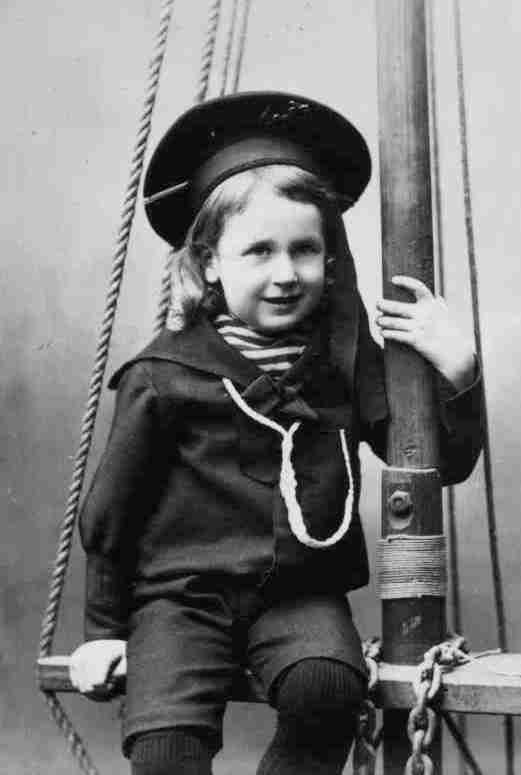
Figure 1.--This photograph was taken in Welligton, New Zealand during the 1890s. The fact that the photgrapher has a sailor setup shows that the sailor suit was commonly worn. Note the long stockings and ringlet curk. |

|
The garments worn by New Zealand boys were almost identical with those worn in England until after World War II. The primary difference was that New Zealand boys were less likely to wear shoes and stockings, in part becaise of the mild climate. New Zealland like neigboring Australia had a significant Scottish imigration and some boys did wear kilts at the turn of the century. The sailor suit was, as in England, a very popular 19th century style for boys after breeching. As in England, the sailor suit was usually worn to about the time boys began preparatory boarding school, or about 8 years of age. Boys were more likely to wear stockings and shoes for formal occasions. The same pattern continued in the 1910s when bous began wearing short pants instead of knee pants. They would commonly go barefoot, but would wear shoes and long stockings and later kneesocks when dressing up. After World War II clothing began to be increasingly casual. Clothing began reflecting the New Zealand climate more than the English climate. American styles began to appear and British styles were no longer the exclusive influence on local clothing. Un recent years increasing attention has been given to sun-safe garments.
HBC has no information on the extent to which boys wore smocks in New Zealand. Available photographic images, however, do suggest that in the early 2oth century that some
boys did indeed wear smocks. We suspect that it was not as common as say France, but instead followed the English pattern where smocks were worn, perhaps more commonly by boys
from affluent families or families involved or influenced by continental European culture. We do not know of smocks being worn to school, but do believe that that some boys wore smocks at home.
New Zealland like neigboring Australia had a significant Scottish imigration. The Scottish were particularly important on South Island. Kilts were worn by New Zealand boys, but it appears to be primarily a style for prosperous families during the 19th cenntury. It was probably more commoin for New Zealanders with Scottish ancestry. Large scale immigration began in the 1860s and 70s. This was about the time that that boys in England were beginning to wear kneepants more commonly than long pants. Short pants became very common in the eaely 20th centuty. Shorts wee commonly worn by boys to school. Short pants school uniforms were adopted by most secondary schools.
A New Zealand reader tellsus, "Came across this website by chance and whilst looking for pockets found parka. In New Zealand this is a light rain jacket, usually waist length or covering the bottom, sometimes pull over the head and usually with a hood. However I think we spell it parkha. Although in common use I can't recall ever having written it, which might indicate, as with many words used in New Zealand, that it originated in India."
Suits were very common in New Zealand during the 19th and first half of the 20th century. This is basically the same pattern as in Europe And America. Suits were much more common at the time than is the case today. We do not see skeleton suits becuse these suitswere worn befdore European settlement (early-19th century). We note a range of suis for younger boys. The sailor suit was, as in England, a very popular 19th century style for boys after breeching. As in England, the sailor suit was usually worn to about the time noys began preparatory boarding school, or about 8 years of age. Boarding school was not as common in New Zealand as in England. Boys living on remote farms might board, but it wa not as common for city boys to board. In part becaise the schools were in the cities. Thus perhaps somewhat older boys wore sailor suits in New Zealand. We also see Fauntleroy suits in the (late-19th century). We see the same suit styles in New Zealand as in Britain but the time British settlement began (mid-19th century). The two main suit elements are the jacket (often clled coat) and the trousrs (commonly called pnts in America. We do not see as many cut-sway jackets as in Britain as they were most popular at a very early phase of European settlement. We do see Norfolk and Eton suits and after the turn-of the 20th century double- and single-breasted jackets. Knee pants suits were very common and than subsequently short pants suits. Knicker suits were not very common. We also see long pants suits, but by the time long pants increased in poularity we see fewer boys wearing suits, except as part of school uniforms which often included suits or blazers.
New Zealand was settled by the British much later than America. It only became a colony in the 1840s and the Maoris still outnumbered the Maori in the 1850s. Large scale immigration began in the 1860s and 70s. This was about the time that that boys in England were beginning to wear kneepants more commonly than long pants. By the turn-of-the century most New Zealand boys, even quite old boys wore kneepants. Short pants style popularized by the Scout movement and the large numbers of New Zealand soldiers participating in the British campaign in Palestine. Thus after World War I (1914-18) most New Zealand boys wore short pants. This did not begin to change until the 1960s, although secondary-level schoolboys continued wearing short pants school uniform.
British boys mostly wore long stockings during the late 19th century, in part because of the climate. Mew Zealand was a British colony and children fashions in New Zealand generally followed Britoish fashions. There was one major exception. A lot of New Zealand boys and girls went barefoot, primarily because the climate was so mild. When dressing up, boys were more likely to wear stockings and shoes for formal occasions as was the case in Britain. For every day wear, howecer, going barefopot was very common. The same pattern continued in the early 20th century. By the 1910s when boys began wearing short pants instead of kneepants. They would still commonly go barefoot, but would wear shoes and long stockings and later kneesocks when dressing up. After World war II, knee socks began to decline in popularity, except for school uniforms and youth groups. American fashions becme influential after the War. And hosiery trends except for school were essentially the same as in America and now common patterns throughout Europe and North America. The only major difference is that going barefoot is still common in New Zealand.
Clothing styles in New Zealand were very similar to those in Britain, This only began to change after World War II when American syles began to have some influence. This was especially true for casual clothes. School styles continued to be essentially British styles. The one major difference is footwear. From an early point in the settlement of New Zealand, children commonly went barefoot. We are not entirely sure why thst was. The climate had to be a fsctor. And consumer goods before local industries developed much have been very expensive. Even after cattle wwre introduced, we suspect the quality of footwear was poorer than in England and the price was higher. This alomg with the climate may explain why going barefoot was much more common in New Zealand than Britain. We assume that footwear manufacturing by the early 20th century became comparable to Britain, although New Zealand is of course a much smaller market which would mean that companies did not enjoy economies of scale. Hopefully New Zealand readers can tell us more about this. We note boys wearing inexpensuive leather shoes with rubber soles in the late-20th century. They were almost always black shoes. British school sandals were never very popular in New Zealand, although many schools had Roman sandals as part of the summer uniform. Boys do not appear to have worn sandals much outside of school. Sneakers becane popular in the 1970s as was common in most countries.

Navigate the Boys' Historical Clothing Web Site:
[Return to the Main New Zealand page]
[Introduction]
[Activities]
[Bibliographies]
[Biographies]
[Chronology]
[Clothing styles]
[Countries]
[Essays]
[Contributions]
[FAQs]
[Glossaries]
[Images]
[Links]
[Registration]
[Boys' Clothing Home]
Navigate the Boys' Historical Clothing national pages:
[Return to the Main countries page]
[Australia]
[Belgium]
[England]
[France]
[Germany]
[Ireland]
[Italy]
[Japan]
[Korea]
[Mexico]
[Netherlands]
[New Zealand]
[Scotland]
[United States]