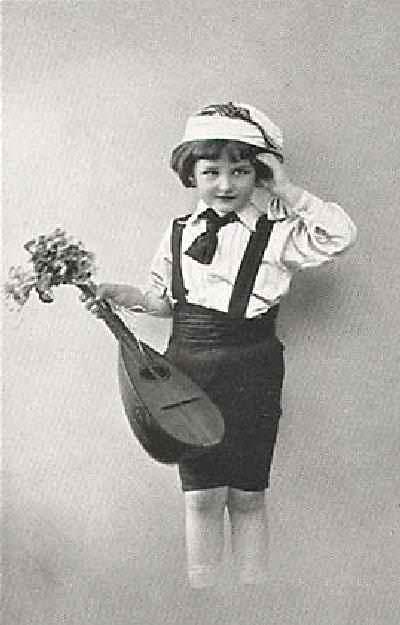
Figure 1.--This pre-World War I Austrian post card shows a child dressed in what looks like a Gypsey costume, at least the sash and hand band. Dressing up as a Gypsey shows that some Austrians hadaomantic view of the Gypseys. |

|
The German term for Gypsies used in Austria is Sinti. The first reports of Gypsies in Austria date to the 14th century, a century after they first appeared in Romania. The spread of the Gypsies seems to relate to their efforts to flee from Ottoman control. The Ottomans were expanding north in the Balkans, destroying Christian kingdoms in the process, including Bulgaria, Serbia, and Hungary. Utimately Vienna itself in eastern Austria became a major objective. With the help of the Poles, the Austrias were able to repel the Ottoman attacks. And over time the Ottoman Empire declined and Christian kingdoms were reconstituted in the Balkans. In those countries and in Austria, the Gypsies were a colorful presence.
Austria after defeat at the hands of the Prussians formed a dual monarchy with the Hungarians known as the Austro-Hungarian Empire. This created a huge area within the Gypsies could move with reltive freedom. The Gypsey population of Hungary was much larger than that of Austria. The Gypsies became a part of the Austrian folk tradition. The gypsies are more associated with Hungary, but as part of the same country, they became an important part pf the Austrian folk tradition as well. The energetic gypsey folk tradition also influenced the music of Hungary and Austria. The gypsies were looked down on in Austria. We note post cards picturing children in gypsey dress, but have not noted parents have their children photographed in gypsey costumes. Even before the rise of Hitler, the public in Austria and police officials complained about gypsies. After the Anschluss, the NAZIs targeted Austrian gypsies for sterilization or extermination. Inspient anti-semitism in Germany was expanded and intensified by the NAZIs as a primary policy. In the case of the gypsies, persecution appears to have developed as result from local demands as well as an outgrowth of NAZI racial policies. [Lewy]
The German term for Gypsies used in Austria is Sinti. The origin of 'Sinti/Sinte' is obscure. Scholars believe it was adopted in the 18th century,although the actual source is unknown. The Austrian Gypsies claim it comes from their Indian origins and they point to the Sindh, a historical region in the northern part of Asian Subcontinent,today aakistani province. Mahmud Ghazni raided into India from Afghanistant. Such raids would eventually lead to the establishmenht of the Delhi Sultabate. It is true that Muslim raiders do seem to have promted the migration of Gypsey people from India. The Banjara in India are usually identified as the people from whom European Gyysies sescended. The belief that Sinti is derived from "Sindhi" is not credited by scholars, butb is popular among the Gypey community.
The first reports of Gypsies in Austria date to the 14th century, a century after they first appeared in Romania. The spread of the Gypsies seems to relate to their efforts to flee from Ottoman control. The Ottomans were expanding north in the Balkans, destroying Christian kingdoms in the process, including Bulgaria, Serbia, and Hungary. Utimately Vienna itself in eastern Austria became a major objective. With the help of the Poles, the Austrias were able to repel the Ottoman attacks. And over time the Ottoman Empire declined and Christian kingdoms were reconstituted in the Balkans. In those coujntries and in Austria, the Gypsies were a colorful presence.
The Gypsies in Austria as in other countries wore colorful clothes and spoke Romanu, their own language. They also had
a range of destinctive customs. They made their living by exchanging goods for survival. Men worked as light smiths,makings pots and a variety of brass objects. They often worked in brass because it had aower melting pointbthan iron and was thus easier to work with basic facilities. Some Gypsies found work as musicians. Women might make money by telling fortunes or selling handmade goods or fruits and flowers from their wagons. Gypsy society was strongly centered on the family group and larger clan groups. Individual accomplishments were less important than in wider Austrian society.
Gypsies almost always married other Gypsies. Marriage with a non-Gypsy usually meant tht the couple was oustracized from the community. This to most Gypsies was a dreadful sabction, worse thn anything the state could do.
The gypsies were looked down on in Austria. We note post cards picturing children in gypsey dress, but have not noted parents have their children photographed in gypsey costumes. Even before the rise of Hitler, the public in Austria and police officials complained about gypsies. The Gypsies embraced a different life style than the bulk of the hard working Austrian people. For most Austrians, work was a virtue in itself. The Gypsies saw work as something that had to be endured and many just worked enough so that they could earn the bare essentials of life which meant mostly food. Thry lived in wagons or hovels and spentvery little on clothes. Thec children often wore rags. They gave little thought as go heir long term future. Most lived from day to day. And their moral ethic allowed stealing from the wealthy if it was necessary. As least gthat was the ideal. As the wealthy were usually wellprotected, it was usually the commom Ausyrian people who found items stolen. For the Gypsies, freedom was the ultimate goal and social demandslike schoolnd wirk were a obstacle to threir freedom. So rather than settling down nd wirking, most preferred to wander the roads in their wagons and brter for hat they beeded. After World War I many Gyseys began to settle down, but they still did not assimilate, buiding semi-permant hovels on the outskirts of towns and cities where they likved among themselves. Allof this of course did not sit well with the Austrians who tended to see them as not only slovenly, lazy, and dishonest, but often thieves and prostitutes
Austria with the rise of the Hapsburgs emerged as a major European power. Because of the popular attitides toward Gypsies, Austrian authorities begiunning with Emperess Naria Theresas began enacting laws to control them (18th century). The laws and regulations enacted was to ban their migrant lfe style. The Austrians were established 'colonies' for them. Austria after defeat at the hands of the Prussians formed a dual monarchy with the Hungarians known as the Austro-Hungarian Empire. This created a huge area within the Gypsies could theoretically move with reltive freedom. The Gypsey population of Hungary was much larger than that of Austria and not as regulared as the smaller Austrian Gypsey population. The Gypsy policies of Emperess Maria Theresia and her son, Emperor Joseph II, signiicantly affected Austrian gypsy settlement patterns. Settlement was somewhat successfulonly in the west--Burgenland along the Hungarian border. The measures were enforced through repressive actions. The Gysies were at the same time granted some rights, a legal status that they did not previously enjoy. The laws did not, howver, did not have the desired effect. To an extent Gypsies were forced into settlements. This did not mean, however, that even the settled Gypsies were integrated into Austrian society.
Moving out of their wagons into small houses did not mean assimilation. And even then,many had to move a great deal to seek occassional or seasonal jobs. About half were migrant wirkers. They continued to be a foreign element which occupied the lowest ranks of the social order.
The Gypsies became a part of the Austrian folk tradition. The gypsies are more associated with Hungary, but as part of the same country, they became an important part pf the Austrian folk tradition as well. The energetic Gypsey folk tradition also influenced the music of Hungary and Austria.
With the division of the Austro-Hunagrian Empire after World War I, only a small number of Gypsies were left in the
new Austrian Republic. Various sources estimate the population at about 8,000-11,000 Gypsies. Most lived in the province of Burgenland. They wee largely the descendents of the Gypies 'forcibly settled' by Emeress Maria Teresa anhd Emperor Joeph II. in the 18th centu=ry. This mean threy were a population who had lived a sedentary or partially sedentary life, for 200-300 years. They were also a desperately poor population. The partition of the Empire left Austria a small republic which had itseconomic ties severed. And it was alargely agrivcultural state. Much of the heavy ndisdtry of the Empire was in the Czech lands, now Czechoslovakia. This caused considerable economic location which was cfurther exacerbted by the Depression. And if the Austrian peasahntry and urban workers were brought close to poverty, the Gypseys as the lowest rank of society were in an even worse condition. This may have prompted increased criminal activity increasing the populart attitudes toward the Gypsies.
After the Anschluss (March 1937), the NAZIs began targeting Austrian gypsies for sterilization or extermination. Inspient anti-semitism in Germany was expanded and intensified by the NAZIs as a primary policy. In the case of the gypsies, persecution appears to have developed as result from local demands as well as an outgrowth of NAZI racial policies. [Lewy] NAZI authorities commonly say the Nuremberg Laws as applying to Gypsies as well as Jews. Thus with the Anscluss the force of NAZI fell upon the small Austria Gypsey community. The fate of Austrian Gysies becomes intwined with that of German Gypsies. NAZI authorities issued a decree on 'crime prevention' (December 1937). Because of their reputation for criminality, this provided the kegaljustification for arresting may Gypsies before an organized program was developed. Deportations began soon after. An estimated 1,000 Gypies were transported to
concentration camps at Buchenwald, Dachau, Sachsenhausen, and Lichtenburg (a female camp) (June 1938). The next year more Gypsies were transported to the Mauthausen, Ravensbrück, Dachau, and Buchenwald concentration camps (1939). Treatment as well as identification varied. Gypsies werecgenerally given the black triangular patches identifying 'asocials' or the green pstches for professional criminals. A few were given the Z pstch. NAZI authorities set up two special internment camps for Gypsies in Austria. One for 80-400 people was estalished near Salzburg (October 1939). A larger camp for 4,000 people was opened near Lackenbach in the Burgenland (November 1940). This was the eastern Austrian state bordering Hungary where manhy Austrian Gypsies lived. This was not a temprary camp, but was mainjtained theougout the War. Conditions were especially bad there. While it was not a death camp, conditions were so bad that many died there. The camps were used for forced labor as well as to concentrate Austrian Gysies for eventual deportation to the NAZI concentration and death camps in Poland. Sone were deported to occupied Yugoslavia. More than half of the Austrian Gypsies were arrested and deported to concentration camps or other places of detention during World War II. That was not as high a proprtion as the Jews arrested abnd deported. We are not sure at this time just only half of the Austrian Gypsies were deported. Most were eventually killed in the death camps. Few of those deported survived. About half of Austrian Gypsies (about 4,500 people) survived the War.
Some 40,000 Gypsies lived in Austria today. As so many Austrian Gypsies were murdered by the NAZIS. many modern Austrain Gysies have immigrated from the Balkans after the War. They are primarily found in and around Vienna and Burgenland province. They now mostly speak German, but many of the older people are fluent in Romany or Sinti languages. And cthey are no longer largely nomadic. Most live in settled communities. They are not as separated from Austrian society as they once were, but they are also not well assimilated into Austrian society. Many Gypsy children now attend Austrian schools, but without support at hime and often weak German language skills their academic performance is often poor meaning tht their employment opportunities are limited. Some see school as a limitation on their 'freedom'. Austria like Germany has a successful apprenticeship program for youth (mostly boys)not going on to college. One source reports, "Young men who have completed apprenticeships are described by their employers as hard-working and honest." For some reason, however, the appretices often do not go on to become long-term employees. Most want to return to threir fmilies.
Young women commonly find employment factories or as kitchen help in restaurants.
Guenther Lewy, The Nazi Persecution of the Gypsies (Oxford University Press, New York 2001).
Thurner, Erika. Edited and Translated by Gilya Gerda Schmidt. <1>National Socialism and Gypsies in Austria.

Navigate the Boys' Historical Clothing Austrian pages:
[Austrian catalogs]
[Austrian choirs]
[Austrian movies]
[Austrian school uniforms]
[Austrian youth groups]
[Lederhosen]
Navigate the Boys' Historical Clothing Web Site:
[Introduction]
[Activities]
[Biographies]
[Chronology]
[Clothing styles]
[Countries]
[Bibliographies]
[Contributions]
[Essays]
[FAQs]
[German glossary]
[Images]
[Links]
[Registration]
[Tools]
[Boys' Clothing Home]
Navigate the Boys' Historical Clothing national pages:
[Return to the Main Austrian folk page]
[Return to the Main ethnic country page]
[Australia]
[Austria]
[Belgium]
[England]
[France]
[Germany]
[Ireland]
[Italy]
[Japan]
[Korea]
[Mexico]
[New Zealand]
[Scotland]
[United States]