
Russian Activities: Religion
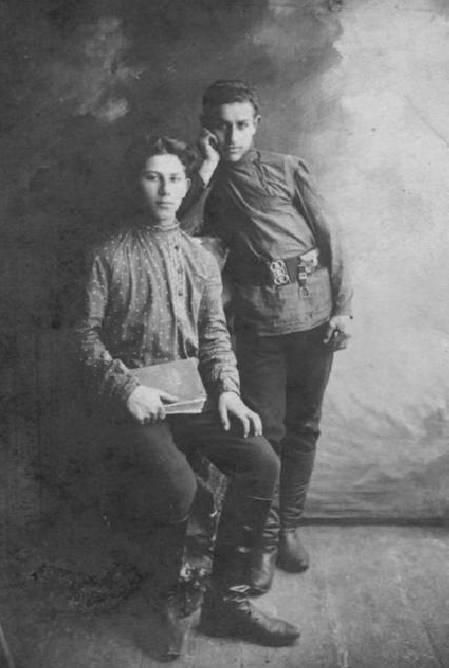
Figure 1.-- These youth had their portraits taken probably about 1910. One holds a book entitled 'Mecca'. Presumably he is a Muslim from the Caucases or Central Asia. They seem to be assimilated Muslims. We do not know at this time much about Tsarist policies toward Muslims.
|
|
The principal religion of Russia for a millenia was Eastern Orthodox Christianity. Russia's Russian Orthodox Church is believed to have been founded by the Apostle Andrew, although this is by tradition rather than any real historical records. St. Andrew may have visited Scythia and Greek colonies along the northern coast of the Black Sea. One tradition reports Andrew reaching what was to become Kiev. St. Andrew's Cathedral today is reportedly located where At Andrew planted a cross. Better historical records show the influence of Byzantium and the Eastern Church on Slavic lands by the 9th century. Saint Cyril and Saint Methodius translated parts of the Bible into Old Church Slavonic (863-869). This was an important step in the Christianization of the Slavs. Patriarch Photius or Patriarch Ignatios at Constantinople sent the first Christian bishop to Novgorod (866-67). Chritianity had begun to make inroads with the Kievian nobility (mid-10th century).
Greek and Byzantine priests were active. Princess Olga of Kiev was the first ruler of Kievan Rus to convert to Christianity (945/957). Olga's randson, Vladimir the Great, made Kievan Rus' a Christian state. Prince Vladimir I of Kiev officially adopted Byzantine Rite Christianity (988). The Russian Orthodox Church has come to see this date as the creation of the Russian Orthodix Church. The Church thus traces its apostolic succession through the Patriarch of Constantinople. The Kievan church was a Metropolitanate of the Patriarchate of Constantinople. As Kiev began to decline with the Mongol invasions, the Metropolitanate and thus the center of the Russian Church moved to Moscow (1326). While the Nongols conquered Russia, they did not attempt to destroy the Church. By the time Ivan drove out the Tartars, Russia was thorougly Orthodox Christian. The fall of Constantinope (1453) made Moscow to claim the role as the center of the Orthodox Church. Religious diversity occurred as a result of Tsarist military campaigns. Werstern rite Roman Catholics were brought into the Empire with the acquisition of the Western Ukraine, Poland, and Lithuania. The conquest of Estonia and Finland brought Protestants. Catherine's success againt the Ottomans in the south brought Muslins into the Empire. The Russian Revolution brought the Communists to power who promoted atheism (1917). Stalin persued a ruthless program to supress both the Orthodoix Church and Islam. The program had considerable success, but did not suceed in totally destroying religion and there has been a revival since the fall of Commuism and the disolution of the Soviet Union (1991). Today in Russia boys dress up for special occassions which now includes attending church or outings of various sorts.
Christianity
Eastern Orthodoxy
The principal religion of Russia for a millenia was Eastern Orthodox Christianity. Russia's Russian Orthodox Church is believed to have been founded by the Apostle Andrew, although this is by tradition rather than any real historical records. St. Andrew may have visited Scythia and Greek colonies along the northern coast of the Black Sea. One tradition reports Andrew reaching what was to become Kiev. St. Andrew's Cathedral today is reportedly located where At Andrew planted a cross. Better historical records show the influence of Byzantium and the Eastern Church on Slavic lands by the 9th century. Saint Cyril and Saint Methodius translated parts of the Bible into Old Church Slavonic (863-869). This was an important step in the Christianization of the Slavs. Patriarch Photius or Patriarch Ignatios at Constantinople sent the first Christian bishop to Novgorod (866-67). Chritianity had begun to make inroads with the Kievian nobility (mid-10th century).
Greek and Byzantine priests were active. Princess Olga of Kiev was the first ruler of Kievan Rus to convert to Christianity (945/957). Olga's randson, Vladimir the Great, made Kievan Rus' a Christian state. Prince Vladimir I of Kiev officially adopted Byzantine Rite Christianity (988). The Russian Orthodox Church has come to see this date as the creation of the Russian Orthodix Church. The Church thus traces its apostolic succession through the Patriarch of Constantinople. The Kievan church was a Metropolitanate of the Patriarchate of Constantinople. As Kiev began to decline with the Mongol invasions, the Metropolitanate and thus the center of the Russian Church moved to Moscow (1326). While the Nongols conquered Russia, they did not attempt to destroy the Church. By the time Ivan drove out the Tartars, Russia was thorougly Orthodox Christian. The fall of Constantinope (1453) made Moscow to claim the role as the center of the Orthodox Church.
Church State Relationship
The most important schism in the Russian Orthodox Church was the Old Believers who (старове́ры or старообря́дцы) who separated from the official date-supported Russian Orthodox Church (1866). They objected to church reforms introduced by Patriarch Nikon (1652-66). Patriarch Nikonwas disturbed by differences he noted between diiferences with the Greek Orthodox rites and texts. He unilaterally ordered that the Russian rites be changed to bring them into conformity with the Greek rites. He proceeded rapidly. There was no real consulation with the clergy and he did not call a Church council as one might expect for such a major change. The Old Believers held firm to the liturgical practices of the Russian Orthodox Church before Patriarch Nikon's reforms. The term for the skism is raskol (раскол), means cleaving apart. Meeting resistance, the Orthodox heirarch supported by the Tsarist Government acted to supress the Old Believers. The Old Believers vigorously pursued their opposition. Archpriest Avvakum Petrov (c1620-82) assumed leadership of the conservative party within the Old Believers' movement and denounced all ecclesiastical reforms, refusing any compromose even after a Church council was belstely called. . The Church hierarchy anathematized both the old rites and books as well as the individuals remaining loyal to the old rites--Synod of 1666. This mean that the Old Believers officially were stripped of their civil rights. The Hierarchy ordered the Old Believers arrested. Seceral including Archpriest Avvakum were executed (1682).
The Hierarch launched a comprehensive program of persecutions (1685). The intensity of the persecultion varies. Under Peter the Great (1682–1725)it was fairly mild--double taxation. Other under tsars it was intene, such as Nicholas I (1825–55). In the Tsarist state, religious diversity was often seen as a security threat. Old Belivers arrested were tortured and sometimes executed. Some Old Believers fled Russia to escape the persecution. This was the beginnin of the establishment of Old Believer communities in Europe. There are important centers in the Ukraine and Romania and eventually around the world, including America and Australia. The Hierarchy never suceeded in eliminating the Old Believers heresy. The Old Believers even remained the dominant force in isolasted areas far from Moscow such as the Far North as well as pockets elsewhere (Kursk region, the Urals, Siberia, and Russian Far East). The last Imperial Russian census found that about 25 percent of the Russian Empire adhered to Old Believer branches (1910). With the victory of the Bolsheviks and the atheism campaign, more Old Believers sought refuge abroad. The Moscow Patriarchate revoked the anathemas imposed on the Old Believers (1971).
Religious Diversity
Religious diversity occurred as a result of Tsarist military campaigns. Werstern rite Roman Catholics were brought into the Empire with the acquisition of the Western Ukraine, Poland, and Lithuania. The conquest of Estonia and Finland brought Protestants. Until this time, Jews were not permitted in Russia. These conquests brought large numbers of Jew in to the Empire. Catherine's success againt the Ottomans in the south brought Muslins into the Empire.
Communist Atheism Campaign
The Russian Revolution brought the Communists to power who promoted atheism (1917). Stalin persued a ruthless program to supress both the Orthodox Church and Islam. Under Stalin, the program was pursued with great vigor. The collectivization program and the Ukranian Famine significantly ubndermined the peasantry whivh had been a bastion of the IOrthodox Church and traditions. Stalin pursued the atheism campaign with considerable brutality. The program had considerable success, but did not suceed in totally destroying religion. The campaign was largely suspended during World war II after the German invasion (1941). Stalin position the war effort as an egfgfort to sabe Mother Russia and Russian traditions. After Stalin's death, the atheism campaign was not suspened, but it was no longer brutally pursued. Aperson could get into trouble for teaching children about God, mostly people outside the family. And religious devotion was not good for a person's career or even access to higher education.
Modern Russia
There has been a revival since the fall of Commuism and the disolution of the Soviet Union (1991). Today in Russia boys dress up for special occassions which now includes attending church or outings of various sorts.
Christians for centuries after the fall of Rome (5th century AD) gererally tollerated and coexisted with Jews and anti-Semetic eruptions were limited. At this time there were very few Jews living in Eastern Europe. Beginning with the Crusades (11th century) this began to change. Anti-Semetic laws, vicious programs, and expullsions spread in waves over Western Europe. European Jews fleeing the oppression of Roman Catholic Western Europe moved east to Polandand other Eastern Ruropean states. The Tsars did not tolerate Jews within their empires and as Muscovy expanded their were mass killings in newly acquired cities. The Tsar adopted an openly ant-Semetic policy (1721). Areas conquered by the Russian Army were cleared of Jews, such as the Ukraine (1727). This was normally done with great brutality. Ironically the Jews of Greater Russia developed into the largest and most important Jewish community in the world. This was in large measure the result of the Polish Partitions (1772-95) and the incorporation of Poland into the Tsarist Empire. Russian Jewery became the heart of the Jewish world and the origins of the Zionist movement. The opressive policies of the Tsars also lead many Jes to embrace socialism and revoutionary politics. As many as 5 million Jews are believed to have lived in Russia before World War I and the Revolution. Jews played a oprominant role in the Revolution and Bolshevik movement. Tsarist Russia became the Soviet Union and finally the Confederation of Independent States (CIS) with a deminished, but still very sizeable Jewish population.
Islam
HBC

Navigate the Boys' Historical Clothing Web Site:
[Return to the Main Russian activities page]
[Return to the Main national religion page]
[Introduction]
[Activities]
[Biographies]
[Chronology]
[Clothing styles]
[Countries]
[Girls]
[Topics]
[Bibliographies]
[Contributions]
[FAQs]
[Glossaries]
[Images]
[Links]
[Registration]
[Tools]
[Boys' Clothing Home]
Navigate the Historic Boys' Clothing Russian pages:
[Ballet]
[Children's literature]
[Choirs]
[Fashion magazines]
[Movies]
[Royalty]
[School uniform]
[Youth groups]
Navigate the Boys' Historical Clothing Web Site:
[Return to theMain country page]
[Australia]
[Canada]
[England]
[France]
[Germany]
[Ireland]
[Italy]
[Mexico]
[New Zealand]
[Poland]
[Scotland]
[United States]
Created: 5:05 AM 2/5/2007
Last updated: 12:45 AM 4/20/2019