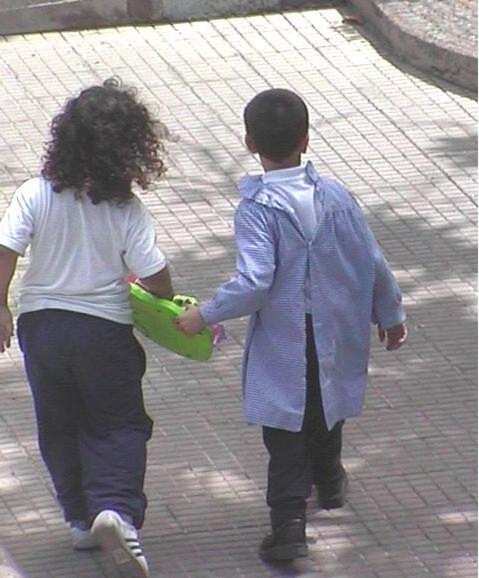
Figure 1.--Many school children on Grand Canary Islands wear smocks as in some other sections of Spain. |

|
There are several important regions of Spain. We have only begun to collect information on these regions. There were important differences between those regions, but since World War II these differences have declined significantly. Some of the major regions are Andulucia, the Basque country, Castille, Catalonia, and Galicia. There is also the Canary Islands. We have very limited information on clothing differences at this time. We note that school scghool smocks are especially common in Catalonia. They also seem common in the Canary Islands.
Spain under the 1978 constitution following the death of Franco has 17 autonomous regions. These regions are based on the historical refions of Spain. These regions have their own parliament, president, government, administration and Supreme Court (plus its own flag and capital city). The regions are not, however, independent of the central government. The regions are funded by the central government. The different regions vary as to their authority and responsibilites. The Basque Lands, Catalonia, Galicia and Andalucia are responsible for matters such as economic development, education, health, environment, police, public works, tourism, culture, local language and social security. Other regions have, however, substantially less autonomy and more limited responsibilities. The people of the Basque country, Catalonia and Galicia are recognized as separate ethnic groups with the right to use their own languages in education and administration. These rights were granted by the the Statute of Autonomy which was approved in a national referendum (1983). The issue of regional power and autonomy is an important issue in modern Spanish politics.
Each Spanish region is divided into provinces, rather like counties in American government. There are about 50 provinces.
Al Andalus was the term for the Mudlim vcontrolled area of the OIberisn Penindula. It was after the Arab conquest all but a few minor moujntenous areas in tyhe northwest (711). Some 500 years of Muslim rule left a lastig influenceon Andalusia's culture. Al Andlus became an extremely wealthy and the most cilturted aewa of Western Europe. Rulers cultivated scholarship and and thur weere advances in many areas. WEe still see the Moorish influence in the architecture, language and customs such as ion of bull fights and Gypsy flamenco music and dance. Andalusia provides the strongest external image of Spain. Gradually the Christians launchd the Reconquista, driving the Muslums often called Moors further and further south. Grenada was the last Muslim kingdom to fall (1492). The modern Spanish province of Andalusia is the southernmost autonomous region with both an Atlantic and Mediterranean coasts. It is the most populous and the second largest autonomous regiom The Spanish Government regonizes Andausia as a 'historical nationality'. The region is divided into eight provinces: Almería, Cádiz, Córdoba, Granada, Huelva, Jaén, Málaga, and Seville. The capital is Seville. Facing the Atlantic, Seville asfter Columbus' discovery became the gateway to Spain's new empire in the Smericas (16th century). The Casa de Contratación was located in Seville ehivjh became one of largest and ruchest cities in Western Europe (16th century). Ity bisd here thst th treasureshios arrived loaded with gold and silver. The small, but strategic British overseas territory of Gibraltar has a 1.2 kilometres and border with the Andalusian portion of the province of Cádiz. Andalusia offers Spain's most-varied terrain and vegetation. Ther terainev includes alpine mountains and pine forests at the higher elevations, arid and barren deserts. TYhere asre some fertile irrigated plains that support the ciltivationm of subtropical fruits. Andalussia bebefuts fron a Mediterranean climate prevails in lowland Andalusia, with mild, rainy winters and hot, dry summers.
The Canary Islands are located off the northwestern coast of Africa, very close to southern Morocco. The Canaries archipelago includes seven major islands (El Hierro, La Palma, La Gomera, Tenerife, Gran Canaria, Fuerteventura, and Lanzarote). They are all volcanic in nature, the cones remnaining from extinct volcanoes. The semi-tropical Weather and beautiful beaches have made the islands a modern tourist attraction, especially for northern Europeans seeking a vacation escape from cold, rainy weather. The Canary Islands were known to the ancient world. They were presumably known to the Phoencians, Greeks, and Carthiginians, all people who engaged in commerce into the Atlantic. The first written reference is Roman. They referred to them as the Fortunate Islands. As a linguistic quirk, the islands were not named for birds (canaries), but large dogs (Canes) found there. Pliny the Elder, the archipelago was found to be uninhabited when visited by the Carthaginians under Hanno the Navigator who noted the ruins of great buildings. This suggest that the islands were inhabited by other peoples prior to the Guanches, a general term for the neolithic people encountered by the Europeans. They are believed to be related to the Berbers before Islaminization. The Arabs and Portuguese are known to have visited the islands, but did not attempt to seize them. The Portuguese did seize the Azores and Maderia to the north. The islands were seized by Castille (beginning 1402). Castille by this time had emerged as the most important Iberian nation and was in the process of creating a unified Spain. Until this time, however, Castille unlike Aragon, was a land power. Castill had a very small navy and no overseas possessions. As with the case of Clumbus, foreigners were used by Castille. French explorers Jean de Béthencourt and Gadifer de la Salle launched the conquest for Castilian King Henry III, the grandfather of Isabella. Spanish administration would provide the template for the Spanish conquest and administration of the Indies. The islands later became important as stopovers for Spoanishs ships headed for the Americas. The first of course were Columbus' fleet. This brought a degree of prosperity to the islands. Over time as ships developeda greater capability and the sugar industry had trouble competing with that of the Indies, the Canaries became a backwater, among poorest regions of Spain. This only changed after World War II and the advetboif cheap air fares which resulted in the development of an important tourist industry. A major problem has arisen in recentears with African migrants fleeing the poverty of their countries and trying to reach the islands as a way of gaining entry to the European Union.
Extremadura is a historical region of Spain encompassing the large southwestern provincias of Cáceres and Badajoz bordering on Portugal. Castile-León lies to the north, Castile–La Mancha to the east, and Andalusia to the south.
The region got its name because as the Christian Reqonquest advancec south, the area was conqwuered by tyhe Chrustians (1248). The Moors began calling it Ext=remadura -- a region that was outside of the Moorish territory. This is a rugged area and historically one of the poorest and least known regions of Spain. The capital city is Mérida. Located in the central-western part of the Iberian Peninsula. The Day of Extremadura is celebrated September 8. It coincides with the Catholic festivity of Our Lady of Guadalupe. She is the blessed Virgin Mary who appeared five times (1531). A venerated image on a cloak is now enshrined within the Basilica of Our Lady of Guadalupe in Mexico City. The rugged topography meant that there was a limited area of arable land. And since agriculture was the primary economic base, Extrmadura wa a generally impverished area of Spain with few econimicv prospects. As a result, many of its adventurous young men after the completion of the Reconquista (1492) has fewcprospects. After Columbus' voyage in the same year, they turned to the Americas. leadingb the creation of the Spanish Empire. More than a few of the famed Spanish conquistadores, including the two most important (Coirtez and Pizarro) and earlier settlers of the Americas came from Extrmadura (16th century). Columbus was Italian, but it was Extremadura that provided the military fiber for empire. As a result, many important Latin American cities are named after towns in Extrmadyra. This has meant that many large Latin Amrerican cities are named after small towns in backward Extrmadura. Mérida in Mexico's Yucatan Peninsula is Extremadura’s capital city. Trujillo in Peru is named after one of Extremadura’s most beautiful towns. Cities in Colombia, Venezuela and Puerto Rico). are also named Trujillo. There is a Cáceres in Colombia. Medellín is a large Colombian city, named after a small town in Badajoz province. Other Medellíns are fojund in Mexico, Argentina and the Philippines. Interestingly, many Americans who have never heard of Extramadura are familar with it--it was widely featured in the TV blockbuster 'Game of Thrones'.
The various regions of Spain are the result of past invasions that gave birth to several languages, of social and political history, of
the existence of natural barriers such as mountains and rivers etc etc.
Phonicians, Greeks, Carthaginese, Romans successively invaded Spain, followed by some German tribes after the fll of Rome. Among the German tribes, the most important ws the Visigoths. They finally were replaced by the Arabs.
During these periods several languages developed. The official Spanish language is the Castillian, three other are officially
recognised by the central government: Catalano, Galiciano and Vascuence (Basque). Some other such as Valenciano (very near to
Catalano) are very vivid.
There is no such thing than an official list of regions but one could proceed here in two ways, the tourist approach and the historical way.
Tourists, mainly coming from northern Europe, will invade the coasts that, starting from the French boarder are: Costa Brava, Costa Dorada (golden), Costa del Azahar (orange blossoms), Costa Blanca (white), Costa del Sol (sun), all these on the Mediterranean Sea, then past Gibraltar on the Atlantic the Costa de La Luz (light) and
back to north between Portugal and France the Costa Verde (green). Inside the country tourists would know only some old famous towns such as Cadiz, Granada, Toledo or Salamanca with their marvellous old
architectural treasuries.
Taking the historical way the regions of Spain would include first the former kingdoms of Aragona, Castilla, Leon, Murcia and Navarra. Castilla as such is divided into the new (la Nueva) and the old (la Vieja). The other regions are along the french boarder:
Asturias, El Pais Vasco (Basque) and Cataluna, then down to south Galicia and Andalucia. On top of these regions from the peninsula España one must add the two groups of islands, Las Islas Baleares ( Mediterrannean) and Las Canarias in the Atlantic.
21st century images show relatively little differences between boys' clothing in different Spanish regions. Images from Majorca, for example shows mot boys "T" shits and polo shirts with jeans ans sneakers. [Hammer] This has infact become almost a pan-European style.
Spain developed the first great European world empire. The country began to build a colonial empire even before it completed the Reconquista. This was because Aragon was not an exclusively Spanish kingdom, but rather had extensive Mediterranean trritories. Castille conquered the Canary Islands which served as a model for the conquest and coloinization of the Americas. Immediately after completing the Reconquista with the conquest of Grenada (1492), Ferdinand and Isabella approved Columbus' voyage west which led to the estanlidshment of a vast New World Empire and vast quantities if gold and silver. The Spanish also followed the Portuguese south, leading to African quantities. Moorish raids of Spanish shipping and cpoastal areas led to wars with the Moors and the seizure of coastal asreas. Other colonies were acquired, including the Philippines ikn the Pacific. The Napoleonic Wars led to the loss of most of the American colonies, except Cuba and Puerto Rico. Spanish colonial rule, however, did not develop the economies or prepare the population for self-rule. The result was basically two centuries of chaoltic government and underdeveloped economies. The United Stastes seized these last American colonies during the Spasnish Amneriucan War and the Philippines (1898). Spain and France vied for control of Morocco during the early-20th century. Spain turned over the Spanish Sahara to Morocco and Mauritania (1975). Spain has has retained a few small outposts along the Moroccan coast. Spain still retains several possessions along the Moroccan coast, including Ceuta, Melilla, and the small island of Pe��n de Alhucemas, Pe��n de V�lez de la Gomera, and Islas Chafarinas.
Hammer, Ute Edda. ed. Majorca". Culture and Life (Edited by Koenemann, Cologne, English ed. 2000).

Navigate the Boys' Historical Clothing Web Site:
[Spanish art]
[Spanish choirs]
[Spanish ethnic groups]
[Spanish movies]
[Spanish royalty]
[Spanish school uniforms]
[Spanish youth organizations]
Navigate the Boys' Historical Clothing Web Site:
[Introduction]
[Activities]
[Biographies]
[Chronology]
[Clothing styles]
[Countries]
[Bibliographies]
[Contributions]
[FAQs]
[Spanish glossaries]
[Images]
[Links]
[Registration]
[Tools]
[Boys' Clothing Home]
Navigate the Boys' Historical Clothing national pages:
[Return to the Main Spanish country page]
[Return to the Main countries page]
[Australia]
[Belgium]
[England]
[France]
[Germany]
[Ireland]
[Italy]
[Japan]
[Korea]
[Mexico]
[Scotland]
[United States]