|
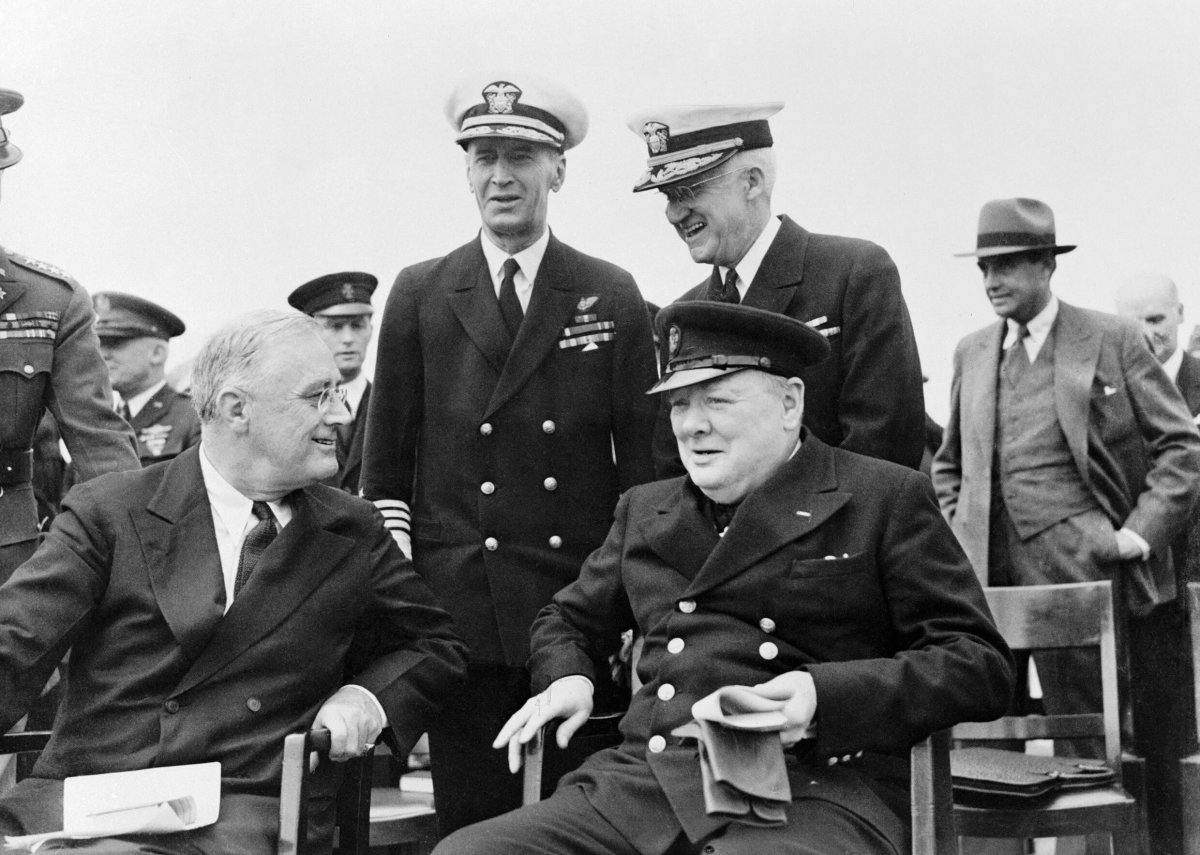
The Atlantic Charter is one of the key documents of the 20th century and remains still relevant today. President Roosevelt and Primeminister Churchill meet aboard the Prince of Wales on August 9-13, 1941 at Placentia Bay. The Prince of Wales had been badly mauled by Bismark in May. It was to be sunk by a Japanese aerial attack in December. Roosevelt and Churchill issue the Atlantic Charter. The two were war time allies. Britain had weathered the worst that the NAZI Luftwaffe could throw at it. America and Britain were fighting the U-boats in the North Atlantic to keep Britain alive. It was clear that America would soon be drawn into the War. America had already played an important role in keeping Britain alive and the two countries were the only hope of the occupied European and in fact Western civilization itself--threatened by the evil tide of NAZI tyranny. The two leaders, the two most important men of the 20th century, agreed to a simple, but elegant eight-point statement of their aims which today still stands as the central credo of the Atlantic Alliance.
President Roosevelt and Primeminister Churchill meet aboard the Prince of Wales on August 9-13, 1941 at Placentia Bay, Newfoundland. The Prime Minister had arrived on the Prince of Wales. The President on the cruiser Augusta. The Prime Minister first visted the President on the Augusta, delivering a letter from King George VI. He then briefed the President on Britain's peilous strategic position. The next day on Sunday President Roosevelt attended church services with Prime Minister Churchill onbopard the Prince of Wales. Churchill after the services continued his description of the War and the need for American intervention. [Alsop, pp. 180-181.] Out of the discussions emerged the Atlantic Charter. President Wilson's Fourteen Points had provided the ideological basis for the Allied war effort in World War I agree America entered the War. The Atlantic Charter was to state the aims of the world's two great democracies in the upcoming struggle and the peace to follow.
Britain had weathered the Blitz and the worst that the NAZI Luftwaffe could throw at it. America and Britain were fighting the U-boats in the North Atlantic to keep Britain alive. It was clear that America would soon be drawn into the War. America had already played an important role in keeping Britain alive and the two countries were the only hope of the occupied European and in fact Western civilization itself--threatened by the evil tide of NAZI tyranny. The war situation had dramtically expanded when Hitler ordered Operation Babarossa, the invasion of the Soviet Union (June 1941). At the time, however, the Wehrmacht had driven deep into the Sovirt Union, smashing whole Russian armies. It was unclear if the Soviets would be able to withstand the onslaught. Britain had just experienced defears in the Balans and the Nirth African campign ws not gioing well. In the Pacific, the sutuation was now heating upmas well. Japan was mired down in China, but now appeared to be iopening upm a new front in Southeast asia. They had just occupied southern Indo-China (Vietnam) leading to an American oil embargo. he War was ckarlyb reachig a critical pointb and America was still not in it.
The HMS Prince of Wales was the Royal Navy's newest and most powrful battlleship. it had been badly mauled by Bismark (May), pimarily because it had not yet completed its shake down cruise. It had just undergone extensive repairs. The Alantic Charter was tragically the ship's one shining momment (figure 1). It would be sent to the Pacific to help protect Singapore along wuith the battle cruiser HMS Repulse. It would be sunk by Japanese aerial attacks a few days after Pearl Harbor (December 1941). This for ever settled the question as to how vulnerable surface ships, even battleships, were to aerial attack.
Roosevelt had met Churchill during World War I, although Churchill did not remember. President Franklin Roosevelt and Prime Minister Winston Churchill issued the Atlantic Charter. The two became close war time allies. This was their first meeting of the two men in the ensuing emergency of World War II. Churchill sailed accroos the Atlantic for the meeting. There would be several more meetings in which these two men would forge an alliance that would save Western ciuilization.
Stalin had been a indispensable ally for Hitler, jointlyb inmvading Poland launching the War. Abnd then invading neighboring countries and conducting brutal NAZI-like occupations. The only major duifference was yhe NAZI obsessuionb with destroying the Jews. Most imprtantly, the Soviets supplied the NAZIs with huhev quanties of ctitical material that resource-poor Gernany lacked--especially oil. The NAZI Western capaignn leading to the fall of France and the air campaign against Britain woud have been difficult without Soiviet resource shipments. Of course, this all change after Hitler ordered Operation Barbarossa (June 1941). Roosevelt and Churchill tried to involve Stalin in endorsing the Atlantic Charter. Despite the needs for allies, Marshall Marshall Stalin demured at some of the provisions of the Charter.
President Roosevelt's key adviser Harry Hopkins was sent to Britain to lay the groundwork for the meeting. While there he flew to the Soviet Union to meet with Stalin and get a first hand report on Soviet ressistance as well as Soviet needs. (American military experts did not think the Soviets would be able to stop the NAI panzers.) Hopkins got back to Britain just in time to join Churchill on the Prince of Wales. He was not a well man, the flights to and from Russia were very difficult, and he had left his meecine behind in Russia. At the meeting he played a key role. Itvwas imperatuive that a joint statement be issued by the two leaders immediately after the meeting to gain the full publicity and image of joint purpose. A disagreement over trade issues threatened to prevent agreement on the text. Hopkin's genius was his ability to cut to the heart of an issue and he convinced Roosevelt to conceed the text on trade so that agreement coukld bereached on the joint statement. [McJimsey, p. 176-77.]
HMS Prince of Wales with Primeminister Churchill sailed into Placentia Bay down a line of U.S. Navy ships to the waiting USS Augusta. Here President Roosevelt awaited him. Both men had left their capitals with cover stories. The President was supposedly in New England on a 10-day fishing trip. Churchill boarded Augusta.
The two leaders were silent for a brief moment until Churchill said "At long last, Mr. President." Roosevelt replied "Glad to have you aboard, Mr. Churchill". Churchill presented a letter from King George VI and made a formal, official statement which, despite two attempts, a sound-film crew present failed to record.
President Roosevelt and Prime Minister Churchill attended church services on Sunday aboard the Prince of Wales. Both Roosevelt and Churchill discussed the service beforehand. Churchill chose his favorite hymn, "O God Our Help In Ages Past," which was sung first. Roosevelt chose "Eternal Father Strong to Save." They also sang "Onward, Christian Soldiers". [Meacham] It was a emotional point in the developing relation between Churchill and Roosevelt and through them Britain and America.
President Roosevelt and Prmeminister Churchill had been secretly correspomding ever since Churcill had returned to the Admiralty (September 1939). This was their first face to face meeting since a brief encounter at the end of World War I which Churchill did not even remember. They spent hours together and there is no record as to what was said in their private conversations. The primary discussions were about the War and here there was general agreement. An area of contention was Britain's empire. Prime Minister Churchill reported to cabinent members that the President had told him that he would order the U.S. Navy into an undeclared naval war in the North Atlantic which would bring America into the War. It is likely that the President did make such a commitment, but his actual words are not know. And this does not sound like something the President would have said at the time. The U.S. Navy had been ordered to escort convoys months earlier and incident hd already begun to occur. So precisely what the President said is unknown. Britain's desperate plight may have affected how Churchill remembered Roosvelt's actual words. It seems likely they would have discussed the impact of incidents. There is no doubt that American programs like Lend Lease bordered on acts of war and committing the Navy to protecting Atlantic convoys would inevitably lead to incidents between escorts and U-boats.
American and Btitish commanders held high level talks concerning joint strategies and safeguarding the movement of American war supplies in the North Atlantic.
T he two leaders, the two most important men of the 20th century, agreed to a simple, but elegant eight-point statement of their aims which today still stands as the central credo of the Atlantic Alliance. The Charter was awkward in that it was essentially a statement of American and British war aims--but America was not at war. Thus it had to be very carefully couched for American public consumtion.
The President of the United States of America and the Prime Minister, Mr. Churchill, representing His Majesty's Government in the United Kingdom, being met together, deem it right to make known certain common principles in the national policies of their respective countries on which they base their hopes for a better future for the world.
First, their countries seek no aggrandizement, territorial or other;
Second, they desire to see no territorial changes that do not accord with the freely expressed wishes of the peoples concerned;
Third, they respect the right of all peoples to choose the form of government under which they will live; and they wish to see sovereign rights and self government restored to those who have been forcibly deprived of them;
Fourth, they will endeavor, with due respect for their existing obligations, to further the enjoyment by all States, great or small, victor or vanquished, of access, on equal terms, to the trade and to the raw materials of the world which are needed for their economic prosperity;
Fifth, they desire to bring about the fullest collaboration between all nations in the economic field with the object of securing, for all, improved labor standards, economic advancement and social security;
Sixth, after the final destruction of the Nazi tyranny, they hope to see established a peace which will afford to all nations the means of dwelling in safety within their own boundaries, and which will afford assurance that all the men in all lands may live out their lives in freedom from fear and want;
Seventh, such a peace should enable all men to traverse the high seas and oceans without hindrance;
Eighth, they believe that all of the nations of the world, for realistic as well as spiritual reasons must come to the abandonment of the use of force. Since no future peace can be maintained if land, sea or air armaments continue to be employed by nations which threaten, or may threaten, aggression outside of their frontiers, they believe, pending the establishment of a wider and permanent system of general security, that the disarmament of such nations is essential. They will likewise aid and encourage all other practicable measure which will lighten for peace-loving peoples the crushing burden of armaments.
Signed: Franklin D. Roosevelt and Winston S. Churchill [Note although the memeographed copy released said "signed", there was never an actual signed document. A memeographed copy was released to the press August 14.]
It was not only Stalin that objected to provisions of the Atlantic Charter. Churchill also had concerns, especially as the soaring retoric of freedom if applied to the Empire was troubling. Enlisting the support of the United States for the war effort, however, was primary for the British at the time. Roosevelt was adament. He has stronly endorsed the concept of collective security enshired in the League of Nations. As the War progressed, President Roosevelt began to conceive of a new organization, the United Nations, to serve as forum to arbitrate disputes and protect of the peace. In fact, the United Nations declaration of January 1, 1942, the countries signing the document pledged to adopt the principles of the Atlantic Charter.
The Atlantic Charter was just a declaration. Hitler senced the propaganda import of the Charter. He instructed Goebbels not to publish it least it give any inspiration to the people of occupied Europe or cause concern with the German public. [Black, p. 656.]
Public reaction was muted. Public opinion in Britain aplauded the principles enuciated and Ameruican support in the war against the NAZIs. But there was still no clear statement of American entry into the War. Churchill himself had hoped for more, but had to be content with what occurred.
The term "Atlantic Charter" was coined by the Daily Herald, a London newspaper. Only after the newspapers began referring to their statement as the "Atlantic Charter" did first Churchill and the Roosevelt begin using that term.
The term "charter" appealed because it had aoft sound and avoided the issu of an alliance. The President knew that an alliance would require Congressional approval and be strongly resisted by the Isolatiinists. American public opinion generally agreed with the principles. Editorial opinion was predictablt divided along interbentionist and non-interventionit lines. By this time, the Isolantists had lost every important struugle with FDR. The one remaining issue was American entry in the War. Here the Isolationists still held the support of the American people. In that regard while the Churchill-Roosevely meeting was publicized, there was no publicity given to the meetings between American and British military commanders, especially as they went beyond protecing Atlantic convoys.
Sir Anthony Eden just prior to becoming British Prime Minister was asked "what copy of the Atlantic Charter..." "is in this country; if he will cause it to be exhibited..."" and "where the original copy is now to be found."(March 1955).
Eden's written reply was: "The declaration of principles known as the Atlantic Charter was issued by the Prime Minister of the United Kingdom and President of the United States of America on 14th August, 1941. It was presented to Parliament as Command paper 6321 of 1941. The document is not a treaty, nor was it signed. There is consequently no original copy which could be either photographed or exhibited."
Alsop, Joseph. FDR: A Centenary Rememberance (Viking Press: New York, 1982), 256p.
Black, Conrad. Franklin Roosevelt: Champion of Freedom (Public Affairs: New York, 2003), 1280p.
Brinkley, Douglas. David R. Facey-Crowther (Editor). The Atlantic Charter (Franklin and Eleanor Roosevelt Institute Series on Diplomatic and Economic History, Vol 8).
Divine, Robert. Roosevelt and World War II (1969).
McGregor Burns, James. Roosevelt: The Soldier of Freedom (1970).
McJimsey, George. Harry Hopkins: Ally of the Poor and Defender of Democracy (Harvard University Press: Cambridge, 1987), 474p.
Meacham, Jon. Franklin and Winston (Random House, 2003).
Smith, Gaddis. American Diplomacy During the Second World War (1964).

Navigate the CIH World War II Section:
[Return to Main World War II American isolation and FDR page]
[Return to Allied World war II conferences]
[Return to Main World War II page]
[About Us]
[Aftermath]
[Biographies]
[Campaigns]
[Children]
[Countries]
[Deciding factors]
[Diplomacy]
[Geo-political crisis]
[Economics]
[Home front]
[Intelligence]
[Military forces]
[POWs]
[Resistance]
[Race]
[Refugees]
[Technology]
[Totalitarian powers]
[Bibliographies]
[Contributions]
[FAQs]
[Images]
[Links]
[Registration]
[Tools]
[Return to Main World War II page]
[Return to Main war essay page]
[Return to CIH Home page]