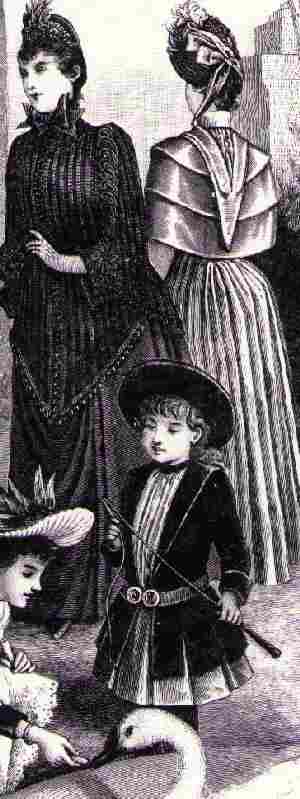
Figure 1.--This 1889 illustration from "Harpers" shows a brother and sister on a outing to the park. |

|
We have found quite a number of magazines that might be called ladies or women's magazines. Some began as vehicles for patterns which were a features in most of the magazines. The most important and best known, of course, are the Seven Sisters. There are, however, many other magazines over time. Several have been of considerable importance for a time. We will also list the non- periodical publications we have found. Each had their own unique history and destinctive focus. These magazines are interesting because they depict a wide range of societal values, fashions, and conventions and because they are dated, they help to follow societal conventions over time. Fashion changes over time are clearly depicted in these magazines. The articles and images depict the changing interests, values, and convention of women. Fashions are also deopucted, although the fashions are not just women's fashions, but children's fashions as well. Another interesting trend is the increased purchasing power of women and the subsequent interest of advertisers and publishers to reach the increasingly important female audience.
No information available yet.
Parents' Magazine for its first few months was
published as Children, the Magazine for Parents. Especially in its early years it had frequent sections on fashion, including boys' fashion.
Cosmopolitan or "Cosmo"as it became known has changed greatly over time. It began as a general interest magazine, rather than a wiman's magazine. It included noteworthy muckraking investigative articles. This changed after World War II. The general interest formt becme less attractive with the advent of television. Editors transformed "Cosmopoliran" into a trendy woman's magazine, but with a curring edge that differed it fro the Seven Sisters. It was aimed at a younger dempgraphic--younger unmarried women or women without children. With the Women's Progra,. Cosmo addressed women with careera interested in success.
Demorest's Monthly Magazine first appeared as Mme. Demorest's Mirror of Fashions. It was a beautifully decorated quarterly and sold for 10 cents. It competed with Sarah Josepha Hale's Godey's Lady's Book. The magazine was founded my Nell Curtis, a milliner. Curtis had married Williams Jennings Demorest, a widower merchandiser in 1858. Hale with assistance from her black maid Kate, developed an innovative way to to cut and assemble dresses from patterns using thin paper. They received medals at a Philadelphia exhibition for the process. As a result, patterns were included in Demorest's from the beginning as a promtion to ordering such patterns by mail. This proved very popular and fashions designers were added to the staff to produce trendy fashions, often drawing on French styles. Curtlis was an eraly equal opportunity employer, hiring both black and white women at equal salaries. Complaints from clients were ignored. Curtlis in 1879 simplified the name of their magazine to Demorest's Family Magazine. I'm not sure when they ceased publication, but note an issue as late as 1896.
A more scientific approach is seen in the 1908 publication of What A Young Wife Ought to Know (Philadelphia: The Vir Publishing Co., 1908). Written by Emma Drake MD, this book begins to make a transition into the approaching Progressive era. This book, while detailing the importance of etiquette and cleanliness, also warns against the restrictive corsets and sedentary lifestyles so typical in Victorian society.
Another example
of the social instruction manual is Florence Hall's The Correct Thing to do in Society (Boston:D. Estes & Co., 1888). Very focused on etiquette, Hall's manual specifically defines women�s roles in and their obligations to society.
The concept of the ladies magazine was first developed in Ameica by Sara Josepha Hale, editor of Godey's Lady's Book. She has been referred to as the �doyenne of 19th century manners. From 1837 to 1877 she slowly, with gentle words, aimed to make-over the Victorian personality and pave the way for the modernization of women. As editor she set the first trend in ladies magazines by developing "departments" such as health and fashion, which became known as a "formula." Unfortunately Sara would not see the real efforts of her hard work after retiring in 1877 and then passing on. But her influence appears to have transformed the generation coming of age in the 1880's when girls were reported to have started batteling their way into colleges in large numbers. By then it was apparent that a "modern" woman in America had been born. She was riding bikes, playing tennis, going to college, and becoming doctors and writers. With all these new changes in women, magazines had a lot to report on. After Godey's fell, changes in technology developed new
formulas for magazines, and fashion played a large role in this with the invention of the sewing machine & the sewing pattern. Godey's devoted some attention to children's fashions and issues. While a relatively small part of the magazine. The relative rarity of photographic images in the early years of publication make Godey's an extremely valuable resource.
Good Housekeeping first appeared May 2, 1885. It was one of of several popular women's magazines established suring the 1880s and 1890s. The magazine provided information
about running a home and raising children. This the modern Good Housekeeping conytinues today. The Good Housekeeping seal of approval was developed to assure housewives of a product's value. Letters from readers were an important facet. The early magazine, however, also included a broad range of literary offerings. Good Housekeeping was founded by journalist-businessman Clark W. Bryan in Holyoke, Massachusetts. The magazine moved to Springfield, but by 1911 the circulation was only 0.3 million. This changed when it was purchased by the William Randolph Hearst and moved to New York. The citculation was soon in the millions of copies. Many well known writers have contributed to Good Housekeeping, including Somerset Maugham, Edwin Markham, Edna St. Vincent Millay, Frances Parkinson Keyes, and Evelyn Waugh. Following the death of President Calvin Coolidge his widow, Grace Goodhue Coolidge, memorialized him in its pages. In an efforts to stay close to its audience, Good Housekeeping accepts articles by ordinary readers who are not professional writers. No one individual is more associated with Good Housekeeping than famed American children's illustrator Jesie Wilcox Smith. Over two decades, Good Housekeeping brought her work into millions of Americans homes every month (1917-33). In all she did more than 200 covers for the magazine.
Harper has played an important role in American publishing since the early 19th century. Several different magazines have had the Harper's title. Harper's Magazine first appeared June 1850. It was founded by the important New York book-publishing firm Harper & Brothers. It was a immediate success. The first press run was only 7,500 copies. They quickly sold out. The publishers within 6 months were printing 50,000 copies for each issue. Harper's was founded as a literary magazine. When the magazine was founded, it mostly carried English literary work that had already been published. Harpers soon began to publish American matrial, bith art work and literary pieces. Contributors constitute a Who's Who of 19th century American letters, bothe authors and political figures. Contributors included Horatio Alger, Stephen A. Douglas, Theodore Dreiser, Horace Greeley, Winslow Homer, William Dean Howells Henry James, Jack London, John Muir, Frederic Remington, Booth Tarkington, and Mark Twain. The publishers created departments to report on different topics and issues of the day. Important new books were announced. Major accomplishments such as the first trans-Atlantic cable. Inventions were also noted and Thomas Edison was a popular figure. A major issue covered in detail was women's rights. Harper's was actually several different publications. The publisher next founded Harper's Weekly Magazine (1857). The publisher conceived it as a family newspaper. This was followed by Harper's Bazar. This was more of a fashion magazine. This magazine offered not only the latest fashions and patterns, but also literary work and cultural articles. The concept for the magazine was a German fashion Der Bazar The publishers promoted Harper's Bazar as a family publication. Publication commensed after the Civil War (1867).
(The) Home Manual (Chicago: HJ Smith and Co., 1889) is a comprehensive textbook for the Gilded Age woman. From washing diapers to choosing china, the home manual leaves no room for the young wife to go astray socially or aesthetically.
As the oldest still publishing, most respected women's service magazine in the country, The Ladies' Home Journal has always focused on issues of crucial importance to millions of women. Since its first issue in December 1883. This long history make The Ladies Home Journal and invaluable source of information on American fashion trends. Its covered an incredibly wide range of topics beyond just fashion, from the latest medical research and consumer news to parenting know-how, workplace survival, good skincare, nutrition facts and much, much more. It was The Ladies Home Journal who sucessfully merged the elements and produced the right formula, becoming the top ladies magazine in America. The Ladies' Home Journal both empowered women and applauded their growing power.
The Ladies' Monthly Review was published by the The Butterick Publishing Company (Limited), in London amd New York. I'm not sure when they began publishing, but we note issues at least as eaely as 1894.
The Ladies' Standard Magazine was published by the Standard Fashion Company, New York and Chicago. We are not sure when they began publishing, but note issues as early as 1893.
McCalls has been a leading fashion and women's domestic magazine. It was founded in the 19th century, although I have only limited details. It was founded as The Queen about 1880. It was at first primarily to sell patterns. The title was changed to The Queen of Fashion. The tirle McCalls was adopted about 1897. McCalls did not become a major mass-market publication until the turn of the century. The circulation peaked at 6 million in 1960. The content varied over time, but fashion was always an important element. The magazine included the work of impotyant authors like Willa Cather, F. Scott Fitzgerald, Gelett Burgess, Ray Bradbury, Jack Finney, Anne Tyler, Tim O'Brien, and many more. Two of the major editors were: Harry Payne Burton (1921�28) and Otis L. Wiese (1928�49). McCalls was a major company publishing home sewing patterns. McCalls because it published an important woman's magazine could easily market its home sewing patterns. We have found a few McCalls patterns from the early 20th century. An example is a tunic suit which McCalls calls a Russian suit. The patterns at the time cost 10-15 cents. Notice that there were outlets in New York, Chicago, San Franciso, and Toronto. The Toronto outlet shows how closely tied the American and Canadian economies were and helps explain similarities in American and Canadian fashions. A McCalls pattern published in 1908 is another example. We note that by 1916 that they were publishing a catalog of their patterns which appared to emphasize clothing for women and children. McCalls continues to be a major factor in the pattern and home sewing business. The McCalls webite for Spring 2002 reads, "McCalls introduces the newst designs in glamerous evening and bridal dressing. Browse through the McCalls website and you'll find a great selection of brightly colored children's and infant's wear, cozy sleepwear, fleece-wear, and women's/large sizes. You'll also find fun accesories, home decorating, crafts and even Renaissance costume patterns!"
I have been unable to find any details on Modern Pricilla. We do know that it was popular fashion magazine in the 1910s, but do not know when it was first published or how long that it was published.
No information available yet on the United States woman's magazine, New Idea. I do know it was published around the turn of the century and included extensive fashion information. The 1903 illustration on this page is a good example of the fashion illustrations available in New Idea.
Parents Magazine is the leading family magazine in the United States for parents. It provides practical advise, tips, techniques and advice from America's foremost childcare
experts. As originally conceived it was primarily pitched to mothers. This is probably still the case, although men are playing an increasing role in raising children. We do not yet have details on when the magazine was founded. We note illustrations that look to be dated from the 1920s. We note numerous issues from the 1940s. The nagazine is still being published. Besides the articles with advise on child raising, there were many advertisements of products for children. This included clothing and patterns for making children's clothing.
Parents' Magazine for its first few months was published as Children, the Magazine for Parents. Especially in its early years it had frequent sections on fashion, including boys' fashion. Parents Magazine is the leading family magazine in the United States for parents. It provides practical advise, tips, techniques and advice from America's foremost childcare experts. As originally conceived it was primarily pitched to mothers. This is probably still the case, although men are playing an increasing role in raising children. The magazine was founded in 1925. The magazine is still being published. Besides the articles with advise on child raising, there were many advertisements of products for children. This included clothing and patterns for making children's clothing. A HBC reader notes that there were many ads in the magazine for underwear--apparently a major shopping concern for mothers of the period. Or at least the advertisers who used PM thought so.
The Parents Review was published from 1890 to well into the 1900's. It was the publishing arm of the Parents' National Educational Union (PNEU), an educational organization founded by Charlotte Mason aimed at training governesses/tutors and parents. Charlotte Mason herself wrote six books on education. The first book, Home Education (as in, the time children were home before going off to boarding school -- around 9 years old) has a section on children's clothing. Just like this article, it stresses wool, even in summer! You can read it in Ambleside Online's Annotated Charlotte Mason Series. The articles in The Parents Review were aimed primarily at mothers to inspire them to expose their children to nature, the arts, and literature as well as provide them with practical information, such as health matters. This sometimes included suggestions about clothing. One such article was by Dr. Helen M. Wilson from 1893-94 "The Food and Clothing of Children Beyond Infancy, in Volume 4, pp. 913-919. The article is coming from a health perspective rather than fashion and deals with such subjects as the necessity of keeping children warm enough and wearing clothing that is not too tight. The article contains some interesting historical details that apply to both genders and that reveal certain prevailing attitudes about the way to dress boys and girls in the final decade of the 19th century. [Laurio]
Peterson's Magazine was a monthly publication very similar to Godey's. Often, these magazines were bound together in book form, an entire year (12 issues) per volume. Each issue had a hand painted, fold out fashion plate, several other black/white prints of fashion, and a pattern for needlework. Most issues gave a small scale diagram for clothing. Also included are articles on fashion, health and other items of interest. There is also a steel plate to illustrate a story and many pages of literature and poems, the bulk of the magazine.
The Pictorial Review is an American magazine that was first published at the turn-of-the 20th century (September 1899). The magazine was founded to showcase dress patterns of William Paul Ahnelt's American Fashion Company. It developed into much more
than a pattern catalog. It became one of the most important American woman's magazines. Yje magazine had attractive colored cover illustrations--usually a fashionablely dressed woman. Patterns were just one of the features. The circulation reached over 2.5 million copies (1925). The magazine braged that this was the largest circulation ever achieved by any publication. This is interesting as very few people today have ever heard of the magazine. The Depression adversely affected sales. As circulation declines, the publisher sold the magazine to its Vice President, Adman George S. Fowler (1936). In an effort to survive, Pictorial Review merged with The Delineator, another once popular women's magazine that featured patterns (1937). Publication ceased (1939).
Vogue has always been fashion oriented. Few magazines have had such an impact on American fashions, especially after te purchase of the magazine by Conde Nast in 1909. He heloped direct the magazine to be the leading periodical addressing high society fashion in America. The focus has always been on women's fashions. By the 1930s, however, Vogue was giving considerable attention to children's fashions. Attention to children's fashions appears to have declined since the 1970s, perhaps the impact of the Women's Movement. Fewer women are now so concerned with children's fashions as was the case of stay-at-home moms. Women's style and fashion continues to dominate Vogue. These fashionable articles never in the 1990s address childrens clothes, nor do children normally appear in the magazine. The social sections sometimes show the children of the rich and famous--but almost always in long baggy pants.
This Crowell Publishing Company publication focused on women's issues, fashion, and homemaking as well containing excellent fiction and interesting period. The magazine was founded in 1883 and published until 1957. It was one of the most important American women's magazine. At its peak it had 4 million subscribers. Many respected authors contributed both fiction and non fiction on a range of topics.
It was particularly known for wondurful covers done by important artists and illustrators.
The most important editor was Gertrude Battles Lane who served in that position for the longest period (1911 -41). During this period the format of each monthlyb included two serials, four to five short stories, six specials, and a variety of departments which changed over time. Advertising declined in the 1950s, presumably as companies began shifting some of their advertising budget to television. Crowell-Collier sold the American Magazine in an effort to save Collier's Weekly and the Companion. Finally the company was forced to close both.
Laurio, Leslie Noelani. E-mail message (May 15, 2021). Laurio maintains a website which includes a range of books and articles on education. She tells is that Charlotte Mason and her method of education made a comeback in the U.S. homeschooling community in the 1980s. My website's primary purpose is to provide free curriculum for families designed around her principles. We maintain her books and articles so that parents can read first-hand source material for their own research.

Navigate the Boys' Historical Clothing Web Site:
[Return to the Main women's magazine page]
[Return to the Main periodical page]
[Return tp the Main U.S. fashion publishing page]
[Return to the Main photo, printing, and publishing pages]
[Return tp the Main fashion publishing page]
[Introduction]
[Activities]
[Biographies]
[Chronology]
[Clothing styles]
[Countries]
[Bibliographies]
[Contributions]
[FAQs]
[Glossary]
[Images]
[Links]
[Registration]
[Tools]
[Boys' Clothing Home]
Navigate the Boys' Historical Clothing Web Site:
[Sailor suits]
[Sailor hats]
[Buster Brown suits]
[Eton suits]
[Rompers]
[Tunics]
[Smocks]
[Pinafores]