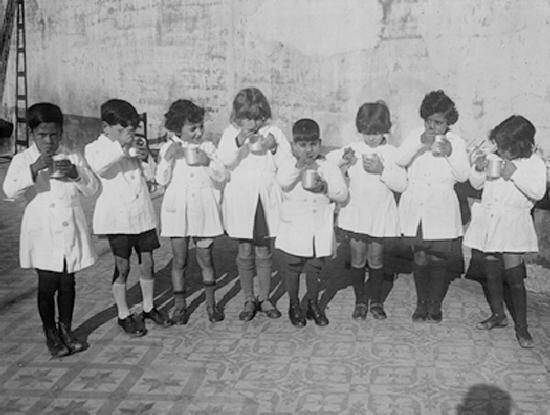

Latin America and the Caribbean were colonized by England, France, the Netherlands, Portugal, and Spain. Thus there are a great mixture of educational approaches and systems. This is a little complicated as there was no tradition of public education in Portugal and Spain at the time of independence. The Church had played the major role in education before the wars for ibndependence. Many of the newly-independent Latin American countries turned to countries like France and Germany for models when they began to build national public education systems. An issue here was the role of the Church. Diferences between Liberal secularists and conservative Catholics was a major political divide thrroughout Latin America in the 19th century, Many countries have adopted school uniforms. English styles are important in their former colonies, but some countries like Chile and Peru have adopted English styled uniforms. Other countries have used basic khaki clothes. Several countries, especially Argentina and Uruguay, have adopted school smocks as worn in Spain and Italy--an important immigrant group.
The Caribbean is the most diverse area of Latin America. The rest of Latin America is dominated by Iberian culture, either Brazil or Spain. The Caribbean has a much wider cultural diversity. Britain is very important in the Caribbean with several former colonies (the Bahamas, Barbados, Jamaica, Trinidad, and a number of smaller islands). Spain certainly is important in the Caribbean. Several of the larger islands (Cuba, Dominican Republic, and Puerto Rico) are former Spanish colonies. And other European counties (Denmark, France, and the Netherlands) had colonies. The United States is also present with Puerto Ricio. And there are ethnic differences. The Native Americans on the islands were largely exterminated during the early Spanish era and replaced with African slaves. The African populstion is greater in the Caribbean than most of the rest of Latin America. The economies are also different with relatively limited natural resources. The public education system on the islands has been generally underfunded, primarily because of the generally poor economies of the area. Unlike other countries with limited natuaral resources (Japan, Singapore, South Korea, Taiwan, and others), no Caribbean country has suceeded in building a modern prosperous economy. Limited expenditures on educatioin is not helping the coutries involved build modern economies. Cuba of all the counties in the region has placed the greates emphasis on eduction. But because of Castro and Commnism, Cuna has been transforned from the wealthiest Caribbean country to one of the poorest.
Belize is the only Central American country that was not a part of the Spanish Empire, Belize was British Honduras and the education system is thus influenced by the British education system. The education has the standard three levels: primary, secondary and tertiary. Primary education is a compulsory 8 year program, consisting of 2 years of infant classes and another 6 years. Infants is a British term for the younger primary years. The secondary education is a 4 year program. Many Belize schools are affiliated with church but also are supported by the government. The tertiary sysymen consists of the University College of Belize founded in 1986 and several colleges including the Belize Teachers' College, Belize Technical College and College of Agriculture. Primary schools are located all over the country, making education available even in rural areas. Secondary are located in the towns abd cities and thus available ti the rural population. Some of the Belizean schools with the highest academic standards are: St. John Vianney Roman Catholic Primary School, Holy Redeemer Primary School, and Saint Andrew's Primary School Belize.
Honduras is a relatively poor Central American country. The country is so poor that until the late-1950s there was not even a national education system. For the most part, only families which could afford tom pay tuition at private schools could arrange to educate their children. Reforms passed in 1957 launced the effort to build a national system of free public schools. The government of Ramón Villeda Morales (1957-63) began to build the country's first national public school system. The Secretaría de Educación de Honduras (SDEDH--Department of Education) is the Government agency responsible for administering public education. The Honduran Constitution now mandates a free primary education for every Honduran child between the ages of 7-14 years of age. This is more of a goal than a reality. The country faces a lackm of schools especially in rural areas, both teacher shortages and poor training, inadequate teaching materials needed for these schools. As a result public education is often unavailable and of a poor quality. Thus, families that can afford to do so, generally send their children to private schools. The SDEDH reports that illiteracy is still widespread, an estimated 40 mpercebnt and perhaps doube that in rural areas. A substantial number of Honduran children still do not receive any formal education. The situation is especially severe in rural areas. Where they do exist, children often have no way of getting there if they live beyond walking distance. Even so, many schools are badly overcrowed. Some teachers have as many as 70-80 children in their classroom.
I understand that Mexico has mandated uniforms for all kids in school. This was reportedly done primarily because it makes it hard to tell the haves from the have-nots and gives the poor kids better feeling. I don't have confirmation of this, but one correspondent tells me: This could very well be true - living 3 miles from The Border/Tijuana and a frequent visitor into non-tourist areas from Tijuana to south of Ensenada], all school children I have seen wear uniforms. The children always look neat and tidy. Despite a lot of these children living in the most shocking conditions (plywood shacks, no running water, electricity, sewerage etc), their parents always take pride in ensuring the children are neat and clean for school.
We have only limited information on Nicraagua. A early 20th century photograph shows schoolboys wearing a military peaked cap and a rounded hat. Both boys wear kneepants. The boys go barefoot in the tropical climate.
We have very little information about Panamanian schools at this time. We do have one school photograph from what looks likea seconady school in 1937. We have no information about the school, but the boys picture are wearing elaborate military uniforms. We do not know if all the students wore these uniforms or if it a band or cadet group within the school.
|
Education was very limited in Portuguese and Spanish colonial South America and the province of the Roman Catholic Church. Here there are some differences in the Guianas. After the wars of lineration (early-19th century), liberal ideas began to circulate in South America. Progress was slow brcause of the poverty endemic in the area and the poor state of publkic fiancing. The situation was somewhat better in the Southern Cone, especially Argentina which was moving toward developing a modern economy until Col. Juan Peron and the labor unions wreked wide-spread economic damage that continues today. And without a strong, productive economy, the governments of the region cannot finance an effective educational system. Financing is not the only factor, but it is a very important one. Poor financing continues to limit education in the region. We have begun to collect some basic information about schools in South America. Here Brazil is very important because it is about half of the continent in both area and population. We have, however, not found much information on Brazil, but hopefully our readers will provide some information. We have been more successdul in finding information on the Spanish-speaking countries in South America, especially Argentina. As might be expecte, Spanish educational trends have been very influential. In Argentina, Italy seems to have been important. School children in both Argentina and Uruguay have worn white smocks and we think has also been common in Uruguay and Bolivia as well. Throughout South Anerica, public education has been underfunded and this continues to be the case today.
One notable characteristics of education in Latin America is that they rarely rank high in internatiol assessmebts of academic achievement. This might be seen as simply a result of the regions's Third World status. There are Third World cojuntries that have begun to report very impressive academic standard. These include Japan and the Asin Tigers (Singapore, South Korea, and Taiwan). Other Asian countries have begun to report impressive advances in academic achievement. This has not occurred in Latin America. Academic standards are far below European and North American standards and now increasingly below standards being achieved in Asia. We are not sure just why this is. Certinly funding is a major factgor, but several Asian countrie began to report impressive results before economic sicess began to significntly increase incomes or state funding for education. e have not seen this discussed to any extent in the literature, but believe it is a factor in the regions's relatively limited sucess in developing modrn successful economies.

Related Chronolgy Pages in the Boys' Historical Web Site
[The 1880s]
[The 1930s]
[The 1940s]
[The 1930s]
[The 1940s]
[The 1950s]
[The 1960s]
[The 1970s]
[The 1980s]
Related Style Pages in the Boys' Historical Web Site
[Long pants suits]
[Short pants suits]
[Socks]
[Eton suits]
[Jacket and trousers]
[Blazer]
[School sandals]
Navigate the HBC School Section
[Return to Main national school page]
[Return to Main school page]
[About Us]
[Activities]
[Chronology]
[Clothing styles]
[Countries]
[Debate]
[Economics]
[Garment]
[Gender]
[Hair]
[History]
[Home trends]
[Literary characters]
[School types]
[Significance]
[Transport and travel
[Uniform regulations]
[Year level]
[Other topics]
[Images]
[Links]
[Registration]
[Tools]
[Return to the Historic Boys' School Home]