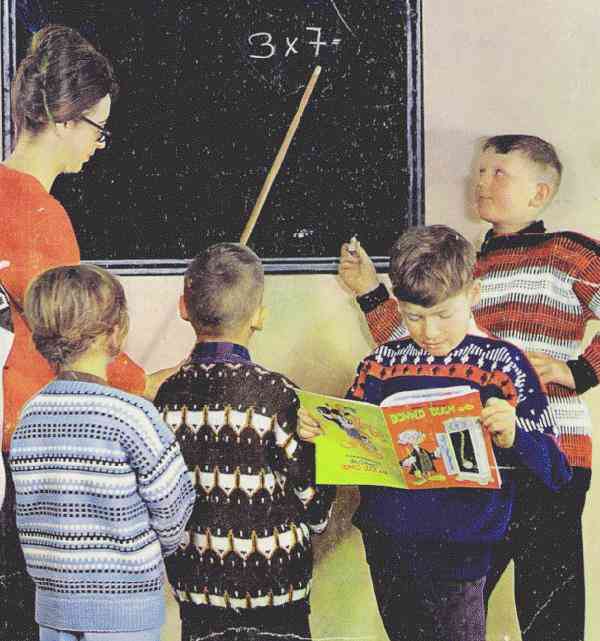
Figure 1.--Sweaters are popular scoolwear in Norway. This image is from a 1963-64 Sandnes Uldvarefabrik (Sandnes Wool Company) catalogue, which makes Peer Gynt yarns. This one is a schoolroom, with each child wearing a different sweater. |
|
Norway schieved independence from Sweden (1905). We are not sure at this time how this affeced education, if at all. Norway has a fine educatin system. Northsea oil has allowed Norway which was not a ric country, to fully fund its education system. The schools are strured in a three fold system: primary school (Barneskole), lower-secondary school (Ungdomsskole), and upper-secondary school (Videregående skole). Children must begin school at 6 years of age, althouh many begin earlier. Attendance is required through age 16 years. Norway like other Scandanavian countries have not required school uniforms. Boys wore their normal clothes so school wear has simply reflected the contemprary Norwegian fashions. Norwegian readers tell HBC that the individuality and importance of personal choice has meant that school uniform has never proven popular in Norway.
Norway has an old tradition of the so colled "selraaderetten", that means in English "selfgovernment right". A concequece of this, according to a HBC reader is that the average Norwegian is verry "individual" orientated. In practice this means that the people in local communities are not willing to be governed from a central place. For this reason, Norwegians are relatively "undisciplined". Norway was never, exept in the Wikingera; a great powered nation and has never had any colonies. In contrast, Norway was a colony of Denmark between 1319 and 1814. From 1814 to 1905, Norway was part of a union with Sweeden. Only from 1905 up to now, except during the World War II German occupation (1940-45), Norway has been a soverign independent nation.
Norway and the rest of Scandinavia did not have organized schools through much of the medevil era. Soon after Chrstianization and becoming an archdiocese (1153), cathedral schools were established to train priests. The first schools were created in Trondheim, Oslo, Bergen, and Hamar. Haakon VI (1339-80) was the last separate Norwegian king for 500 years. There was a brief union with Sweden (1319- 1343). Haakon also served as king of Sweden and then engaded in war with Sweden. He married Margaret, the daughter of King Waldemar IV. Their son, King Olaf, became king of both Norway and Denmark. As a result, when Christian III became king, Luterenism became
the state religion in both Denmark and Norway (1537). The cathedral schools became Latin schools. The Crown required all market towns to have such a school. The sandinavian countries like Germany were leaders in ublic educatio. Norway passed to Sweden (17th century). The Crown required basic education, especally reading (1736), although actual implemetation took some time. Norway introduced the folkeskole (people's school), a primary school (1837), but only made mandatory for 7 years (1889). It tool a nearly another cenury to extend this to 9 years (1969). A factor here was Northsea oil which provided the financing to build a modern school system. The folkeskole was abolished and the grunnskole (foundation school) was introduced (1970s-80s). Some poorer counties (Finnmark and Hedmark) still have large number of children who only complete the compulsory primary education level.
We have very limited information on Norwegian school activities at this time, but we have begun to collect some information. Activities at Norwegian schools are basically the same as those at other European schools. We believe that like quite a number of European schools the sports program and other extra-curricular activities is rather limited compared to American schools. The basic difference we have noted in Norway relates to the climate, the cold weather and snow. This affects how the children dress, go back and forth to school, as well as the games and sports they play. Other than this, as far as we know, the basic academic and school activities in Norway are comparable to those in other countries.
The Norwegian historical experience has mean that words such as "uniforms", "discipline", "respect" and "union" have generalyy negative consequences. A good example of this is the 1994 referendum about joining the European Union in 1994 was answered with NO from
the people in Norway. The idea tradition of school-uniforms in Norway has have never struckt parents, teachers and the Ministery of Education here. This idea was tried out in a few central schools in Norway's larger cities. A HBC reader reports that a semiprivate girl-school during the 1910s in Oslo tried a so called "voluntary schooluniform", but it died out. Since then school-uniforms have never been worn by Norwegian pupils. One of the few exceptions is the British School in Stavanger (the Nnorwegian oil-capital) who have a uniform.
One of the most popular school garments in Norway is the knit sweater. Traditionally they were knitted by mothers and grandmothers. Today many are store brought readymade sweaters. The Norewgian climate of course makes warm weather clothes like sweaters a popular and useful school garment. These are not grey uniform sweaters like the ones worn in Britain, but rather brightly colored swaters with manhy varied designs.
A HBC reader reports that discipline in Norwegian schools have "nivellated" rapidly after the World War II (1945). Since then, Norwegian pupils have been allowed to adress every teacher with the familiar form "You" instead of "Though". Simular to the with
the German use of "Du" and "Sie". In the last 20 years, Norwegian pupils are also allowed to adress their teachers with their Cristian name to.
Careful, clicking on these will exit you from the Boys' Historical Clothing web site, but several are highly recommended

Related Chronolgy Pages in the Boys' Historical Web Site
[Late 19th century]
[The 1930s]
[The 1940s]
[The 1930s]
[The 1940s]
[The 1950s]
[The 1960s]
[The 1970s]
[The 1980s]
Related Style Pages in the Boys' Historical Web Site
[Main Norwegian page]
[Main Norwegian knit page]
[Long pants suits]
[Knicker suits]
[Short pants suits]
[Socks]
[Knits]
[Jacket and trousers]
[Blazer]
[School sandals]
Navigate the HBC School Section
[Return to Main national school uniform page]
[About Us]
[Activities]
[Chronology]
[Clothing styles]
[Countries]
[Debate]
[Economics]
[Garment]
[Gender]
[Hair]
[History]
[Home trends]
[Literary characters]
[School types]
[Significance]
[Transport and travel
[Uniform regulations]
[Year level]
[Other topics]
[Images]
[Links]
[Registration]
[Tools]
[Return to the Historic Boys' School Home]