|
The Ottoman Empire was one of the greatest European powers, for a time threatening the very existence of Christian Europe. Gradually the Empire's power declined. There were many reasons for that, one of the principal reason was that the Ottomans did not develop their human capital. Ottoman children for the most part did not have public schools to attend. Nor did seculasr universities develop for advanced studies and to develop modern technology. This only began to change (19th century). Educastion was part of the Tanzimat Reforms, but the system was not universal or achieved the quality of the Western schools. Not did an important secular university system develop. The Empire instead of developung a modern technological capability, simply imported technology from the West. With the abolition of the Empire, the new Turkish Republic placed a great emphasis on developing a modern education system. The Atatürk Reform included a major effort to develop a modern, secular education system. The goal was to create a skilled professional class for the social and economic development of the country. The beginning of a primary system already existed, but the secondary system was poorly developed. Atatürk also launched a new system of secular universities. This was inadertently, but significantly aided by Adolf Hitler and the NAZIS. One of the first NAZI actions on taking power (1933), was to dismiss Jewish civil servants, including university professors. Thus quite a number of highly competent German professors found positions in the new Turkish universities. This permitted a quality of instruction that at the time was beyond the means of these institutions. The Atatürk reforms instituted school uniforms. Elementary boys in Turkey wear smocks, generally blue smocks with white Peter Pan collars, and long pants. We are not sure, however, just when this fashion was first instituted. Secondary school students also wear uniforms, but we do not yet have details on the style.
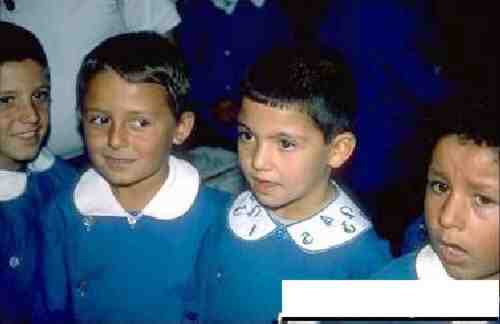
HBC is not yet sure what types of clothes or uniforms that boys wore to school during the long Ottoman period. Girls education was more limited. And our infomation even on modern Turkey is limited. We have found a few useful school portraits. The Atatürk Reforms were launched with the new secular school system (mid-1920s). Smocks were intoduced as the school uniform, but we are not sure just when. We see children wearing smocks with wide Peter Pan collars. We are not sure precisely when this occurred. There appear to be some changes in styles with boys now often wearing front buttoning smocks. A HBC reader reports in 1995, "I went to Turkey recently and during a long journey on a bus I noticed what Turkish boys wear to school. As our bus stopped for a short period near a school at 'leaving time'. Elementary boys tend to wear only a short school smock, usually blue with white Peter Pan collars with a small version of the Turkish flag on each collar. Some differ with double buttoned fronts and some have a single line of buttons along the back. They wear no noticeable other uniform garments apart from this. Senior boys tend to wear black shoes, long grey trousers, a white shirt and a solid colored tie, i.e., usually blue red or black. On one occasion I noticed a boy wearing a tartan tie in a different town."
As far as we can determine, Turkey has only one school uniform garment--the blue school smock. It is a back buttoning, rather short smock. As far as we can tell, boys and girls wear the same style of smock. It is worn with a wide white collar. We note that many boys and girls wear embroidered designs on these collars. We see some are the Islamic cresant and star that are a symbol of Turkey, but there are many other designs as well. Other than this smock, the children wear their own clothes--almost exclsuvely long trousers. We do not see Turkish school children wearing any kind of caps with their school smocks.
Turkey made fundamental reforms in education immediately after the foundation of the Republic in 1923-24. The most important was its secularization. Education has been made a top priority of national development. It has the largest budget of any ministry with an allocation of over 20 percent of the national budget. The aim of the Turkish educational system is to nurture productive, happy individuals with broad views on world affairs who will unite in national consciousness and thinking to form an inseparable state, and will contribute to the prosperity of society through their skills. This is thought to be instrumental in making the Turkish nation a creative and distinguished member of the modern world.
Apart from the general educational system, pre-school training is available only on a private basis or with public sector facilities. However, this level of education is not yet common and is limited to only about 5-10 percent of Turkish pre-school children.
These include Special Education Schools for the mentally or physically handicapped or enhanced learning centers for exceptionally bright children.
|
Primary education is compulsory for 5 years, started at the age of 7 generally but, depending on the physical development of children, it can also be at 6. There is a new trend to change the obligatory period from 5 to 8 years and some pilot schools have already started in some areas. About 96 percent of primary-age children attend school. In some rural areas parents cannot physically manage to get their children to school.
A special feature of primary schools is that one teacher takes care of all the students in one class, from the first grade and continues with those children for five years until they finish their compulsory education. The school age population of Turkey is very large and often school buildings and teachers are insufficient to cope. This results in two sessions of school, one in the morning and one in the afternoon. This helps to explain why so many children are seen in the streets during weekdays. The average number of students in each classroom is 25-40, but in some rural areas, where there are not enough teachers, even more students have to fit into the same classroom. All over the country, in each classroom above the blackboard, a portrait of Ataturk is hung. On one side you will see his Speech to the Turkish Youth and on the other, the National Anthem. There are no fees for education until college or university. At the beginning of the week on Monday mornings and at the end of the week during Friday afternoons, flag ceremonies are held with all the teachers and students present in the courtyard or playground of each school. Each morning, primary school students pledge in chorus to be honest and studious, to protect the young and respect the old, to love their country more than themselves and to give their existence as a present to the Turkish Nation. The chorus is concluded by saying "So happy is the man who says he is a Turk".
Secondary education in Turkey consists of Middle School and High School, each of which normally takes 3 years. A Middle School can be either on its own campus or annexed to a High School. In these schools, the system of one teacher for each class changes to a specialist teacher for each subject. Students can choose one foreign language from English, French or German. Religious Education lessons, depending on the present government's policy, is often optional, and is actually a comparative study of religions rather than only of Islam. The aims of these schools are to secure a level of general knowledge, develop an awareness of individual and community problems and to contribute to the economic, social and cultural growth of the country as well as preparing students for higher education. Anatolian, Science, Fine Arts, Vocational, Technical, Islamic Theological and Private High Schools are different from the general High Schools, but are still a part of the Secondary Education system. The Anatolian, Science and Private High Schools are the best and consequently most popular. In these schools there is an extra year (prep class) at the beginning to teach one foreign language and in the following years, all science lessons are taught in that foreign language. The education at this level is free of charge except at the private schools where an average fee is about US$3,000 per year. Students show respect for their teachers by addressing them 'sir' or 'teacher', or by standing up as a class when a teacher enters the classroom.
Atatürk also launched a new system of secular universities. This was inadertently, but significantly aided by Adolf Hitler and the NAZIS. One of the first NAZI actionson taking power, was to dismiss Jewish civil servants, including university professors. Thus quite a number of highly competent German professors found positions in the new Turkish universities. This permitted a quality of instruction that at the time was beyond the means of these institutions.
Turkey has a long history of private schools, dating back to the Ottoman Empire. In fact, privare schools were established before the Ottomam Empire began to play a major role in public education. Many are operated by minority grouos in Turkey or foreigners living and working in Turkey. There are four types of private schools in Turkey.
First are private schools for the majority Turkish Muslim population. This includes schools with a religious orientation. There were many dershane meaning cram schools. The Turkish dershane system were similar to the Indian and Japanese cram schools. Older students over theweek-ends or after weekday school hours were drilled on various aspects of sevondary curicukum to improce university placement. This was a cheaper alternative to private schools. The Government banned these schools (2014). The schools have an option of transforming onto provate schools. There is also aublic subsidy option.
Secound are schools for minority groups. The Ottoman Empire was a multi-ethnic polity. Turkey has minorities, but the Turkish population is now dominate. Schools for Greeks, Armenians, and Jewish minorities after World War I were placed under guarantee by the terms of the Lausanne Treaty. These are not foreigners, but they are Turkish citizens of the various minority groups. Today the largest minority is the Kurds. I don't think that the Kurds are permittedseparate schools.
Third are schools for foreign residents. These are schools first established during the Ottoman Empire by American, Austrian, French, German, and Italian groups and which continue their activities under the terms of the Lausanne Treaty. Some Turkish chilkdren attendcthese schools today, primarily because the parents involved belive they offer not only opportunities to learn foreign languages, but also because of higher academic standards than the state operated public schools.
Fourth are private international education institutions. They have been opened under the authorization of the amended article 5 of the Law no. 625.
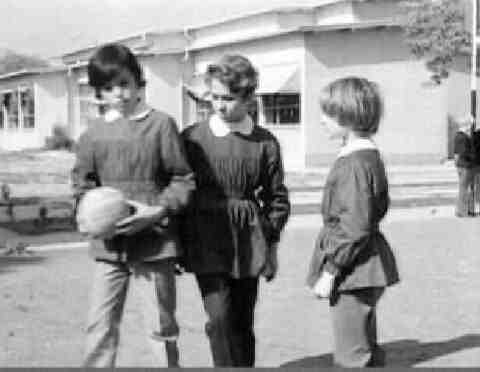
We have very limited information on Turkish school uniforms at this time. We see some children wearing military uniforms in the 19th century as the Ottoman Empire began to build a public school system in the 19th century. We have found no written material on Turkish school uniforms at this time. All of our infomation comes from the photographic record and we have been able to find very few images at this time. We note primary children, both boys and girls, wearing school smocks. We do not know when smocks were first introduced. We suspect it may have been in the 1920s when the school system was significantly expanded as pary of the Atatürk reforms (1920s). We do not have many may images from the 1920s and 30s, but we see a lot of post-World War II images. This seems to have been an Italisn influence. We say that because the smocks we see look more like Italian than French smocks. The large white collars are an Italian touch. The purpose must have been the samed as in Europe, to cover up the the social class difference that were apparent from the clothes the chilren wore to school. We do not have much information on secondary schools at this time. We do not see older boys wearing smocks, but older girls may have worn them. This was a pattern in Europe and may have been the same in Turkey.
|
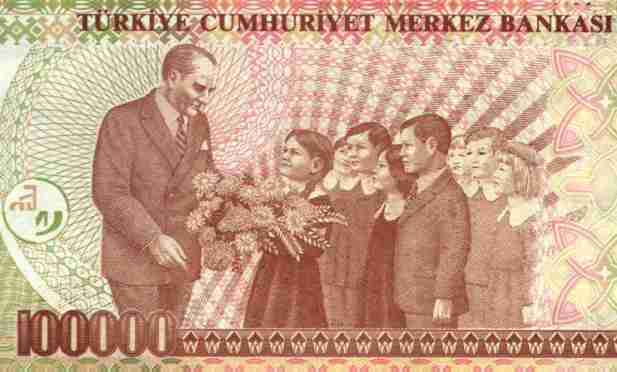
The history of modern Tukey was largely a history of Kemal Ataturk. He was one of the few hero's to emerge as hero from Turkey's participation in World War I. He is named the hero of Galipoli, where British forces in a plan promoted by Winston Churchill tried unsuccessfully to seize the Dardanells so war supplies could be delivered to Russia. After calling national congresses, he was elected President of the Turkish Grand National Assembly in April 1920. From then until his death in 1938, he remained in power in Turkey. In 1934 everyone had to take a surname and Mustafa Kemal received the surname Atatürk which means "Father of the Turks". He proceeded to guide Turkey through a series of fundamental reforms designed to implementation the secularization of Turkish society--the Atatürk Reforms. The Caliphate was abolished in 1924. Western clothes were promoted. The fez was abolished in 1925. Religious brotherhoods were supressed in 1925. A civil law code was adopted in 1926. The Latin alphabet was introduced in 1928. Women were made eligible to vote in elections and to become members of Parliament in 1934. A major undertaking was abolition of Medrases, unification of education, renovations of school programs according to contemporary and national needs, opening of new universities. A solar calendar was adopted and Moslem holy day of the week, Friday was changed into a weekday with Sunday becoming the official day of rest. at some pont, Turkish authorities adopted blue smocks, often with white collars as the uniform for primary children. We are not sure just when, but notice children wearing these smocks by the 1950s. Blue socks were worn by Turkih school children for the rest of the century. The urkish National Education Ministry (MEB) finally ended a mandtory school uniform requirement. The cabinet decision, which regulates the procedures and the bases of the new dress code in public and private schools was published in the Official Gazette (2012). The children were allowed to wear everyday attire, but MEB mandated a new dress code. New rules were intriduced. MEB forbid tights, short pants, sleeveless tops, mini skirts, transparent and torn outfits, accessories and outfits depicting political messages, make-up, bearda, mustachea and dyed hair. Girls will be allowed to wear a headscarf in the elective Quran classes. Uniforms were allowed in private schools if more than 60 percent of the parents appriove. Students were allowed to wear their uniforms in the 2013-2014 school year. ["Turkey abolishes"]
The Turkish schjool smocks appear to be rather short cut smocks. Back buttoning smocks have been the traditional style. Some have smocking. Some boys wear front buttoning smocks--often with the buttons offset to the side. They are commonly worn with wide white Peter Pan collars, but without bows.
Turkish boys appear to wear blue smocks. Although I have noted various shades of blue, the boys only seem to wear blue smocks. Some Turkish smocks look very dark. They are either dark navy blur or perhaps black. Most of the color images we see meaning images since the 1970s show a lighter shade of blue. Both boys and girls wear the same blue color. There were differences gender differences in the white collar, but not the color.
Some Turkish movies povide images of the children in their school uniforms. The boys commonly wear the blue school smocks.
"Turkey abolishes mandatory school uniforms," DünyaTimes (Novemberr 27, 2012).
Careful, clicking on these will exit you from the Boys' Historical Clothing web site, but several are highly recommended
Boys' British Preparatory School Apertures Press printed book on British preparatory schools
British Preparatory School: Apertures Press E-books on British preparatory schools. There are six volumes available.
New Zealand School: Apertures Press E-books on New Zealand schools. There are three volumes available. New Zealand as a former British colony has been heavily influenced by British education.

Related Chronolgy Pages in the Boys' Historical Web Site
[Late 19th century]
[The 1930s]
[The 1940s]
[The 1930s]
[The 1940s]
[The 1950s]
[The 1960s]
[The 1970s]
[The 1980s]
Navigate the HBC School Section
[Return to the Main Middle Eastern school page]
[Return to the Main national school page]
[About Us]
[Activities]
[Chronology]
[Clothing styles]
[Countries]
[Debate]
[Economics]
[Garment]
[Gender]
[Hair]
[History]
[Home trends]
[Literary characters]
[School types]
[Significance]
[Transport and travel
[Uniform regulations]
[Year level]
[Other topics]
[Images]
[Links]
[Registration]
[Tools]
[Return to the Historic Boys' School Home]