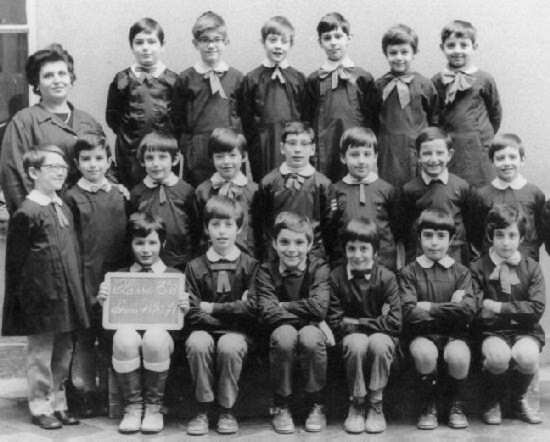
Figure 1.--These Italian children in 1970-71 all wear back-buttoning smocks with white collars. Most with bows. Note that several boys wear long pants. The boys seem to be weaing smaller bows than was the case in the 1960s. |
|
School smocks appear to have been commonly worn in the early 20th century, but HBC has few detais. Smocks were so common in Italy that we believe there were government regulations requiring smocks, but we can not yet confirm this. Mussolini and the Fascists took over in the 1920s, but we do not know to what affect they had on school clothing. There does not appear to have been one style that was worn at any one time, but dark smocks with large white collars appear to have been especially prevalent by the 1930s. Floppy bows appear to have been very common. Such smocks were commonly worn through the 1960s, but became less common for older boys in the 1970s. The style of smocks began to change in the 90s with front buttoning smocks bcomeing increasingly common. We believe that greater variety of colors also appeared in the 1970s. Smocks are still worn in Italy, unlike many ther countries like France where they are now rarely seen. They are not as prevalent as formerly, but still common.
School smocks appear to have been commonly worn in the early 20th century, but HBC has few detais. Smocks were so common in Italy that we believe there were government regulations requiring smocks, but we can not yet confirm this. Most boys wore smocks with kneepants. We do not see smocks at the San Giorgio della Richinvelda village schoolin 1901.
A reader writes, "Seeing the HBC section on smocks reminded me of my father-in-law saying that he wore smocks to school about the time of the World War I. The purpose was to keep the clothes clean that were worn under the smock. He grew up on the Island of Ischia, in the Bay of Naples. He told me about the smock over 40-years ago. One of my children (all girls) must have been wearing something that reminded him of the smock. I'm sure that's how the subject came up. I think he had the bow in front of his smock, but I don't remember if he said what color it was. He would be 100 years old in another year or two if he was still living. I'm sure he said he had to wear it whether he wanted to or not. He didn't say he objected to, since it was functional in that it protected the clothing underneath. Since every boy in his class was required to wear a smock, he didn't think much about it." An Italian reader tells us, "I think that in early 20th century smocks were already worn in some urban schools. However in many schools, especially in little villages, children went to school wearing their everyday clothing in 1910s and also in 1920s." A good example is the Caeranovillage school in 1913. We do not see smocks at the Ma href="/schun/country/it/is/alpha/c/iis-cvs.html">Capoterra Village School on Sardinia in 1915.
Mussolini and the Fascists took over in the 1920s, but we do not know to what affect they had on school clothing. Wearing smocks with short pants became common in the 1920s. We do not see smocks at the San Giorgio della Richinvelda village schoolin the 1921.
An Italian reader tells us, "By the 1930s, most Italian primary children wrre wearing smocks. We see some schools where only some of the children are wearing smocks, but smocks were very common." There does not appear to have been one style that was worn at any one time, but dark smocks with large white collars appear to have been especially prevalent by the 1930s. Floppy bows appear to have been very common. Boys at the Ginnasio Parini did not wear smocks in the 1930s. We do not see smocks at the San Giorgio della Richinvelda village schoolin the 1933.
Mostly very young children are wearing smocks at the Biancade Village School in 1944. Italian education was disrupted by World war II, especially sfter the Allied invasion (Swptember 1943).
We continue to see Italian boy boys wearing school smocks in the 1950s. We are not sure about the requirements. We see some schools where all the biys are wearing smocks and sone school in which none of the biys are weat=ring smocks. Clearly there was no national requirement. As afarvas wevcan tell, it was all up to the individual schools. Perhaps some provincial aithorities were involved, but we are not sure about that. We also see schools where some boys are wearing smocks. The proportion varies from school to school. Here we assume that some parents decided to puchse smocks on their own without any direction from school autorities. We do not see boys wearing smocks at the Fossato Jonico village school in 1950. Virtalally all the boys at the Scuola Italiano in Tangiers, Morocco during the early 1950s. Teenage boys at the Liceo Foscarini were not wearing snocks about 1950. We see two boys the Cosenza Province, Calabria Region, southern Italy wearing the traditional smocks with bows in bare feet during May 1957. The Italian Economic Miracle at gthevyime was changing Italy. We see fewer boys without shoes, but it was still fairly common in Calabria. We note the Liceo Bianca Villa in 1958. About half the boys wear dark smocks, wude white collars, and bows. Subsequent photographs show few boys wearing smocks at the school.
School smocks continued to be commonly worn in Italy through the 1960s. The dark blue smocks with wide white collars and floppy bows appears to have been particularly common. We also see light-cilored smocks. Children began wearing smocks with long pants in the 1960s, but short pants were more common. This varied somewhat seaonally. One Italian reader tells us that smocks were still theoreticall required. We are not sure if there was an actual law or national Ministry of Education directives. Hopefully one of our Italian readers will know. Schools did not, however, send a child home if he or she did not sear one. So we see schools where only a few children were wering smocks. Or even schools where none of the children were wearing smocks. There continued to be very poor areas, especially in southern Italy. We do not see smocks at the San Nicola village school in the early 1960s. This had largely disappeared by the end of the decade with European economic growth generated by the German Economic Miracle and European integration. Smocks were still common, but gradually declining. Most teachers and school administrators just left it up the parents.
Smocks became less common for older boys in the 1970s. Some schools still required the dark smocks with wide wite collars and floppy bows. We believe that tnhis was espcially common at Catholic schools. The style of smocks began to change in the 70s with front buttoning smocks becoming increasingly common. We believe that greater variety of colors also appeared in the 1970s. Wearing smocks with long pants became increasingly common in the 1970s.
Smock usage varied greatly in the 1980s. There were many schools in which they were not worn or not commonly worn, especially in urban areas. At other school they were common for younger children. Some schools required them. Front buttoning smocks became increasingly common. We note many children weaing smocks without the wide white collars and floppy bows. I note quite a few smocks in Rome (1989).
Smocks were still worn in Italy during the 1990s. Unlike many ther countries like France where they are now rarely seen, we still saw smocks in Italy. They are not as prevalent as formerly, but we still saw them. I worked in Rome for several months and saw boys wearing school smocks. This was primarily at schools which required them. They were less common at schools where they were not required, but not unknown.

Navigate the HBC School Section:
[Activities]
[Chronology]
[Clothing styles]
[Countries]
[Debate]
[Economics]
[Garment]
[Gender]
[Hair]
[History]
[Home trends]
[Literary characters]
[School types]
[Significance]
[Transport and travel
[Uniform regulations]
[Year level]
[Other topics]
[Images]
[Links]
[Registration]
[Tools]
[Return to the Historic Boys' School Home]
Navigate the Historic Boys' Clothing Web chronological pages:
[The 1890s]
[The 1900s]
[The 1910s]
[The 1920s]
[The 1930s]
[The 1940s]
[The 1950s]
[The 1960s]
Navigate the Historic Boys' Clothing Web style pages:
[Return to the Main Italian school smock chronology page]
[Return to the Main Italian school page]
[Return to the Main smocks page]
[Dresses]
[Bodice dresses]
[Kilts]
[Sailor suits]
[Sailor hats]
[Ring bearer/page costumes]
[Pinafores]
[Shortalls]