|
We have not yet been able to build detailed chronology of American rompers. HBC believes that rompers first appeared in America during the late-1890s as dresses became less common for younger children. HBC has not noted rompers before the late-1890s. Rompers in America were most common in the 1910s and 20s. The Montgromery Ward catalog, for example, had a wide selection of rompers in their 1920s catalogs. Rompers tened to be quite roomy garments, often worn at knee leength. HBC has noted rompers worn by boys on the Continent as late as the early-1960s. They were particularly popular in France, modtly for pre-school boys. They were much less common for boys in America. They were, however, very popular for girls and were worn as both gym uniforms and as casual wear as well as bathing suits. Rompers even before the 1960s were firmly estsblished as a girls' garment, especially as they were used as girls' gym uniform at many high schools. By the 1960s they were clearly a girls' garment in American minds. And becoming an increasingly popular casual summer style for girls. This was espcially the case for grade school girls, but some teenagers also wore them. In the 1950s boys wearing rompers were rare-, but we see occasional examples. This was no longer the case in the 60s. Rompers have never totally disappeared. They are still available in 2000, but only for infant boys and younger todlers.
HBC believes that rompers first appeared in America during the late 1890s as dresses became less common for younger children. HBC has not noted rompers before the late 1890s.
We notice a short blurp in the New York Times (May 20, 1904) which seems to describe rompers as if they were an inovative garment. This was in the "In the shops" section. This was not an advertisemnt, but describing trendy new merchandise. It read, "Rompers for children are pinaforelike garments, but wth an extra long band around the lower edges of the skirt, turing up under the dress skirts. There are little petticias and buttons around the waust. The children can play in the dust with these and still keepo fresh and clean when the romper is removed. The garments come in blue and white, pink and white plaids, and other simple designs of wash materials. They cost 39, 49, and 75 cents." There was no accompanying illusrtration. Although gender was not mentioned, the reference to "children" clearly suggests that this was a garment for both boys and girls. No sizes are specified.
Rompers in the 190s were worn by boys and girls, although there were substantial age conventions. The photographic record hows substntial numbrs of pre-school childre, both boys and girls, wearing rompers. They were very roomper ropers, billowing out at the waisttine and closing at the knees. Most of the exmples we have found come rom rural or mall-town Americ. e are not sure to what extent they were worn in urban areas. They were available as they were advertized in the major mail order caralogs. Rompers in America became a popular style for younger boys. We are not yet sure about the gender conventions, but we think that the romper was a toddler garment with no gender connotations. We notice both boys and girls wearing romper suits in the 1910s. And catalogs and patterns tended to describe rimoper's as a 'child's' garment. A good example is a 1912 Butterick pattern for children 1-3 years old. We are not sure if the age conventions varied for boys and girls. We notice boy, girl, and general children's rompers. A good example is the romper suits offered by Best & Company, a New York Department store in their Spring-Summer 1912 catalog. They were available in sizes up to 5-8 years, depending on the style. We do have some images showing girls wearing rompers. How common this was I am not sure. I do know that older American girls were wearing a kind of romper or bloomer suit became a standard for girls' gym classes in high schools.
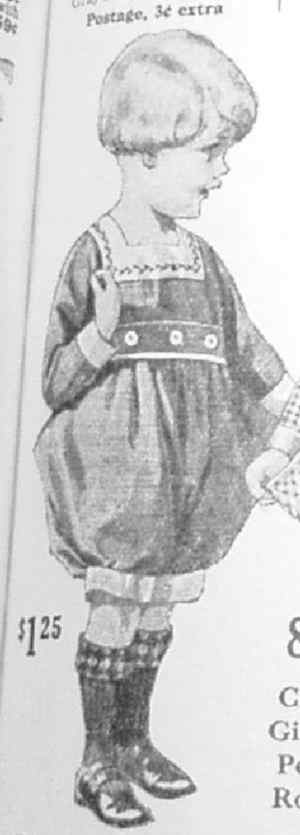
Rompers were most common in the 20s, although because many available snap shots are not dated, this is a little difficult to tell with any precesion. They were available in many styles, The Montgromery Ward catalog, for example, had a wide selection of rompers in their 1920s catalogs. The rompers worn in the 1920s teneded to be quite roomy garments, often worn at knee length. Some were called "Dutch" rompers. I am not sure yet what the specific characteristics of a Dutch romper were. Here we see a romper suit from a 1922 catalog (figure 1). The illustration shows the boy wearing the romper suit with knee soicks and strap shoes. We note a Mexican-American boy from Los Angeles named Roldolfo wearing a very similar romper suit with long stockings and sandals in 1925. The family speaks Spanish, but the clothes seem to be entirely American in style.
The French romper or 'barboteuse' was becoming a standard garment for pre-school French boys in the 1930s. In America the romper declined in popularity during the 1930s, at least for boys. We find fewer examples in the photographic record. We do note one HBC reader who recalls wearing rompers in the late-1930s and early-40s. They were wool rompers knitted by his grandmother. And we see examples of infant and todler boys wearing rimprs. They were nuch less common than in the 1920s and we see younger boys wearing them. This was different fo girls. We note schoolage firls wearing them. They seem populr for summer camp. We also see Girl Scouts wearing them. Middy blouses and bloomers were worn by girls in school gym classes.
We do not have a lot of information on American rompers during the 1940s. We see girls wearing romper outfits as casual summer wear. They were not very common for boys. We see a few pre-school boys wearing them, but relatively few. We note matching brother-sister H-bar rompers in 1941. In this case it was a rare example of an older boy and younger girl. And also a rare example of an American boy wearing rompers beyond the toddler stage. They were entirely a summer play outfit. We think the relative rarity in the photographic record is a good relection of actual prevalence. At school we see girls' gym uniforms making the transitions from bloomers to romper suits.
HBC has noted rompers commonly worn by boys on the Continent as late as the early-1960s. They were especially popular in the 1950s. Romper suits were not very common for American boys during the 1950s. We do notice one boy wearing romper pants as a bathing suit. This looks rather like the gym pants we notice some Scandanavian boys wearing. This was, however, not very common. Even younger boys did not commonly wear romper suits. Shortalls seem more popular in America 6han the romper suits worn in Europe, especially France. Rompers im America seem to have lrgely acquired the image of a girls' style by the 1950s. Girls were still commonly wearing the romper or bloomer style gym uniform in the 1950s. This varied from school to school. More conservative school districts tend to have the romper gym suits. By the end of the decade short pants were becoming more common. Girls also wore romper suits as casualwear and swim suits.
Rompers even before the 1960s were firmly estsblished as a girls' garment, especially as they were used as girls' gym uniform at many high schools. By the 1960s they were clearly a girls' garment in American minds. And becoming an increasingly popular casual summer style for girls. They were extensively advertised in mailorder catalogs. This was espcially the case for grade school girls, but some teenagers also wore them. In the 1950s boys wearing rompers were rare-, but we see occasional examples. This was no longer the case in the 60s. Rompers had become an exclusivly girls' garment, although by the end of the decade they had largely dusappeared as a girls' gym uniform style.
Rompers continued to be an exclusively girls' garment in America. They had disappeared as a girl's gym uniform garment, but were still worn as a popular girls' summer casuasl gasrment in a varirty of styles. They continued to be widely advertised in mail order catalogs. The term romper, however, begins to become more fluid in the 70s. Before the 70s the term was used for a type of top-shorts combination that has elasticized leg closings and balloned out. This contrasted to short pants which were basically strait-leg designs. By the 1970s, however, we begin to see the term 'rompers' also being used for tops connected to ordinary short pants with no leg hem estatisided closures.
Rompers have never totally disappeared. They are still available in 2000, but only for infant boys and younger todlers. Many internet retailers offer rompers. Companies like Willbeth, Truffles (sizes uo to 3 years), and House of Hatten. A French reader was impressed with the House of Hatten. She noted a smocked bib for baby (very fashionable in France before the 1960s). But what struck her was the puffed romper, smocked, with short puffed sleeves. She reports that this is a virtual copy of the classic French romper worn in the 1930s-50s, except that there is no back tieing bow.

Navigate the Historic Boys' Clothing Web Site:
[Return to the Main U.S. romper page]
[Introduction]
[Activities]
[Biographies]
[Chronology]
[Clothing styles]
[Countries]
[Bibliographies]
[Contributions]
[FAQs]
[Glossaries]
[Images]
[Links]
[Registration]
[Tools]
[Boys' Clothing Home]
Navigate the Historic Boys' Clothing Web chronological pages:
[The 1890s]
[The 1900s]
[The 1910s]
[The 1920s]
[The 1930s]
[The 1940s]
[The 1950s]
Navigate the Historic Boys' Clothing Web style pages:
[Dresses]
[Smocks]
[Bodice kilts]
[Kilts]
[Sailor suits]
[Sailor hats]
[Ring bearer/page costumes]
[Shortalls]