|
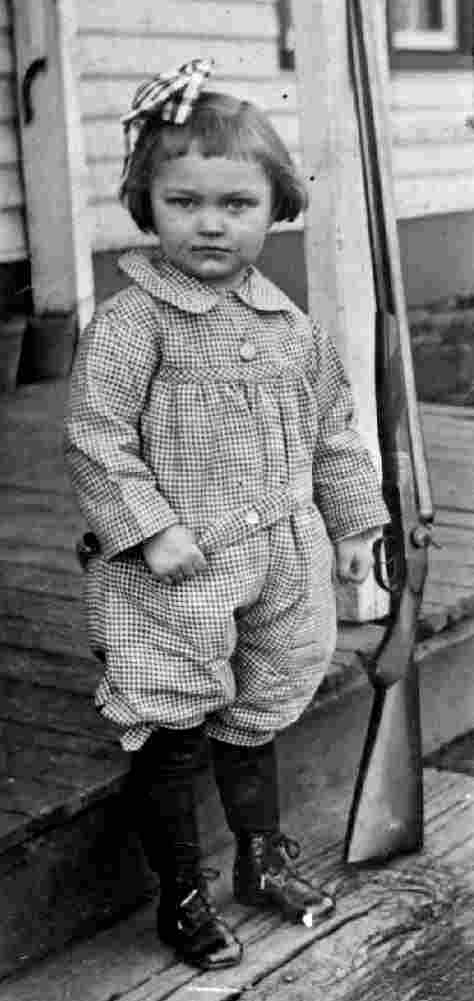
HBC is unsure about the gender conotations of early rompers. I believe they were worn by both boys and girls, especially the rompers worn for play. I'm less sure about the dressier styled rompers. Probably a girl would be nore likely to wear a dress for formal occasions. HBC has, however, very little information on rompers, so this assessment is highly speculative. By the 1940s, rompers had, except for infants, become a casual style for girls. Rompers were commonly used as girls' gym costumes with the romper legs relatively long until the 1940s. They were often worn with long black stockings. Schools did not generally consider shorts apropriate for girls until the 1940s. Rompers also continued into the 1950s and 1960s with shorter legs. I can remember as a Virginia high school student in 1958 that the girls wore rompers rather than shorts for gym.
It is difficult to assess gender connotations for rompers using only the photographic record. For one thing the gendr of younger children is difficult to assess and most available images are unidentified. Another problem is that mothers when dressing younger children might well use romer suits bought for older siblings tht had outgirown them. And for the younger children the romper suit might be used regardless of whether it was a boy or girl suit. And some romper suits were general children's rompers meaning that they could be worn by both boys and girls. So to assess this topic we need other sources such as period catalogs and fashion magazines. A good example is the Best Spring-Summer 1912 catalog. It had a page mostly devoted to rompers. Best was a well known New York Department store.
Rarely does a popular garment have such radically diiferent gender comventions in different countries. HBC is at this time has only limited information about gender conventions for rompers. We believe that they have varied over time. There were also substantial differences between countries. In some countries like France only boys wore rompers while in other countries such as America rompers werre worn by both boys and girls. Here we have cimpiled considerable information on France, but our information on other countriesc is still quite limited. Unlike other garments where we have reports from readers, many readers do not recall wearing rompers because of their ages. Thus we have fewer first hand accounts. The conventions concerning rompers in each country of course has changed over time thus complicating matters. At this time we have only limited information on these conventions and changes over time.
There were several diffrent types of rompers, including casual/play rompers, dessy rompers, bathing suits, gym uniforms, and youth group uniforms. These didderent types were worn for most od the 20th century and the popularity of each varied over time and in different countries. There were very strong gender commontations for these different types of rimpers. There also may have been differences as to gender usage in the type of rompers. While girls in America may have worn rompers as a casual or play outfit, they would not have dressed up in them as some boys were dressed up in romper outfits.
Rompers and related bloomer outfits as a play costume appear to be worn by both young boys and girls, but this caried by country. This appears to have been the case by the the 1910s, although our chronological information is still sketchy as to just when romper suits first appeared. They appear to have continued to be worn by boys in Italy and France into the 1950s. We know that French girls did not wear them, but I'm not sure though if European girls wore them. We do notice them nGermany. Girls in America also wore romper play suits. These were geneally for younger girls. At first the colors were very basic. But in the 1950s romper suits were available in sizes for older girls and we begin to see many different colors and pattens. We contnue to see romper play suits for girls into the 1980s. We notice this primarily in America.
Romper-style bathing suits were a popular style for girls. The first bathing costumes for girls were essentially bloomrs worn with long stockings tht covered everything from the neck dowm. This began to change, especially after World War I. We begin to see romper-style suits after World War II. We see these bathing suits for several decades, mostly the 1950s-80s. We commonly see them in America. We are less sure about Europe.
The original rompers were a play garment. Eventually some were made for more formal attire. This appears to have been more of an European development than an American fashion. HBC has noted some European boys to about 6 years in the 1950s wearing them. Even in the 1990s some fancy rompers for todlers were made. I don't believe girls wore these dressier styled rompers. Probably a girl would be more likely to wear a dress for formal occasions.
By the 1910s a related outfit--bloomer pants usually with middy blouses had been adopted as a gym costume for girls in many American highschools. By the 1940s, bloomer outfits were still being used as a girls gym outfit in secondary schools. Girls' bloomer gym costumes had relatively long long legs until the 1940s. They were often worn with long black stockings. Schools did not generally consider shorts apropriate for girls until the 1940s. These bloomer costumes continued into the 1950s and 1960s with shorter legs. He styles changed from bloomers with middy blouses to one-piece romper suits. I can remember as a Virginia high school student in 1958 that the girls wore rompers rather than shorts for gym. These romper outfits were widely worn in American highschools. We do not at this time know to what extent these rompers were worn by girls as a gym outfit in other countries, if any.
Some Girl Scout and Girl Guide groups had romper/bloomer uniforms. W see this in the 1910sand 20s. At the time short pants were not seen as suitable for girls. This was primarily an outdoors uniform for activities were worn mostly at summer camps. This was only the case for girls.
Rompers are now seen as an infants outfit without sharp gender differences. Romper outfits are generally avialble for children under 2 years of age for both boys are girls. Usually the only difference is the color, pink fior girls and blue for boys. Some other colors like yellow and green can be wirn by boys and girls.

Navigate the Historic Boys' Clothing Web Site:
[Introduction]
[Activities]
[Biographies]
[Chronology]
[Clothing styles]
[Countries]
[Girls]
[Bibliographies]
[Contributions]
[Essays]
[FAQs]
[Glossaries]
[Images]
[Links]
[Registration]
[Tools]
[Boys' Clothing Home]
Navigate the Historic Boys' Clothing Web chronological pages:
[The 1890s]
[The 1900s]
[The 1910s]
[The 1920s]
[The 1930s]
[The 1940s]
[The 1950s]
Navigate the Historic Boys' Clothing Web style pages:
[Return to the Main romper page]
[Dresses]
[Smocks]
[Bodice kilts]
[Kilts]
[Sailor suits]
[Sailor hats]
[Ring bearer/page costumes]
[Shortalls]