|
We assume that theese broad, stiff white collars were first worn at Eton College, but we are not yet sure just when they were first adopted. Part of the trouble here is that many of the historical references we have found refer to the Eton suit and not specifically the Eton collar. We do know that Eton collars were being worn at Eton College in the early 19th century. As the 19th century progressed, they became increasingly popular and were adopted by other schools as part of the school uniform. By the late 19th century they were very common as boys wear. Few English boys grew up in the late 19th and early 20th century without wearing an Eton collar. World War I was the turning point for the Eton collar. The War caused many to rexamine their lives and klife style. Pactical clothes which were usually more comfortable than pre-War fashions were widely adopted. The Eton collar continued to be worn aftyer the War, but rapidly gave way to comfortable soft collars.
We assume that theese broad, stiff white collars were first worn at Eton College, but we are not yet sure just when they were first adopted. Part of the trouble here is that many of the historical references we have found refer to the Eton suit and not specifically the Eton collar. We do know that Eton collars were being worn at Eton College in the early 19th century.
As the 19th century progressed, they became increasingly popular and were adopted by other schools as part of the school uniform. We beliece that Eton collars were becoming fashopnable for more than schoolwear by mid-century, but do not yet have the imafes to demontrate that.
By the late 19th century they were very common as boys wear. Few English boys grew up in the late 19th and early 20th century without wearing an Eton collar.
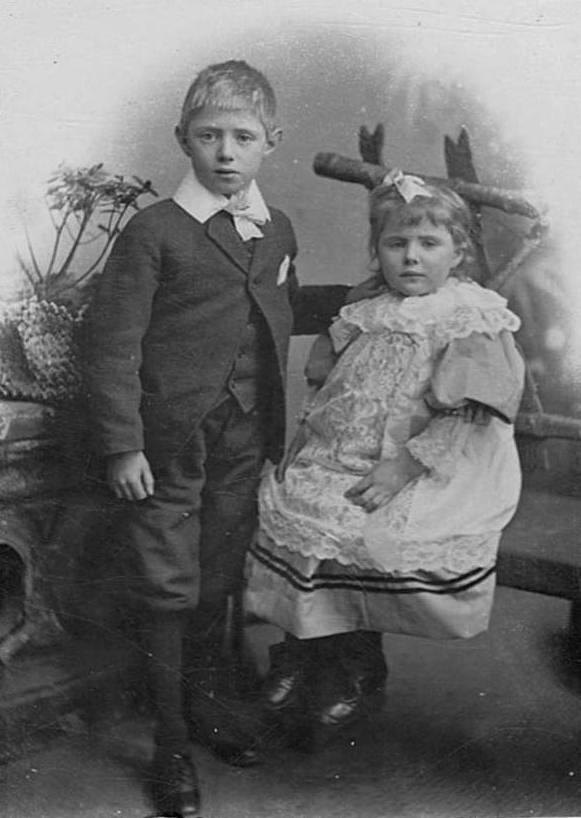
We note large numbers of school age English boys wearing Eton collars in the 1890s. Large stiffy starched Eton collars were srandard. This may have been the peak popularity of the Eton collar popularity. The unidentified London boy here who to be about 8 years old wears an Eton collar with a knickers suit, we think in the 1890s (fugure 1). We note boys wearing Eton collars both with and without neckwear, but the neckwear option seems the most common. We note boys about 6-15 years old wearing these collars during the 1890s, but we are also still assessing the age conventions. The Eton collar was so popular that we lso see some girls wearing them, but not nearly as commonly as the oys. The turn of the century era may have been the peak of the popularity of the Eton collar, but that is something we are still assessing. We notice many boys prominently wearing large Eton collars and not only in London and other large cities. Eton collars were worn throughout the country in towns and villages as well. The Eton collar was worn by boys of a wide social. We are building school chronologies which may be helpful in assessing fashion trends. Unfortuntely at this time we only have a general 19th century school page.
We continue to note mahy English boys wearing Eton collrs in the 1900s. The two decades (1890s and 1900s) were the peropod in which Eton collars were the period in which Eton collas were the most prevalent. It was dressy style, but boys did not just wear the collars when dressing up. They were very common at schools. e see cojuntless shool imahes wiyj the boys wearing Eton collars. We evern see boys wearing Etomn collars on vacation, including vacaions to beach resorts. A good example is Crespal Gordon Stoddart.
The boy on the previous page wears a classic Eton collar about 1910. World War I was the turning point for the Eton collar. The War caused many to rexamine their lives and life style. Pactical clothes which were usually more comfortable than pre-War fashions were widely adopted.
The Eton collar continued to be worn after the War in the 1920s We continue to see boys with Eton collars, but nit as amany as in the 1910s. A good example is a family group in 1924. We think the boys are wearing their school uniforms. Gradualy during the decade the Eton collars began to give way to the more comfortable soft collars, both whn boys dressed upo and at school. By the end of the decade there were farvfewer boys wearing Wtob collars, although they had by no means disappeared.

Navigate the Historic Boys' Clothing Web Site:
[Return to the Main English Eton collar page]
[Introduction] [Activities][Biographies][Chronology] [Clothing styles][Countries][Photography]
[Bibliographies][Contributions][Essays][FAQs][Glossaries][Images][Links][Registration][Tools]
[Boys' Clothing Home]
Navigate the Historic Boys' Clothing Web chronological pages:
[The 1840s][The 1850s][The 1860s][The 1870s][The 1880s][The 1890s][The 1900s][The 1910s][The 1920s][The 1930s][The 1940s]
Navigate the Historic Boys' Clothing Web style pages:
[Long pants][Knickers][Short pants][Scottish kilts][School uniform][Sailor suits][Eton suits][Ring bearer/page costumes]