|
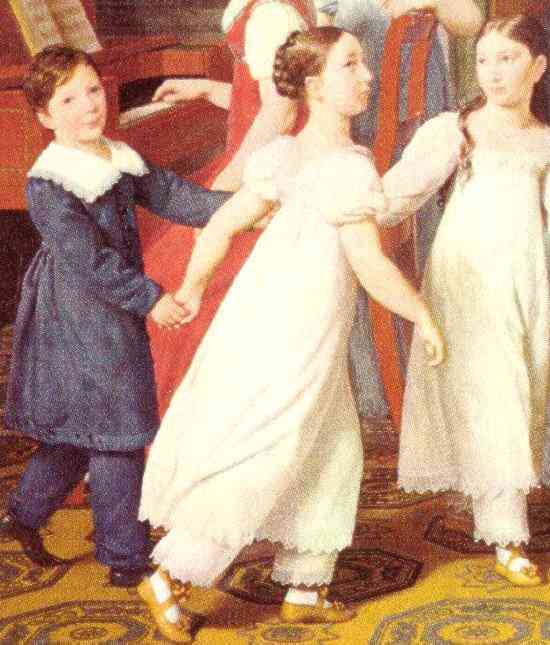
We have noted boys wearing three types of pants with tunics: pantalettes, long pants, and bloomer knickers. The use of these three types varied with the age of te boy and also chronogically. We have noted boys in the early 19th century wearing pantalettes with their tunics. Commonly this was the younger boys that had just been braeched, but some older boys also wore pantalettes as well. We have noted boys wearing pantalettes with tunics as late as the late 1850s.
We note boys wearing long pants with tunics in the 1810s. We believe they were also worn in the 1800, but we cannot yet confirm this. The first long pany worn with tunics appear to have been baggy, looking rather like plain plantlettes. Some were the same color as the tunic. Other were white or other contrasting colors. By the 1820s we note boys wearing tighter fitting long pants. Some contemprary fashion writers referred to the pants worn with tunic suits as bloomers. The destinguishing feature of these pants is that usually bloused at the leg with elastic gathering rather than having buttons or buckles like proper knickers. Some of the tunics may have been worn with knee pants, but the bloucing effect was much more common after the 1850s.
We have noted boys in the early 19th century wearing pantalettes with their tunics. Commonly this was the younger boys that had just been breeched, but some older boys also wore pantalettes as well. We have noted boys wearing pantalettes with tunics as late as the late-1850s. Until the 1860s younger boys might commonly wear a tunic with lacey pantalettes. Tunics for little boys even at mid-century provided many opprtunities for a doting mother to fuss over her son. Small boys between 3 and 6 might wear tunics with white drawers showing below the hem, deopending on the period, often well below the hem. Sometimes the pantalettes were decorated with lace and ruffles. Others were more plain, but still in lighter material than the tunic and usually white. Girls and sometimes boys wore these long lace trimmed pantalletes (drawers). A good example is a painting of an English boy in an idealized Victorian family being cared for by a governess in the early-1850s. We also notice two Hungarian boys about the same time. We also notice examples in the late-1860s and early-70s.
Many boys wore in the early 19th Century wore ankle-length pants with tunics. These pants were quite plain, but some were high-waisted pants with a button front. Quite small boys in the early 19th Century wore long pants. At the time their fathers wore knee breeches and long pants were considered children's wear. We note boys wearing long pants with tunics in the 1810s. The first long pany worn with tunics appear to have been baggy, looking rather like plain plantlettes. Some were the same color as the tunic. Other were white or other contrasting colors. By the 1820s we note boys wearing tighter fitting long pants. Our image are still limited, it is possible that these tighter fitting pants were worn earlier. We note these tight-fitting pants worn into the 1850. We also notice baggy trousers like the Paul Kessler-Trümpi family in 1840. We note boys in the mid-19th century commonly wearing long pants with tunics. Some were boldly pattened pants. A good example is unidentified American boy, we believe in the 1840s. We see a lot of American boys at mid-centyurty wearing what look like long shirts, almost always with long pants. When tunics became very popular at the turn-of-the-20th century, we rarely see them worn with long pants.
We notice boys wearing kneepants looking rather like short pants in the mid-19th century. The ealiest image we have looks to be dated from the mid-late 1850s. We are unsure when wearing shortened length pants with tunics first became fashionable. Certainly younger boys wearing long pantalettes with tunics was prevalent un the early 1800s. We are unsure when they began wearing shorter-length pantalettes. Our images at this time are too limited to make any firm judgement, but we believe that long pants and long panalettes were still common in the 1830s. We are not yet sure about the 1840s. Many of the yunics we have noted were tunic suits with the pants matching the tunic. Some boys, however, wore pants that did not match. We are unsure as to the conventions involved here. These outfits that did not match would not theoretically be called a tunic suit.
Some contemprary fashion writers referred to the pants worn with tunic suits as bloomers or bloomer knickers. Other magazines called them knickerbockers. The destinguishing feature of these pannts is that usually bloused at the leg with elastic hathering rather than having buttons or buckles like proper knickers. Some of the tunics may have been worn with kneepants, but the bloucing effect was much more common after the 1850s. The pants were very plain, almost never with any notable detailing. There were several different types of tunics (Buster Brown, Russian, sailor, and others), but there were no special type of pants assocaited with these different styles. I am not sure if these had pockets or other features. We were not sure. We were also not sure how they were suspended. We wondered if there were suspenders or buttoned on to waists. A McCalls pattern suggests the tunic suits popular at the turn-of-the-20th century had bodices. Some images exist of boys wearing bloomer knickers with tunics. The Tenneyson boys wore tunics and knickers, although I'm not sure how widespread this fashion was. I have noticed knickers with tunics in the 1860s, I'm not if it appeared eralier. Knickers with tunics were quite common after tunic suits became fashiinable at the turn of the 20th cebntury. American boys mostly wore knickers with their tunic suits. French boys wore their tunics suits with both knickers and short pants.
Mostly European boys after the turn of the 20th Century also wore short pants under their
tunics. This appears to have been a particularly popular style in France. I have not
noted it
as being commonly worn in America.

Navigate the Historic Boys' Clothing Tunic pages:
[Return to the Main tunic pants page]
[Historical trends]
[Stylistic features]
[National styles]
[Tunic styles]
[Tunic accessories]
[ Pantalettes]
[Long stockings]
[Fashion magazine--1903]
Navigate the Historic Boys' Clothing Web Site:
[Introduction]
[Activities]
[Biographies]
[Chronology]
[Clothing styles]
[Countries]
[Bibliographies]
[Contributions]
[FAQs]
[Glossaries]
[Images]
[Links]
[Registration]
[Tools]
[Boys' Clothing Home]